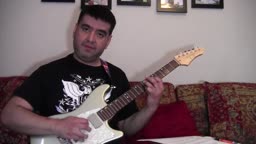
TrueFire Foundry courses are independently produced courses presented by a hand-picked selection of top-notch artists and educators from around the world. Filmed in the educator’s own studio, Foundry courses bring fresh educational concepts and very effective teaching methodologies to TrueFire Students. Maurice Arenas’s Foundry course, Sequences & Patterns for Improvisation will teach you fundamental theoretical applications for improvisation.
Sequences & Patterns for Improvisation is a crash course for guitarists focused on fundamental theoretical methods of improvisation such as sequences, parallelism, line clichés, symmetrical patterns, encapsulation, rhythm and rests, arpeggios, and various forms of chromaticism.
Maurice Arenas is a veteran NYC studio musician with over 40 years of playing, performing and teaching experience. After acquiring a Bachelors and a Masters Degree in performance and composition, Maurice moved to NYC and started working in Broadway orchestra pits and recording sessions for radio, television and for up and coming artists. We’re excited to welcome Maurice to the family with his first self-produced TrueFire Foundry course, Sequences & Patterns for Improvisation.
”The first section of the course focuses on the pentatonic scale, which is explored in degrees by groupings. After groupings are introduced, then the addition of rests and/or syncopated rhythm is added to share the diversity of using one grouping. The end of the chapter shows an example of mixed groupings and how I use it and practice it.”
In this section Maurice covers: The 5 Pentatonic Boxes, Groupings of 2: Straight 2’s, Groupings of 3: Straight 3’s, Groupings of 3 with Rests: Syncopated 3’s, The 7 Diatonic Boxes, Groupings of 4: Straight 4’s, Groupings of 4 with Rests: Syncopated 4’s, Grouping of 5:Straight 5’s, Grouping of 5 with Rests: Syncopated 5’s, How to Practice Groupings: My Practice Routine
”The second chapter covers diatonic scale possibilities, first by exploring intervals and then by using groupings. Once again, I provide a chapter where I demonstrate what I do and how I practice this.”
In this section Maurice covers: Diatonic Approaches, Diatonic Intervals, Diatonic 2nds: Sequenced 2nds, Diatonic 3rds: Sequenced 3rds, Diatonic 4ths: Sequenced 4ths, Diatonic 5ths: Sequenced 5ths, Diatonic 6ths: Sequenced 6ths, Diatonic 7ths: Sequenced 7ths, Octaves: Sequenced Octaves, Diatonic Sequences, Groupings of 3: Diatonic 3 Note Sequence, Groupings of 4: Diatonic 4 Note Sequence, How to Practice Diatonics: My Practice Routine .
”The third chapter covers an often neglected part in a guitarists arsenal, which is arpeggios. I'll show you various ways of using arpeggios in sequences and show how with rhythm and syncopation you can bring sequences to life.”
In this section Maurice covers: Arpeggios: Introduction and Summary, Major Arpeggio Sequences: Major Triad, Minor Arpeggio Sequences: Minor Triad, Major 7 Arpeggio Sequences: Maj7, Dominant 7 Arpeggio Sequences: 7th, Minor 7 Arpeggio Sequences: Minor 7, Minor 7b5 Arpeggio Sequences: Minor 7b5, Diminished 7th Arpeggio Sequences: Dim7, How to Practice Arpeggios: My Practice Routine
”The fourth and final chapter concludes with more advanced ways of using chromaticism with sequences and patterns. From encapsulation like the gypsy guitarists, to more modern concepts like parallelism or symmetry like pianists like Chick Corea and Herbie Hancock routinely mix in with their bag of tricks, it will be all covered here in this section.”
How to Practice Non-Diatonic Ideas, How to Incorporate Chromaticism, Sweeping Pentatonic Ideas, Chromatic Pattern - Minor: Learning Minor Line Clichés, Chromatic Pattern - Pentatonic: Pentatonic Chromaticism, Chromatic Pattern - Encapsulating Chords: Encapsulation, Chromatic Pattern - Parallelism in Dorian: Parallel 4th Sweeps with Dorian, Chromatic Pattern - Blues Scale with Half Steps: Chromatic Blues, Chromatic Pattern - Symmetrical: Symmetrical Intervallic Patterns.
All of the improvisational approaches and studies are charted, tabbed and notated for your practice, reference and study purposes. You’ll also get Guitar Pro files so that you can play, loop and/or slow down the tab and notation as you work through the lessons.
Grab your guitar and let’s pick up on some new improvisational patterns and sequences with Maurice Arenas!
What you'll learn
Navigate the fretboard using the three-fret inversion pattern of diminished arpeggios
Navigate multiple positions across the entire fretboard
Apply alternate picking consistently through complex sequential patterns
Adapt fingering patterns for different techniques (bending vs. speed)
Understand the symmetrical nature of diminished arpeggios and their inversions
This course is a crash course for a guitarist who wishes to learn how to improvise in a system which trains the ear gradually as well as teaching the fundamental theoretical methods of improvisation like sequences, parallelism, line clichés, symmetrical patterns, encapsulation, rhythm and rests, arpeggios, and various forms of chromaticism.
The course starts with something very familiar to guitarists, which is the pentatonic scale. The scale is explored in degrees by groupings. After groupings are introduced, then the addition of rests and/or syncopated rhythm is added to share the diversity of using one grouping. The end of the chapter shows an example of mixed groupings and how I use it and practice it.
The second chapter covers diatonic scale possibilities first by exploring intervals and then by using groupings. Once again, I provide a chapter where I demonstrate what I do and how I practice this.
The third chapter covers an often neglected part in a guitarists arsenal, which is arpeggios. I'll show you various ways of using arpeggios in sequences and show how with rhythm and syncopation you can bring even sequences to life.
The fourth chapter concludes with more advanced ways of using chromaticism with sequences and patterns. From encapsulation like the gypsy guitarists, to more modern concepts like parallelism or symmetry like pianists like Chick Corea and Herbie Hancock routinely add in their bag of tricks, it will be all covered here in this course.
Here's a snapshot on how the pentatonic sequences and patterns are presented, practiced, and illustrated.
Here we'll review all 5 boxes of the pentatonic scale.
The first pentatonic sequence we learn in this system is 2's. We first have to learn the mechanics of the fingering and play it in strict time before we try it rhythmically syncopated with a backing track.
The second pentatonic sequence we learn in this system is 3's. We first have to learn the mechanics of the fingering and play it in strict time before we try it rhythmically syncopated.
Once we have the mechanics of this sequence down, we can now work on utilizing different rhythms and syncopated rhythms with it.
Product image Sequences & Patterns for Improvisation
Lots of great info in this course to keep me busy!
J
Justin Y.
07/23/23
The Mental workout you need!
I'm still working my way through the course because there is a lifetime of information here. It's becomes advanced quickly but this is always the end game course in my backlog.
J
J Y.
09/28/22
Holy Crap look at all this sequence content and I got it so cheap.
Thank you
A
alane011
Verified buyer
03/16/19
Ok
I appreciate the fact that there is no course that is offering just practice patterns at Truefire. However I think the repetition was maybe not needed all the way through every position. Also there was no skipping exercises - ie - 1324 etc.. Good explanations but not sure it was worth it...