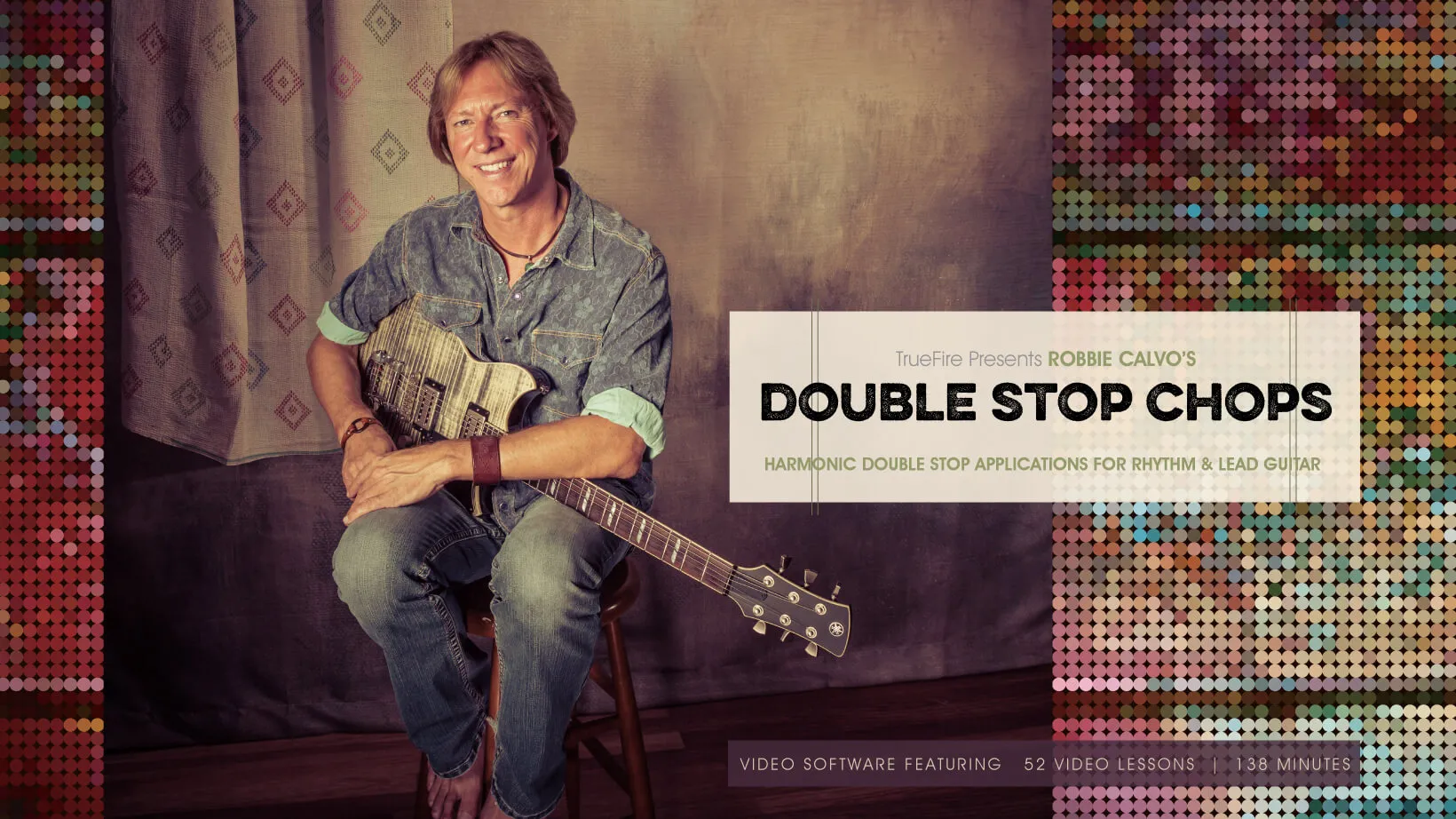
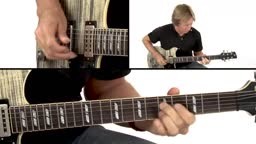
Double-stops (two-note melodic phrases) can be used to create solos, hooks, rhythmic and melodic motifs — even simplified chordal parts. Double-stops are rich and full of harmonic flavor, but most players have a relatively small vocabulary of double stop moves and haven’t yet tapped the full potential of the subtle nuances, phrasing, and articulation possible with a versatile palette of stylistic double-stops.
Robbie Calvo’s Double Stop Chops will take your own double-stop chops to whole new level. Robbie will show you how to locate and create incredibly musical double-stop lines using Major and Minor 3rds, Major and Minor 6ths, 4ths and Octaves. Plus, you’ll learn how to apply your expanded double-stop vocabulary over great R&B, Motown, Rock, and Blues progressions and grooves.
”Double-stops are rich and full of harmonic flavor, and once you hear the potential locked inside these little two-note gems...you'll be wanting to use them all the time. I use double stops in almost everything I do - whether it's a solo at a gig, outlining chord changes in a band setting, or simply to add flavors on a session.”
Robbie will guide you through a series of demonstrations and performance studies starting with an exploration of the sounds of major and minor third double-stops in various shapes and string sets. Next, you’ll learn double-stops that employ the major and minor 6th harmonies using various articulations and phrasing.
As you play your way through the course you’ll learn how to create musical phrases combining 3rd and 6th double stops, double-stop 4ths, and even octave double-stops for more impactful soloing and improvisation. Once you get a handle on all of the double stop variations, Robbie will show you how to mix them together and apply them over a variety of styles and tonalities.
”Studies will include playing over great R&B, Motown, rock, and blues progressions so that you can hear the subtle nuances, phrasing, and articulation associated with stylistic double stops, plus you'll learn how to discern which intervals work best in every range of your guitar.
We'll also combine single note lines with double stops to make sure you get the most out of this adventure. We'll also discuss and point out resolution points and tonality so that you'll always stay within the realms of taste and musicality.”
All of the key examples and performance studies are tabbed and notated for your practice, reference and study purposes. You’ll also get Guitar Pro files so that you can play, loop and/or slow down the tab and notation as you work through the lessons. Plus, Robbie includes all of the backing tracks for you to work with on your own.
Grab your guitar and let’s double up our double-stop chops with Robbie Calvo!
What you'll learn
Use 4ths, 6ths, and 3rds to embellish dominant chords
Reference triad shapes to navigate the fretboard
Understand how to effectively navigate the course material
Understand the value of observation before practice
Develop a personalized learning path based on individual goals
Hi, I'm Robbie Calvo, and welcome to Double Stop Chops. Double stops are two note melodic phrases that can be used to create solos, hooks, rhythmic and melodic motifs, and even simplified chordal parts. Double stops are rich and full of harmonic flavor, and once you hear the potential locked inside these little two note gems...you'll be wanting to use them all the time. I use double stops in almost everything I do - whether it's a solo at a gig, outlining chord changes in a band setting, or simply to add flavors on a session.
In this course, you'll learn how to locate and create incredibly musical double stop lines using major and minor 3rds, major and minor 6ths, 4ths, and octaves. We'll also combine single note lines with double stops to make sure you get the most out of this adventure. Studies will include playing over great R&B, Motown, rock, and blues progressions so that you can hear the subtle nuances, phrasing, and articulation associated with stylistic double stops, plus you'll learn how to discern which intervals work best in every range of your guitar. We'll also discuss and point out resolution points and tonality so that you'll always stay within the realms of taste and musicality.
You'll be playing through this course with everything you need for a seamless and smooth learning experience: tab, notation, fingerboard diagrams, chord charts, and killer jam tracks. Tune up, tune in, and get ready to enjoy the guitar in a whole new way!
I'm often asked by my students the best way to work through one of my current courses. My advice has always been to leave your guitar on its stand and literally watch the whole course like a movie. Take notes of the video sections you think are relevant to you and your goals and only work on those sections. If you've watched a course fully, you'll have a complete understanding of what the content offers, an understanding of the concepts presented, and you can then cherry pick the items that are of most interest and relevance to focus your full attention on.
Taking this approach will help you to not feel intimidated by the magnitude of the information, get you started at the correct point of information you were looking for, and lift any pressure to complete a whole course!
Double stops are two notes of a different pitch played at the same time. Double stops are typically consonant in nature and used to embellish a wide variety of musical styles from country to Latin, blues to calypso. In this course, I want to take a focused look at the typical double stop moves and ideas found in contemporary music. You'll be able to apply my approaches to any style of music...it'll just boil down to sound and phrasing approaches at that point. Double stops can form a complete solo, create memorable hooks, fills, combine with chord moves, and even guide you to a harmony lead guitar part if you separate the tones. They're a great way to outline the harmonic structure of a song and add a full rich harmonic sound to your lead guitar playing.
We'll be looking at major and minor 3rds, 4ths, major and minor 6ths, and octave double stops. I'll show you where they're located within your major scale patterns in position and along the length of your fretboard so that you can flow easily through them all in any given key. I'll also advocate that you focus in small group areas and establish some core licks and moves around a given chord or progression. You may find that some of these ideas become signature moves within your playing style.
Double stops have become a major part of my style and playing now, and I've found that really enhances my live performances when I'm playing solo, as the double-stops have more harmonic and melodic content and seem to fill out the sound more in that musical context.
Double stops can be found within your chords, arpeggios, and scales, so I'll be showing how to notice them and how to create them from each of those elements. It should be noted that chords and arpeggios are all derived from your scales anyway, so another way to look at all of this is to simply say double stops are derived from scales in the same way that chord harmony is constructed. Once we dig into the nuts and bolts, you'll start to see the relationship between the harmonized major scale: The chords and double-stops follow the same principle of maj7 - min7 - min7 - maj7 - dom7 - min7 - min7(b5). The shapes will always be the same unless the string pairs use the B string in the unit, because the B string is tuned a 3rd above the D, not a fourth like all the other string pairs. This means you'll have to get used to making those adjustments or learn the shapes that fall on that B string.
Let's take a look at that on the fretboard for a moment so that you can get a visual of what I am saying. The most important aspect to remember is locating the start of the scale regardless of string pairs that you'll use for your lines, that way you'll understand that the shapes adhere to the harmonized major scale and its chord intervals, too.
Major and minor 3rd double stops are the easiest to visually see follow the harmonized major scale because the chords all adhere to having major and minor 3rds in them. The major chords I-IV-V have major 3rd intervals, and therefore double stop major 3rds. The minor and diminished chords II-III-VI-VII all have minor 3rd intervals, and therefore the double stop will be the same. Let's recap on that on the fretboard and follow the patterns along the string sets.
Here's a quick performance using major and minor 3rds to outline the diatonic Motown chord progression of G-Amin-C-D.
Great explanations and examples of how use--has really been a great set of tools to add to the toolbox! Thanks!
R
rwfyfhczh4
Verified buyer
01/10/23
Aprovado
Muito bom e de incrível aplicação. Recomendo!
O
oldintheway
Verified buyer
08/03/22
Unlock the melody
Such an overlooked topic; study this to unlock beautiful double-stops melodies. the examples are great, and an excellent teacher is accessible and engaging. At least it was for me.
D
dp430
Verified buyer
11/12/21
A good, focussed course
My first purchase by Robbie Calvino and it has NOT disappointed! Robbie suggests watching this through once without playing along, which is what I did and it really did help me to digest the overall flavour of the course, whilst cherry-picking my favourite examples to go back to later.
J
JacobMadsen
Verified buyer
10/25/21
My favourite TrueFire instructor breaks it down to basic elements once again!