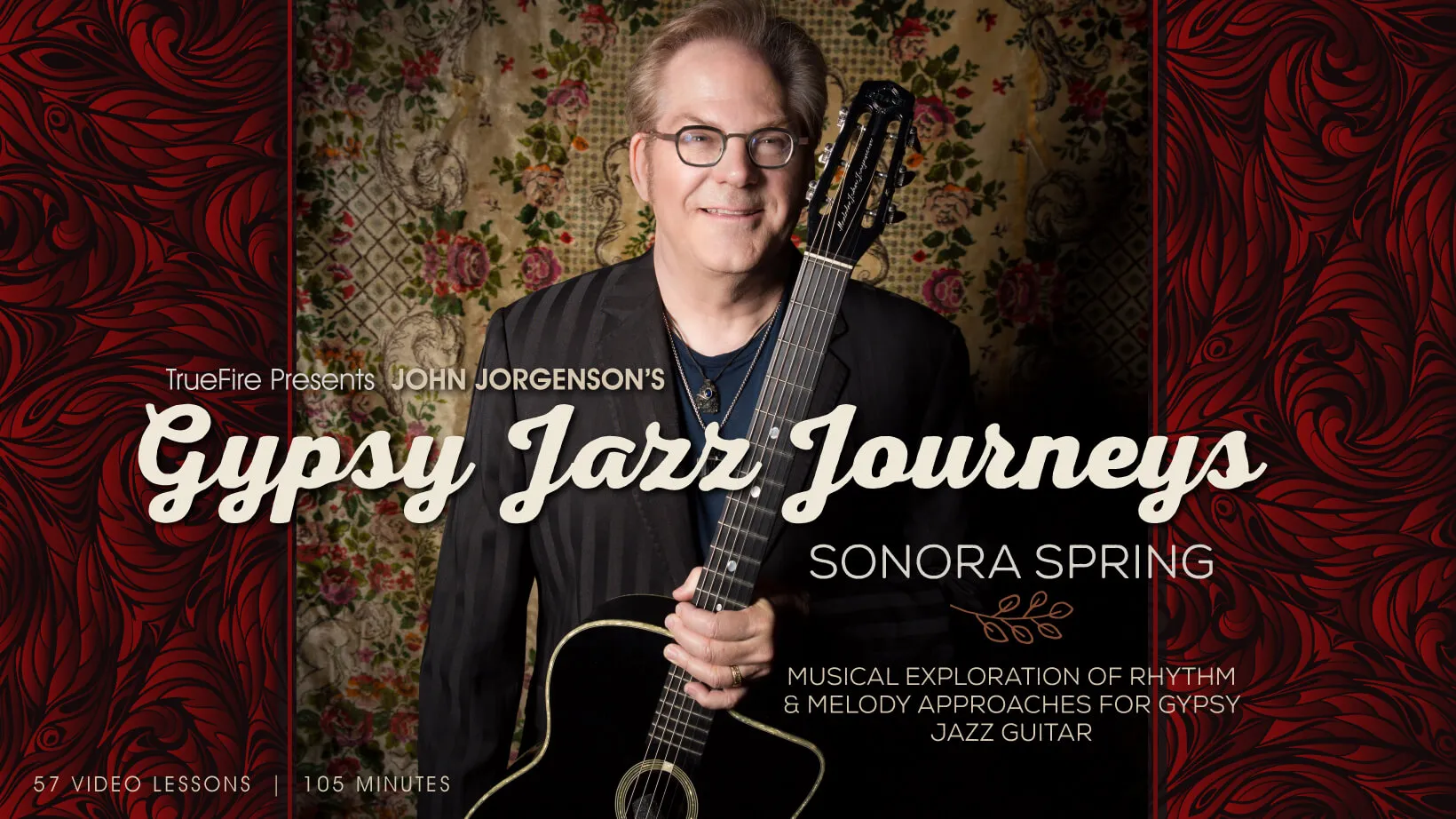
Gypsy Jazz Journeys: Sonora Spring

Musical Exploration of Rhythm & Melody Approaches for Gypsy Jazz Guitar

Marty FriedmanTommy EmmanuelSteve VaiEric GalesEric Johnson

Get this course and 1,000+ more with All Access

Try 14 days free. Cancel any time.

Purchase Individual Course for $9.99
Gypsy Jazz Journeys: Sonora Spring

About this course

Peter Frampton refers to John Jorgenson as the “guitarist's guitarist.” Elton John calls him, ”brilliant.” Brad Paisley says, “If there was one guitar player I'd like to be, it would be John Jorgenson.”

John plays a wide variety of styles from Rock to Bluegrass to Gypsy Jazz, all at a virtuoso level. He’s toured, recorded, and collaborated with the likes of Elton John, Luciano Pavarotti, Bonnie Raitt, Bob Dylan, and dozens of other top artists.

In addition to acoustic and electric guitars, he’s also regularly featured on the saxophone, clarinet, bouzouki, pedal steel, mandolin, and vocals. You can hear him on numerous platinum-selling and GRAMMY-winning albums. We’re very excited to welcome John to the family with his first TrueFire course, Gypsy Jazz Journeys: Sonora Spring!

”Over my many years as a recording and performing artists, in many genres, I've learned the most about playing guitar from gypsy jazz. I’m excited to pass on many of these concepts and techniques by deconstructing my composition, Sonora Spring here in this edition of Gypsy Jazz Journeys.”

John organized this first edition of Gypsy Jazz Journeys into 6 sections, each focused on a particular section of Sonora Spring. John will perform the sections at-tempo and then break down all of the rhythm, melody, and solo parts. Along the way, you’ll also learn 29 astounding and very versatile gypsy jazz licks to add to your gypsy jazz vocabulary. Slow and at-tempo playalongs are included for each of the sections for your practice purposes.

All of the performances are tabbed and notated for your practice, reference and study purposes. You’ll also get Guitar Pro files so that you can play, loop and/or slow down the tab and notation as you work through the lessons. Plus, John includes all of the backing tracks for you to work with on your own, in addition to all of the slow and at-tempo playalongs.

Grab your guitar and let’s start our Gypsy Jazz Journey with John Jorgenson!

What you'll learn

  • Execute complex melodic techniques
  • Complex picking techniques
  • Switching between melody and rhythm parts
  • Analyzing a complete musical piece
  • Learning melodic and rhythmic Gypsy Jazz techniques
Release date: 10/05/2017 • 1h 52m runtime
Start Course
Sample lessons
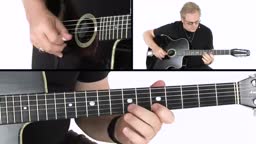
Sonora Spring: Intro & Chorus
Performance
Sonora Spring: Intro & Chorus
Chord Lesson
Sonora Spring: Intro & Chorus
Rhythm Approach
Sonora Spring: Intro & Chorus
Phrase 1 Breakdown

What's included

67 lessons • 15 charts • 9 Jam Tracks

Gypsy Jazz Journeys: Sonora Spring
Hi, I'm John Jorgenson, and welcome to Gypsy Jazz Journeys: Sonora Spring. Over my many years as a recording and performing artists, in many genre, I've learned the most about playing guitar from gypsy jazz.

In this edition of Gypsy Jazz Journeys, I'll show you examples of the concepts and techniques that I've learned and been able to apply to my own music.

We'll deconstruct my composition, Sonora Spring, to demonstrate these concepts and techniques within a musical context. I'll break down the whole song for you, note-by-note, and I include both slow and at tempo playalongs for each of the sections. Everything is tabbed and notated for you, plus you'll get all of the rhythm tracks to work with on your own. So, grab your guitar and let's get started!
Sonora Spring: Full Song
Let's start things off with a full performance of "Sonora Spring".
Sonora Spring: Intro & Chorus
Let's start breaking things down with a performance of the intro of "Sonora Spring", which is also the chorus for the song.
Sonora Spring: Intro & Chorus
So, you just heard me play the intro to my song "Sonora Spring", which is also the chorus. Let's go through the chords that you'll need to know:

It starts out very simple, there's only four chords you need to know: E minor (which I think everybody knows), open D, then C, and then B7. In the beginning, you'll notice that I'm doing whole note strums with the chords, and as the rhythm picks up, I play the chords up on the neck, using different shapes.
Sonora Spring: Intro & Chorus
At the very beginning, the rhythm guitars will play whole notes for the first two phrases. When the rhythm picks up, there's a rhythm pattern that starts up.

I chose to play barre chords in the rhythm pattern as opposed to the open chords because it's easier to pick up your fingers and play through the pattern. It's a little bit harder to make it clear using the open chords. The little lick I play at the end will end every chorus in the tune.
Sonora Spring: Intro & Chorus
Now that we've learned the chords to the intro and chorus, now let's learn the melody. We'll start with the first lick, and as you remember the first chord is E minor, so our first melody phrase is built off an E minor chord, then leading into a D phrase. You'll notice that it's all on the same string to make the picking a little easier, but also to make the tone consistent and so that you'll be able to slide.

With the right hand picking, I'm going to be starting with an upstroke. That way, when the song is on a downbeat, I'm also on a downstroke, and that makes the downstroke a little bit stronger.

So, there it is, our first phrase, E minor to D. Let's move on to Phase 2.
Sonora Spring: Intro & Chorus
Here's the second phrase of the chorus of "Sonora Spring". This is now going from the D chord, moving to the C chord. It all happens on the B, G, and D strings.

Something that happens quite often in gypsy jazz is you'll get two notes on a string, and I imagine that's partially because Django Reinhardt only has use of the first two fingers on his left hand, so he did almost all of his solo work using only his index and middle fingers. I use that technique some, but I throw my other fingers in as well.

So, the phrase is a D arpeggio in scale, starting out on the 10th fret going to the 7th on the B string, then the 9th to the 7th on the G string, and then the 9th to the 7th on the D string. You're picking down-up on each of the three strings, and then you jump back to the B string and do a scale going down. Put them together and you'll have the phrase. A little bit tricky, but you'll get it with practice.

+ 60 more lessons

Start Course

Reviews

6 results

jussikosse

Verified buyer

08/12/25

Very, very good!
Baritonepaul

Verified buyer

01/23/23

John Jorgensen is great.

I have listened to the music, Sonora Spring and love the tune and the excellent playing but it might take a while to wade into this course. Too soon to do a credible review I think. Regards Baritonepaul.

Kap87

08/19/22

more gypsy kings than gypsy jazz

If you're looking to learn actual gypsy jazz a la django this isn't the course for you. If you like the gypsy kings this provides a nice pastiche but look elsewhere for something authentic.

MisterMando

02/23/21

More like this

TrueFire is really lacking in these kinds of courses...in depth study of a great origin, composition...this is excellent

brock25

08/16/19

A Beautiful Song and an excellent course!

If you like gypsy jazz, you will love this course. JJ walks you through an original composition step by step. It is highly detailed, and gives you the opportunity to play at slower speeds until you can play at tempo. What can I say? The song is beautiful. I enjoyed every minute of the course. It was well worth my time to learn. You will gain a great deal of insight into the inner workings of this style. A word of warning: It is NOT for beginners. I definitely struggled to play at tempo, especially the solo. My one criticism is that at times, what he plays does not match the tab. Like most artist, JJ has variations of the licks/solos he plays. That's fine in a live setting. But when you are trying to learn the song, it can be a bit distracting. This is a small quibble. Overall, this is an absolutely stellar course that is well worth your time!

Stop searching. Start improving with All Access.

Try 14 days free. Cancel any time.