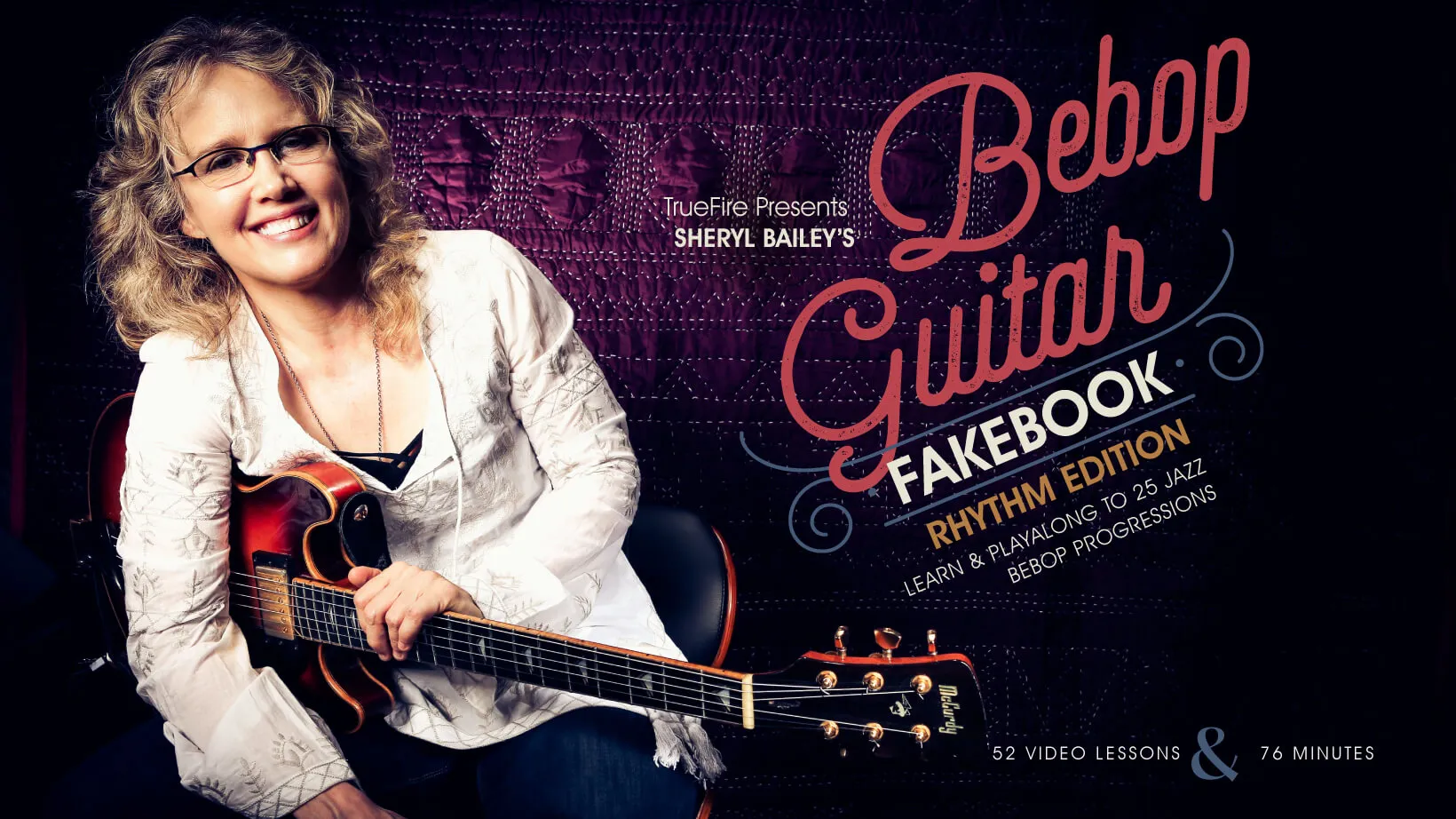
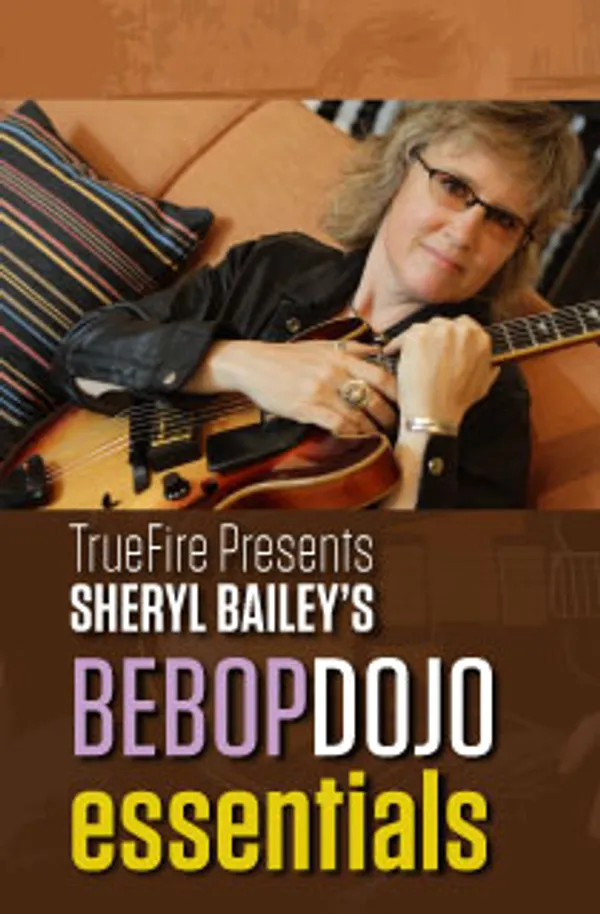
No one would argue that the best way to learn how to play bebop is to learn how to play songs from the bebop songbook. For guitar players, learning songs always starts with learning the chords, progressions, and accompaniment approaches first. In this rhythm edition of the Bebop Guitar Fake Book from Sheryl Bailey, you’ll learn the chords, rhythm patterns, and comping approaches for bebop chord progressions used in dozens of the most popular bebop standards.
”I’ve handpicked 25 progressions based on the most commonly encountered jazz standards being called out on the gig or on the jam bandstand. I perform a playalong for each of the 25 rhythm studies, where I vary the chord voicings and comping approaches across multiple choruses, just like I would on the bandstand.
Each study is charted out with chord grids illustrating the exact chords that I play throughout the playalong. Reference the charts and play along with me to expand your chord vocabulary while also developing your comping skills. Of course, you can also use the playalongs to practice improvising solos over these popular bebop progressions.”
Sheryl pulled the chord progressions from 25 bebop jazz standards: Autumn Leaves, Blue Bossa, The Days of Wine and Roses, Donna Lee, Green Dolphin Street, How Insensitive, Impressions, In Walked Bud, Joy Spring, Confirmation, Ornithology, Quasimodo, I Got Rhythm, Softly (As in a Morning Sunrise), Someday My Prince Will Come, St. Thomas, Stablemates, Stella by Starlight, Summertime, There Will Never Be Another You, What Is This Thing Called Love, Yesterdays, Back at The Chicken Shack, Blues for Alice, and West Coast Blues. You’ll find these chord progressions are also used on hundreds of other classic bebop standards.
Sheryl starts each playalong with basic jazz chords and comping patterns, but as she progresses through the performance, she’ll use substitutions and more sophisticated chord voicings just like you would in a live playing situation. Sheryl also uses more advanced comping patterns and techniques to help you improve your jazz rhythm guitar skills.
All of the performances are tabbed and notated for your practice, reference and study purposes. The charts include chord grids of the voicings Sheryl uses throughout the playalong. You’ll also get Guitar Pro files so that you can play, loop and/or slow down the tab and notation as you work through the material. Plus, Sheryl generously includes all of the rhythm tracks for you to work with on your own.
While the Rhythm Edition of the Sheryl’s Bebop Guitar Fake Books are designed primarily to help players improve their rhythm guitar and accompaniment skills, you’ll also find that each playalong — with Sheryl’s comping parts — are ideal jam tracks for working on soloing and improvisational skills.
Grab your guitar and let’s take our bebop comping chops to the next level with Sheryl Bailey!
Hi, I'm Sheryl Bailey, and welcome to Bebop Guitar Fakebook: Rhythm. The best way to learn how to play bebop is learning how to play songs, and learning songs starts with learning the accompaniment.
In this rhythm edition of the Bebop Guitar Fakebook, you'll learn the chords, rhythms, and comping approaches for progressions used in 25 of the most popular bebop standards. I'll perform a playalong for each of the 25 studies where I'll vary the chord voicings and comping approaches across multiple choruses, exactly like I would on the bandstand. Each study is also charted out with chord grids illustrating the exact chords I play throughout the playalong. Reference the charts and playalong with me to practice the tunes and improve your comping skills. Of course, you can always use the playalongs to practice improvising solos over these popular bebop progressions.
For example, we'll play through changes similar to those of the most famous bebop standards like "Confirmation", "Donna Lee", "Yesterdays", "What is This Thing Called Love", "Joy Spring", and many others. You'll get each progression with detailed chord diagrams, standard notation, tab, and of course, you'll have all the live band rhythm tracks to work with on your own. Grab your guitar, and let's get started!
This is based on the quintessential standard "Autumn Leaves". These changes are the foundation of hundreds of other standards and it's a tune that you can be sure everyone on the scene knows, so it's a good one to commit to memory and be ready to pull out of your bag of tricks.
In this video, I'll play through several choruses to give you a demonstration of the way this classic progression sounds over a backing track. I invite you to play along to the changes with me.
You'll notice that with each passing chorus, I vary the progression slightly, trying some different substitutions and extensions. Try some of that on your own, too!
This progression comes from the Kenny Dorham staple, "Blue Bossa". The version most folks play is based on how tenor giant Dexter Gordon performed the tune, as the original has a written bass line, but I'd like you to be prepared for how it's going to go down on the bandstand, so we're doing the "Dexter version" here.
In this video, I'll play through several choruses to give you a demonstration of the way this classic progression sounds over a backing track. I invite you to play along to the changes with me.
You'll notice that with each passing chorus, I vary the progression slightly, trying some different substitutions and extensions. Try some of that on your own, too!
This comes from Henry Mancini's "The Days of Wine and Roses". Wes Montgomery said that he learned this tune from watching the movie many times, and it was a staple of his repertoire, hopefully it will become one of yours as well!
In this video, I'll play through several choruses to give you a demonstration of the way this classic progression sounds over a backing track. I invite you to play along to the changes with me.
You'll notice that with each passing chorus, I vary the progression slightly, trying some different substitutions and extensions. Try some of that on your own, too!
This is a wonderful tutorial on voice leading, chord voicings, and rhythm. I hate to be greedy, but I'd love it if Sheryl would put together a companion Fakebook Soloing course like Frank Vignola's (only a handful of these tunes are covered in his courses).
J
jotka53
Verified buyer
10/03/21
Bebop Guitar Fakebook: Rhythm
great bebop tutorial
M
milo s.
12/15/20
Swing is King
Ms. Sheryl's Swing is what she wants for you to develpe no matter which tune is attempted. I was lucky enough to be part of the bootcamp and have several other of her courses that give tips of how to play your guitar, in practice/recording/ or live to satisfy yourself/others by hearing a musical rendition performed by a guitarist (you)who is in a groove that is there own making. Thanks to Sheryl.
C
Crhinah
Verified buyer
10/07/20
It’s better than nothing! Anywhere.
E
ebandido
05/11/20
Fantastic Compilation of Tunes
These are really cool songs with beautiful progression and finger friendly chords...Looking forward to learn them all...Thanks Sheryl :)