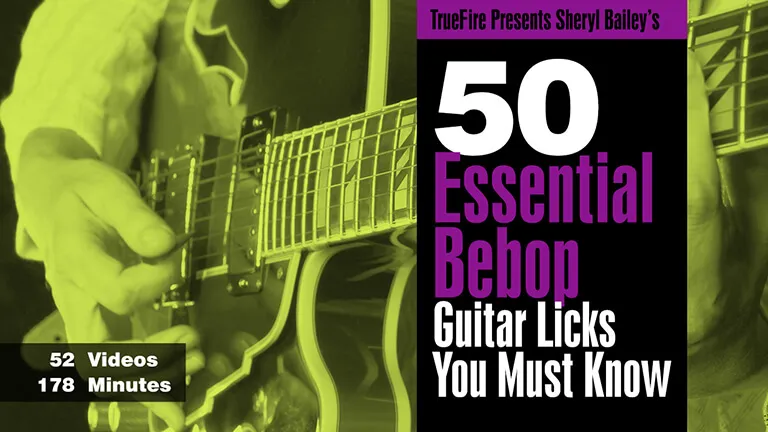
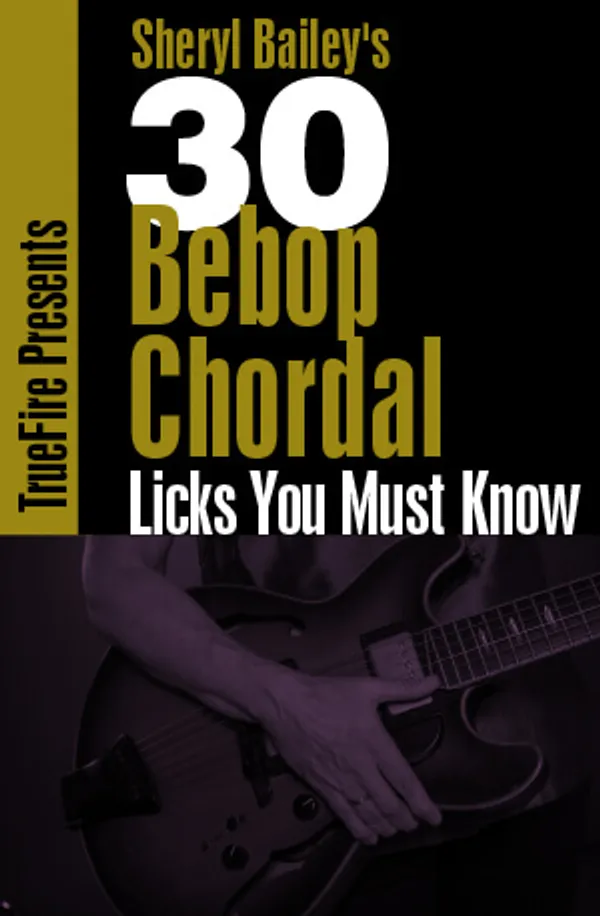
50 Essential Bebop Licks You MUST Know

50 essential bebop jazz guitar licks you must know

Marty FriedmanTommy EmmanuelSteve VaiEric GalesEric Johnson

Get this course and 1,000+ more with All Access

Try 14 days free. Cancel any time.
Purchase Individual Course for $14.99
50 Essential Bebop Licks You MUST Know

About this course

820 different languages and dialects are spoken in Papua New Guinea. Travel there might require a suitcase full of phrasebooks just to book a hotel and order a meal. Fortunately, the language of jazz improvisation has far fewer dialects but you still have to pick one and learn its vocabulary, grammar and phonology -- aka licks, harmony and sonic qualities. Whatever style of jazz improvisation you aspire to master, bebop is an essential rite of passage and you’d be hard-pressed to find a better travel guide than Sheryl Bailey’s 50 Essential Bebop Guitar Licks You MUST Know.

Top recording artist, educator, composer and monster jazz guitarist Sheryl Bailey dug wide and deep into the bebop soundscape to select the lines and approaches that comprise this essential vocabulary of bebop phrases. You’ll learn lines inspired by bebop giants such as Charlie Parker, Joe Viola, Joe Pass, John Coltrane, Pat Martino, Sonny Stitt, Cannonball Adderley, Mike Stern, Dizzy Gillespie, Peter Bernstein and so many more.

“Learning licks from your favorite bebop players is key to understanding the deeper harmonic nuances of the music. Organize your vocabulary of licks by harmonic situations and then plug them into your solos. In time, you’ll uncover the harmonic and rhythmic shapes behind the licks and they’ll become a part of your own musical language. That’s when you’ll really start improvising.”

As you work through these 50 essential lines, you’ll learn to apply the legendary “I’ve Got A Banana” lick, minor 7th line cliche, chromatic below/diatonic above approach, bebop scales, use of repetition, chord substitutions, chromaticism, displaced rhythms, the ‘micro-cosmic’ bebop line, arpeggios, tensions, tritone sub V7, symmetrical diminished, whole tone scale, augmented triads, 3-note melodic embellishments and many more bebop applications. All of the licks are presented over a rhythm track and then broken down note-by-note, technique-by-technique with a thorough explanation of the underlying harmony. Everything is tabbed and notated, plus you get all of the rhythm tracks to practice with by yourself.

We can’t help you with phrasebooks for Papa New Guinea but if jazz improvisation is your destination, then your ticket is but a click away.

What you'll learn

  • Play a classic Dizzy Gillespie-style lick using superimposed triads
  • How to add darker tension to 2-5-1 progressions using diminished arpeggios
  • How to voice lead smoothly between chord changes
  • How to incorporate upper structure tones (6th, 9th) on major 7 chords
  • Recognize and execute tritone interval patterns across the fretboard
Release date: 09/04/2013 • 2h 58m runtime
Start Course
Sample lessons
Diatonic Above
Diatonic Above
Lick 4
Bird's Fave Quote
Bird's Fave Quote
Lick 9
Micro-Cosmic Bebop Line
Lick 25
Darker Tension
Darker Tension
Lick 26

What's included

52 lessons • 50 charts • 50 Jam Tracks

50 Essential Bebop Licks
Think of the process of learning licks as the process of learning new vocabulary words - a new language. Without a common language you can't communicate to those around you. Learning licks is also a way to understand the deeper harmonic nuances of the music, and a way to open your ears to new sounds. When I first started out I learned a great lesson from the Jerry Coker book "Improvising Jazz." He suggested to create an encyclopedia of licks organized by the harmonic situation. The next step was to plug them in and get them to become a part of your musical language. I did exactly what Jerry suggested, and in time I found that I relied less and less on my book of ideas becaue I started to uncover the harmonic and rhythmic shapes behind the licks and I started to be able to truly improvise. This is what I'm presenting to you here in the course: a starting point for developing your musical vocabulary in the hopes that it will help you uncover the bigger concepts of improvisation and the sounds of jazz. I'd like to present to you some of the most important lines a jazz player needs to have under their fingers to sound authentic. These are collected from the masters: Charlie Parker, John Coltrane, Dizzy Gillespie, Joe Pass, and Mike Stern - to name a few. These cover all harmonic situations, from major7 lines to altered dom7 ideas. I will share with you the bigger picture concepts behind these lines, and fueled with a new collection of ideas, you will have a springboard to then begin developing your own concepts and improvisations.
I've Got a Banana
Here it is, the legendary "I've Got A Banana" lick - just sing along with the rhythm of it, and you get the idea! This is a very common harmonic shape that works on several different harmonies: Bbmaj, Gmin7, C7sus, Eø7 and an A7susb9. Phew! Also, the rhythm of this line is an important figure that can be used with any different group of notes.
Donna Lee Thing
This line is reminiscent of the opening line of the Charlie Parker gem "Donna Lee." It uses the Bbmaj bebop scale, which is a scale with a passing note between the 6th and 5th. Also, the triplet rhythm of this line is an important theme in many bebop lines.
Chromatic Triplet
This line starts on the 7th of the chord and moves up chromatically to the 9th, using a triplet rhythm. Again, this rhythmic figure is an important shape to experiment with.
Diatonic Above
Bird played, Joe Pass played, John Coltrane played, all of the greats have used this beautiful melodic embellishment idea to develop their lines from the arpeggios. This lick combines a diatonic above/chromatic below approach tone pattern to create a snaky and flowing melody. This is one to take through all 12 keys for a great chop buster and doorway into exploring new melodic approaches with chord tones.
Viola's Line
Sax legend Joe Viola presents this lick as the foundation of the "chromatic below/diatonic above" study in "Technique of the Saxophone". This lick will also sound great on a Bb7 chord.
Colors of Bebop
Because players have always been exploring how to play the changes with more and more clarity, the major 7 bebop scale evovled. By adding a passing tone between the 6th and 5th, all of the sweet chord tones fall on the downbeats, which gives a very clear sense of the sound of the chord. This line combines the major 7 bebop scale with some diatonic arpeggios to keep things moving forward.

+ 45 more lessons

Start Course

Reviews

33 results

ebrown

Verified buyer

12/16/25

Useful and easy

Very useful and easy Licks and great explanations and names for the licks

behrgott

Verified buyer

08/31/25

Great resource

Really awesome. Tons of great times to work into your playing!

artcast

Verified buyer

01/29/25

Art Cast

I really enjoyed this course to expand my jazz vocabulary. There´s a lot to learn from here.

Andrew H.

12/29/23

great course, deep and challenging

Coming to this as a blues rock guitar player wanting to learn jazz, it is really challenging on two fronts. Firstly, just from the technical perspective, I feel my playing has improved a lot just by trying to learn these licks. Especially if, like me, you have a reluctant little finger. They can be challenging and frustrating at times, but as I've learned to play them I feel my playing in general is now better technically. Secondly, once the technical hurdle was becoming less for me, the theory is so valuable. I am still not there but, for example, I am recognising chord subs now when I see them. Great course. One day I will master it all.

magnajeremie

Verified buyer

12/01/22

wow

amazing!

Stop searching. Start improving with All Access.

Try 14 days free. Cancel any time.