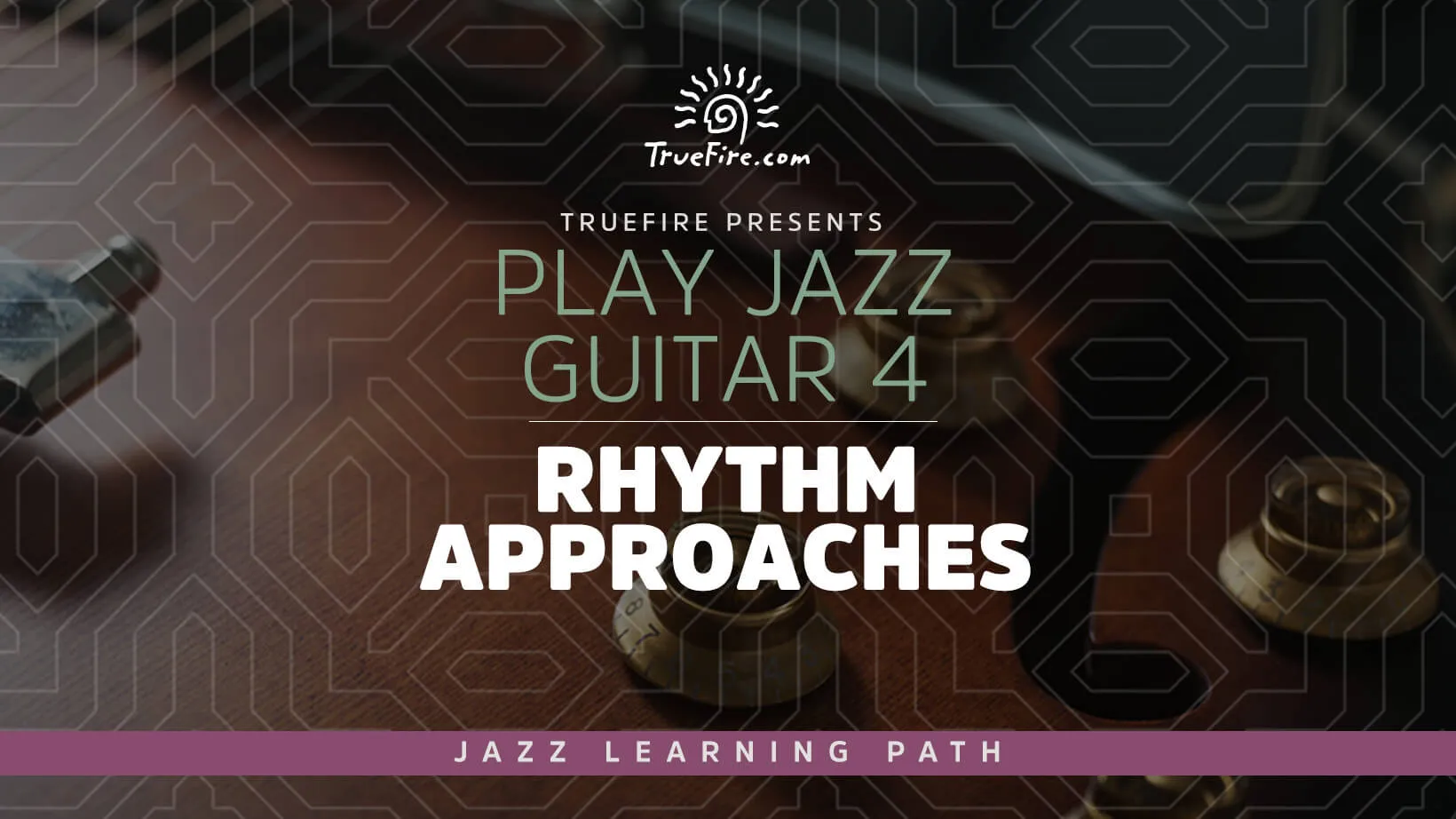
Play Jazz Guitar 4: Rhythm Approaches

Ignite Your Jazz Guitar Rhythm Chops with this Jazz Learning Path Core Course

Marty FriedmanTommy EmmanuelSteve VaiEric GalesEric Johnson

Get this course and 1,000+ more with All Access

Try 14 days free. Cancel any time.

Purchase Individual Course for $5.00
Play Jazz Guitar 4: Rhythm Approaches

About this course

Welcome to Play Jazz Guitar 4: Rhythm Approaches for intermediate to late Intermediate students of Jazz guitar.

This Jazz Learning Path core course is presented by 3 top TrueFire educators: Fareed Haque, Frank Vignola, and Howard Morgen.

The Rhythm Approaches curriculum is comprised of select Jazz guitar lessons from the educators’ existing TrueFire course libraries.

Guitarists spend 90% of their time on the bandstand playing rhythm guitar behind vocals and other musician’s solos, which is why it’s the most important aspect of your playing. Having command of a wide range of chord voicings and rhythm approaches is what distinguishes great players from the mediocre, and it’s also the number one reason that other musicians will want you in their band or invite you back to the jam. The video guitar lessons in this core course will equip you with the skills that you need to take your rhythm guitar playing to the next level.

Play Jazz Guitar 4: Rhythm Approaches is organized into 4 sections. In the first section, Fareed Haque guides you through an intensive series of lessons focused on a wide variety of critical comping approaches. Howard Morgen shares more breakthroughs on chord embellishments in Section 2. Frank Vignola serves up 5 jazz standard progression playalongs in Section 3, and then in Section 4, Frank introduces you to chord melody with 3 simple performance studies.

When you’ve completed the lessons here in Rhythm Approaches, you’ll find more lessons focused on Jazz rhythm guitar in Rhythm Principles, also a Play Jazz Guitar 4 core course.

The educators demonstrate all of the key examples over jam tracks (where and when applicable) to simulate a real-world application, in a musical context. All of the key examples are also tabbed and notated for your practice, reference and study purposes.

You’ll also get Guitar Pro files so that you can play, loop or slow down the tab and notation as you work through the lessons. Plus, you’ll have all of the available jam tracks to work with on your own.

Take as much time as you need to work through each video guitar lesson before moving on to the next lesson. If you want to dig deeper or wider into any of the topics covered in this core course, check out the recommended supplementary courses in your learning path where you’ll find more examples, techniques and insight from top TrueFire educators.

Grab your guitar and let’s get started!

What you'll learn

  • Identify linear movement in chord changes
  • Interpreting jazz chord notation
  • Understand chord embellishment techniques
  • Enhance accompaniment for soloists
  • Developing ensemble playing skills
Release date: 09/14/2016 • 3h 47m runtime
Start Course
Sample lessons
Too Many Big Chords
Too Many Big Chords
How to get fired
Part 1 The Principles and The Blues
(A) Guide Tones
Fareed's 1st Principle of Chord Substitution
Any chord can be a Dominant
Fareed's 4th Principle of Chord Substitution
Lead with Tri-Tone sub

What's included

54 lessons • 26 charts • 7 Jam Tracks

Play Jazz Guitar 4: Rhythm Approaches

Welcome to Play Jazz Guitar 4: Rhythm Approaches for intermediate to late Intermediate students of Jazz guitar.

This Jazz Learning Path core course is presented by 3 top TrueFire educators: Fareed Haque, Frank Vignola, and Howard Morgen.

The Rhythm Approaches curriculum is comprised of select Jazz guitar lessons from the educators' existing TrueFire course libraries.

Guitarists spend 90% of their time on the bandstand playing rhythm guitar behind vocals and other musician's solos, which is why it's the most important aspect of your playing. Having command of a wide range of chord voicings and rhythm approaches is what distinguishes great players from the mediocre, and it's also the number one reason that other musicians will want you in their band or invite you back to the jam. The video guitar lessons in this core course will equip you with the skills that you need to take your rhythm guitar playing to the next level.

Play Jazz Guitar 4: Rhythm Approaches is organized into 4 sections. In the first section, Fareed Haque guides you through an intensive series of lessons focused on a wide variety of critical comping approaches. Howard Morgen shares more breakthroughs on chord embellishments in Section 2. Frank Vignola serves up 5 jazz standard progression playalongs in Section 3, and then in Section 4, Frank introduces you to chord melody with 3 simple performance studies.

When you've completed the lessons here in Rhythm Approaches, you'll find more lessons focused on Jazz rhythm guitar in Rhythm Principles, also a Play Jazz Guitar 4 core course.

The educators demonstrate all of the key examples over jam tracks (where and when applicable) to simulate a real-world application, in a musical context. All of the key examples are also tabbed and notated for your practice, reference and study purposes.

You'll also get Guitar Pro files so that you can play, loop or slow down the tab and notation as you work through the lessons. Plus, you'll have all of the available jam tracks to work with on your own.

Take as much time as you need to work through each video guitar lesson before moving on to the next lesson. If you want to dig deeper or wider into any of the topics covered in this core course, check out the recommended supplementary courses in your learning path where you'll find more examples, techniques and insight from top TrueFire educators.

Grab your guitar and let's get started!
Comping Concepts
In this section, Fareed Haque guides you through 26 jazz comping lessons covering everything from guide tones to tri-tone sub s to adding bass notes and extensions. Fareed also shares three of his "Fareed's Trade Secrets" that will open your eyes and ears to key comping approaches.

TIP! When you start to work on rhythm parts, remember that the number one thing you should be concerned with is staying in time! This might sound obvious, but sometimes it is easy to get distracted by trying to get a cool move or technique down and we forget about keeping it in time!

So always work on a rhythm part slowly at first, using a metronome to make sure the whole thing is staying in time. If you find one part where you keep losing time, then stop and just work on that part until you get it solid. Remember, rhythm is built from the ground up - so make sure you lay the foundation of a groove before you start to worry about all the fancy stuff!
Too Many Big Chords
Too Many Big Chords - How to get fired is a video guitar lesson presented by Fareed Haque and is sourced from Jazz Comping Survival Guide.

One of the biggest problems aspiring jazz guitarists face is learning chords and learning how to use them. Most guitarists learn chords from 'Jazz Chords for Guitar' style books with block chord diagrams, whether it be Mel Bay or Ronny Lee as it was in my case. These books open the door to big 'jazzy' sounding chords that are full and fat and usually four finger voicings. We memorize these voicings with excitement and enthusiasm. I remember sitting with Ronny Lee's book for hours everyday over a summer vacation, memorizing cool chord grips. Then I went on to the Ted Greene books, with pages and pages of amazing sounding chords. How could I ever memorize all of this? So I tried and tried to memorize. Finally got a gig or two. And lo and behold, my chords, so lovingly and painstakingly learned, were, well - almost useless! First thing the bass player says, "Hey man could you not play so many bass notes? It's sort of getting in my way. Next up to rip on me was the piano player, "Hey man, how about laying off those 9th and 13ths and s@#$%^t, it's stepping all over me". And then the sax player, "yeah man, it's cool man, just lay out a bit, ok? Thanks man, yeah great!" Slowly over many gigs I started to find that I was playing smaller and smaller chords. Eventually it was just the 3rds and 7ths that were working. So over the years of teaching, over 20 years of touring and teaching, I've focused my students not on learning chords and then throwing that all out and starting all over again, like me and so many others have had to do. Rather, we start with the small building blocks - just guide tones - and build. So we can use just guide tones when there is a bass player and piano player and vibes player. Or add bass notes when there is no bass player on the gig. Or just guide tones and extensions when there is no piano player. Or add bass notes, guide tones and one or two extensions if you are playing duo with a singer. This approach works! After 20 years of teaching I can humbly say this approach to comping has proven itself many times over. I have had students comping at jam sessions in Chicago after only 3 months of study! Are you ready? Let's go!
Part 1 The Principles and The Blues
Part 1 The Principles and The Blues - (A) Guide Tones is a video guitar lesson presented by Fareed Haque and is sourced from Jazz Comping Survival Guide.

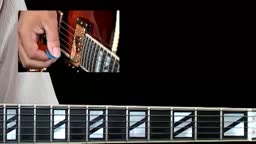
In this first part of the course we will examine playing the blues using only guide tones, and we will also introduce four principles of chord substitution that will become the basis for all of the jazz comping we do from here on out. So please study these carefully and completely, they will have far reaching applications and will be with you for the rest of this course, and probably for the rest of your life as a jazz musician.The ‘guide tones' only approach is a new way of describing what jazz guitarists have been doing for years.

Let's explore it a bit more in depth here.

What are guide tones?

Simple! They are the most important notes in a jazz chord - the 3rd and 7th. Sometimes called ‘color tones', we will call them guide tones, as they outline the important notes in a chord and ‘guide' the player (and listener) through a jazz chord progression.

One of the things I always hated about jazz guitar chord and scale books is how long they were, and how much memorization they expected you to do, page after page of chord symbols, block diagrams, little riffs and licks.

Piano players had nice little formulas for building chords - no memorization! - so did jazz arrangers, why not guitar players too?

Well, as I explored it more I found that building chords on the guitar was simple too. Especially when I started with guide tones. First off, 90% of the time the bass player will be playing the root, or whatever bass note is needed. And the 5th is usually just a clumsy note, often left out of nice chords anyway, so let's start with guide tones for G7. That's the 3rd and 7th of G dominant 7, right? G7 is spelled G, B, D, F - that's 1, 3, 5, b7 of the G major scale, So:

F nat and, B nat are guide tones of G7


move it down one fret and you got the IV chord – C7


move up 1/2 step and you got the V chord – D7


All of the basic building blocks of harmony I,IV and V in a three fret span!

OK, Let's build some chords:

START WITH G7 GUIDE TONES ONLY

-Now flat the third - what dya got? Gm7!


-Now flat 7th 1 ½ step - what dya got? Gm6! (This chord is same as G dim or G ½ dim since there is no fifth at all)


-Now flat the 6th ½ step - what dya got? Gmb6!


-Now raise the B6 ½ step - what dya got? You are back to Gm6!


-Now raise the 6 ½ step - what dya got? You are back to Gm7!


Now raise the B7 ½ step - what dya got? You are up to to Gm(maj 7)!


-Now raise the 3rd ½ step to B natural - what dya got? GMaj7!


-Now flat the major 7th ½ step - what dya got? You are back to G7!


-Now flat 7th ½ step - what dya got? Gmaj6!


-Now flat 6th ½ step - what dya got? Gmajb6!


-Now flat 3rd ½ step and raise the B6 1/2 step- what dya got? Back to Gmb6,


( G dim or G ½ dim!)

Are you ready? That's all of the chords there are. Everything else is just adding extensions, or reorganizing the notes in fun ways, or adding in some more notes, but that's all the chords. In about 4 inches of text. Who said size matters?

Adding extensions:

Now let's have some fun and make big scary chords.


Go back to G7, GT only.


ADD one extension:


Let's start by adding the 13th, E on the ‘b' string. That's ‘G dominant 13', or just ‘G13' for short.

Now how would you create G7b13?


Yes, that's right! Just lower the 13th ½ step.


Now slide that b13 down another step to create G7 w/ the 5th on top.

Slide that puppy on the ‘B' string down one more ½ step and you have got G7b5 (same as G7#11, since the 11th is basically the same as the 4th, #4 is same as b5).

Add two extensions:

Start with G13 guitar tone plus one extension.

Now add the 9th on the ‘E' string, that's G13/9.


Now raise the 9th ½ step, yes that's G13#9. Gnarly.


Now go back to G13/9 and b the 9th for G13b9. Very Gnarly.


Now lower that b9 ½ step more to G, and you have G13 w/ the root on top. Not so gnarly, but very useful.


Now lower the G ½ step to F# and oops, that's G7 w/a major 7th, which just sounds gross. Too Gnarly.


Now see if you can build these chords:

G7#9b13, G7#9nat5, G7#9b5,

G9b13, G9nat5,G9b5

G7b9/13, G7b9b13, G7b9nat5, G7b9b5, G7b9#11

And these:

Gmaj13/9

Gm11

Gm11/9

Gm9maj7

Gm7b5 (same as G ½ diminished)

G1/2 dim nat. 9

Practice building chords in G til it's easy.

Then start building chords in C. Notice that in C (that's the IV chord in the key of G), or in D (the V chord in G) the color tones are flipped: the third will sit on the D string and 7th on the G string:

C9


C13


C7#9,b13


Cm9


Cm9/11


Cm9(maj7)


Cmaj9


C 6/9


C maj9 #11


Make sure to avoid DOUBLING the 3rd or 7th.

It sounds thin and is generally avoided, though if you are playing a nice melody line and the melody note really, really wants to be the 3rd or 7th then go ahead.

Usually if there is a Guide Tone in the melody, try to replace the Guide Tone underneath with another note (6 or 9 instead of 7 and 3) and it'll sound fatter. More gnarly.

Example:

Gmaj7 w/7th in melody, icky. G 6/9 w/7th in melody, delicious!


OK that's your Guide Tone primer. Now let's play some blues!"


Fareed's 1st Principle of Chord Substitution
Fareed's 1st Principle of Chord Substitution - Any chord can be a Dominant is a video guitar lesson presented by Fareed Haque and is sourced from Jazz Comping Survival Guide.

Playing the blues

I remember playing at the High Sierra Music Festival and getting invited to sit in with The Radiators (http://www.theradiators.org/index3.php) - the legendary New Orleans rock and blues band. I had just gotten off stage with my own group the Flat Earth Ensemble, wearing an all white Indian Kurta (formal long Indian concert dress).

When the Rads got a look at me, they sort of panicked - "Who is this weirdo, and what is he gonna do on our stage?" I'm sure I looked like I was more likely to offer them a ‘Hare Hare Krishna' blessing, rather than throw down some jams.

I mentioned briefly that I was from Chicago (home of the blues right?) and that seemed to be okay, but when we hit the stage my one number turned out to be eleven songs 'till how 4 am, you know what they say: You can take the Pakistani kid out of Chicago, but you can't take the Chicago out of the Pakistani kid.

The blues is a deep and wonderful art, and understanding it, or beginning to, was and is a profound lesson for me.

I like to say that the basic difference between blues (and many other African and afro inspired musical forms) and 'western' music is one of intention. Most western music is obsessed with the need to tell a story, hence the operas, long concertos and symphonies of the great classical composers. Most of the tin pan alley ‘standard' songs that jazz is built on tell a story too, they are often from musicals so they were an essential part of telling the story. I call this ‘prosaic' music like the prose of our western literature but on a deeper level. What we love about the blues is that it does not have to tell a story. It is not prosaic but rather it is poetic, in fact one of the most striking and surprising things about the blues is that in the blues nothing happens! We start out at home(I), head to sub dominant (IV) go back home (I) then off to V and back to I where we start the thing all over again. It's hypnotic, right?

In fact the blues progression is basically the same for almost all blues songs. So a blues band plays its set of ten blues songs at the blues festival, 5 bands a day for say 4 days, that's like 200 blues tunes in one blues festival - the same song like 200 times and 200 songs later the audience is still jumpin' and jiving! It still sounds great!

Why doesn't it get boring?

What is it about repetition? Blues feels good and the repetition gets you into a groove. I feel that this difference represents the difference in concepts of time between The West and Africa (and much of the tribal world).

We in the west want things to go somewhere or do something. As a result we are always in a hurry ‘cause we have to get there! To the end, the destination, the goal. But the blues just feels good, and sits there. It does not have to go anywhere or tell a long story to get there because it's already there! We're not in a hurry because we are all ready there and it feels just fine!

So in the blues one of the best things you can do is simply play something that feels good, and then play it again and again and again. Maybe in a slightly different way, like poetry, we are always saying a few things again and again, but with beauty and grace or charm. So it is with the blues

And you'll find the same in so called "bluesy jazz". To groove and play something that feels good and repeat with variation will eventually get the audience into the groove.

It was the great alto sax player Arnie Lawrence (RIP brother) that first clued me into the blues. I was so young (16, 17?) and Arnie and I were playing together in Chile, with some great musicians from down there. He'd sing or play the blues, and then I'd play. I played so corny. I'd play one solo and then have to run backstage to dump the corn cobs out of my guitar. Corny because I still did not understand repetition and variation. Arnie used to kid me - on and off stage – he'd say (In a huge pre-war radio announcer voice) "Ladies and gentlemen, now our young guitarist is going to play for you one of his favorite songs it's called, (and I'm sure you're all going to lovethis snappy little number) "The blues"

Humiliating.

But I eventually started to get it, thanks Arnie for so much music, fun, and a seemingly endless supply of great jokes.

Even the great Joe Zawinul had his take on this. His very first instruction to me at our first rehearsal was "Play this part, and don't ever change it! But be sure to never ever play it the same way twice". That took a week or a lifetime to make sense of, but Joe was making sense. He wanted me to play the part and never change it, but always keep making variations on it, like in nature no two leaves or snowflakes are ever the same, yet all the are the same - but slightly - poetically- different.

Check out Albert Collins, Freddie, Albert and BB King, Hendrix, John Lee Hooker, Robert Johnson for a start on great blues players.
Guide Tones
Guide Tones - Playing Example is a video guitar lesson presented by Fareed Haque and is sourced from Jazz Comping Survival Guide.

In this example I demonstrate using the guide tones only to comp a jazz blues. Don't think this is just academic. I can't tell you how often I have played just guide tones when comping and got smiles all around from the band and audience. Simple is better than complex, almost always.
(B) Guide Tone ii-Vs
(B) Guide Tone ii-Vs - Color tones into ii-Vs is a video guitar lesson presented by Fareed Haque and is sourced from Jazz Comping Survival Guide.

In this section we will play ii-V's, probably the most common progression in Jazz, using guide tones only.

+ 47 more lessons

Start Course

Reviews

9 results

allsorts

Verified buyer

12/23/24

A real find

Along with the Rhythm Principles course, this was just what I needed to take my comping to the next level. It’s a toolkit that lets me focus on the aspects of the course that apply to my playing without having to work through everything. The tutors explain things clearly step by step and I enjoyed it.

jeanpierremelville

Verified buyer

04/06/24

Too much theory, only a few practice

ianmitchell

Verified buyer

08/11/23

Lots of good material

The material is pretty solid in this course, lots of good tips to improve your jazz comping. But I definitely miss the video tab sync and other features in more recent courses.

Eric

07/08/22

Great stuff

Very useful concepts and great for anyone struggling with playing with a piano player

KlausE

Verified buyer

11/07/21

Great Rythm Course

It is a great fun to learn Jazzrythm with this course. To get Lessons from good educators make my Jazzskills netter and will move my Guitar Play forward.

Stop searching. Start improving with All Access.

Try 14 days free. Cancel any time.