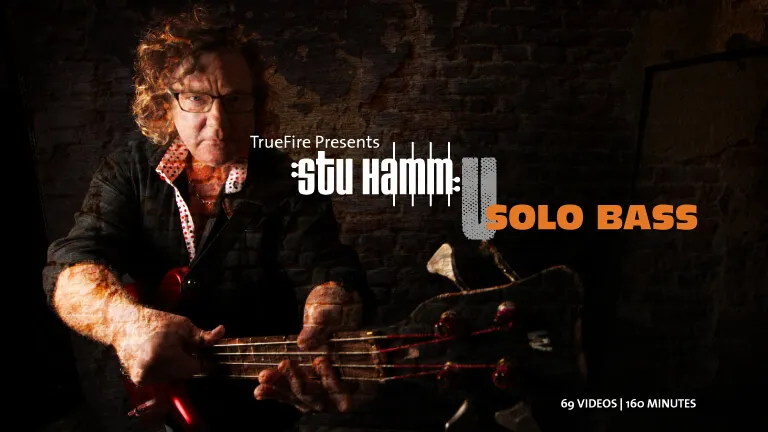
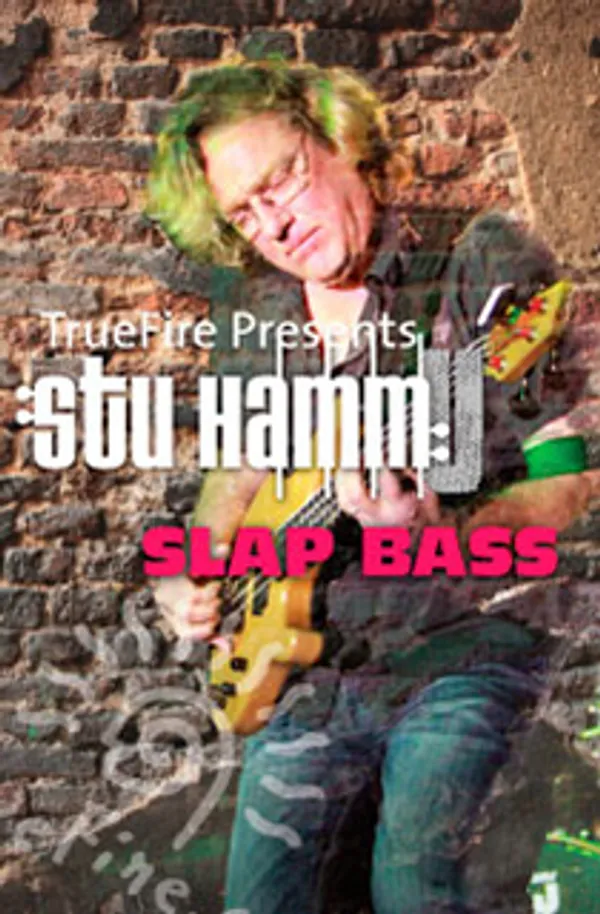
Through his innovative work as a solo artist and his contributions as a sideman to Joe Satriani and Steve Vai, Stu Hamm has firmly established himself as one of the most influential electric bassists of the past half-century.
“As an instrument, the electric bass guitar is still in its infancy and evolving. While the traditional role of the bass in a band is to "hold down the bottom" by establishing the root note and tonality of the chord, the second half of the 20th Century saw an explosion of electric bass players who dared to push the boundaries of the instrument.”
Extending the non-traditional function of the electric bass previously revolutionized by Jaco Pastorius and Stanley Clarke in the 1970s, Hamm helped to reshape the contemporary concept of the bass guitar as an unaccompanied instrument with the utilization of polyphonic, two-handed tapping, slapping and popping techniques, chords and harmonics.
A new addition to the STU U series of interactive instructional courses, Solo Bass presents a remarkable curriculum focused solely on the comprehensive palette of creative approaches and techniques that you’ll need to develop the creative and physical skills required for solo bass composition and performance.
No tedious theory or boring exercises here! You will play your way through seven Solo Bass Performance Studies, each of which contain sections designed to impart particular skills, creative strategies and techniques. Stu will first perform the piece and then break them down measure-by-measure. Stu also demonstrates how to use a looper and integrate the loops into your Solo Bass performances.
PERFORMANCE STUDY 1 - Etude 1: Areas of Focus: Phrasing, Sliding & Dynamics, Proper Hand Position, Pull Offs, Tapping, Fast Passages & Harmonics, DC Al Coda and Basic Chords
PERFORMANCE STUDY 2 - Open Note Aria: Areas of Focus: Hand Positions 1 & 2, Hand Positions 3 & 4 , Hand Positions 5 & 6, Hand Positions 7 & 8, Hand Positions 9 & 10, Hand Position 11, and Final Arpeggios
PERFORMANCE STUDY 3 - A Bit of Blues: Areas of Focus: Intro & Playing The Head, Solo 1: Strumming & Power 5ths, Solo 2: Blues Licks, Solo 3: Finger as a Pick, Repeat of Head & Cadenza,
PERFORMANCE STUDY 4 - Chordally Yours: Areas of Focus: Triads, Four Note Chords, Finger Picking Technique, Whole Tone Intro, Melody Statement, Major B Section, Finger Stretch Solo, Final Melody & Ending.
PERFORMANCE STUDY 5 - Slap Happy: Areas of Focus: Basic Slap & Pop Review, Open String Technique Review, Dynamic Slaps & Pops, Melodies and Power Chords, Bends & Triplets, Tonality Changes & Dynamics, Funky Call & Response Solo, Repeat Form and Ending.
PERFORMANCE STUDY 6 - Harmoni-Cali: Areas of Focus: Natural Harmonics, Tapped Harmonics, Pinched Harmonics, Sliding Harmonics, Tapped Harmonic Intro 1, Tapped Harmonic Intro 2, Rhythmic Harp Section, Chordal Sequence, Here Comes The Melody, Further Melodic Development, Solo Section, Pinched Vibrato, Repeated Harp & Ending.
PERFORMANCE STUDY 7 - Te Extraño: Areas of Focus: Tap Review, Verse 1 & 2, Left Hand, Taps, Hammers & Pulls, Dramatic Rubato & Shakes.
All of the performances are tabbed and notated. You’ll also get Guitar Pro files so that you can loop and/or slow any section down as you work through the lessons. Plus, you'll get all of the rhythm tracks to work with on your own.
Grab your bass, tell your bandmates to take the night off, and let’s go solo with Stu Hamm!
What you'll learn
Apply tapping techniques to create your own solo bass arrangements
How to play the repeat of the head with appropriate dynamics
Multiple ways to end a song with or without cadenza
Creating dynamic contrast after high-energy sections
As an instrument, the electric bass guitar is still in its infancy and evolving. While the traditional role of the bass in a band is to "hold down the bottom" by establishing the root note and tonality of the chord, the second half of the 20th Century saw an explosion of electric bass players who dared to push the boundaries of the instrument. In this course, I'll offer you 8 solo bass compositions that can be played as a suite. Each piece will also show you a different technique or style you can use to make your music more interesting. At the finish of this course you'll be able to use these ideas to create your own solo bass pieces.
Here we're going to examine some different techniques that we're going to use in this course to make the musical vocabulary of the solo bass story you're trying to tell more interesting. This will be a basic overview of the various techniques we will be using in other sections of this course.
Check out this performance for Etude #1. Here we're going to examine some different techniques that we're going to use in this course to make the musical vocabulary of the solo bass story you're trying to tell more interesting.
You can make the music more interesting to the listener by using often overlooked things like phrasing and dynamics. Notice that the same phrase is played in bars 1-4 and 5-8, but they sound different because we're sliding the notes in bars 1-4. We're playing all of the notes cleanly in bars 5-8 and using "call and answer " dynamics to make the repeat of the phrase more interesting. We'll also use dynamic in bars 57-62, playing a Diminuendo, gradually getting softer to increase the dramatic effect of the end of the piece. Notice that we also slide the chords at the end of the piece for a smooth resolution. In bar 5 I introduce a style covered in depth in my course "Fretboard Fitness" and that we'll be using extensively in a future piece. The idea is to use open string as an opportunity to move your left hand up down the neck easily when it's not being used to fret a note.
Another concept covered heavily in "Stu U: Fretboard Fitness" is to have your hand in the correct position, with all of your fingers close to the fretboard at all times. This will make playing these phrases smooth and easily, and will affect the way this passage (and your playing in general) sounds.
Pull-offs are a way to make the strings sound using only one hand . Fret the note with your left hand, and then pull your finger down and away from the bass while at the same time pulling the string with the finger you used to fret the note. This will cause the open note to ring.
This technique will play a big part in solo bass playing, and is covered thoroughly in my TrueFire course "Stu U: Tap Bass". Here let's just look at the most basic application. In Bar 33, tap down on the 10th fret of your string with your index finger and let the G ring. You'll need to hit the string straight down at a 90 degree angle to get a good tone. Then in bar 37, play the G as well as the D on the 12th fret of your D string with your ring finger to play the fifth. This will take some practice if you've never tried it before, but be patient and practice and it will come to you! The final note of this piece will be tapped by your right hand as well.
Stu is an exxellent teacher and videos are high quality.
1
1234djembe
03/06/21
1234djembe
Stu Hamm leadership is effective & creative i enjoy this captivant & warmfull teacher
R
RenatoGF
Verified buyer
08/22/20
Excelent approach
Stu face us an excellent approach to solos, bit per bit, stu build the strategy for better solos
V
vprice
Verified buyer
06/21/20
Great technique workout
Each piece focuses on a set of techniques so they make for great workouts. There's all kinds of riff ideas and dynamic range ideas that you can use as part of your non solo playing.