Essentials: Jazz Bass

Performance Studies & Analysis for Jazz Bass Guitar

Marty FriedmanTommy EmmanuelSteve VaiEric GalesEric Johnson

Get this course and 1,000+ more with All Access

Try 14 days free. Cancel any time.

Purchase Individual Course for $19.99
Essentials: Jazz Bass

About this course

Jazz is a uniquely American art form, musically grown out of blues and soul. Any versatile bassist needs to have a functioning knowledge of basic jazz form and styles. In this Jazz Bass Grooves edition of Essentials, Stu Hamm guides you through 10 jazz bass performance studies in a versatile range of styles, tempos, and keys.

”I’ll show you how to play bass lines over 10 commonly used jazz styles to give you a basic understanding of some of the many different forms and styles that make up the great American jazz songbook. We’ll work on two-beats, walking jazz bass lines, bebop, rhythm changes, and even a few Latin jazz grooves.

As we work through each of the 10 performance studies, I’ll show you different strategies for fingerings, and when and where to play fills to create a melodic bass line. I’ll first perform the bass line over a backing track, and then I’ll break it down slowly for you, measure by measure. By the end of this course, you should be fluent in these diverse musical styles and have the tools that you will need to continue your journey as a jazz bass player. Grab your bass and let's get started!”


Stu will explain and demonstrate all of the key concepts and approaches along the way.  You’ll get standard notation and tabs. Plus, Stu includes all of the backing tracks for you to work with on your own. In addition, you’ll be able to loop or slow down any of the videos so that you can work with the lessons at your own pace.

Grab your bass and let’s jazz things up with Stu Hamm!

What you'll learn

  • Use finger barring technique for efficient position playing
  • Apply chromatic approach notes within modal contexts
  • Maintain a solid, repetitive groove as the rhythmic foundation
  • Understand the difference between Aeolian and Dorian modes
  • Understand what rhythm changes are and their importance in jazz
Release date: 05/20/2019 • 2h 25m runtime
Start Course
Sample lessons
Bebop Jazz
Bebop Jazz
Overview
Bebop Jazz
Bebop Jazz
Performance
Bebop Jazz
Bebop Jazz
Breakdown
Modal Jazz
Modal Jazz
Overview

What's included

33 lessons • 10 charts • 8 Jam Tracks

Essentials: Jazz Bass
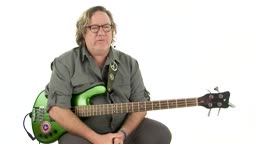
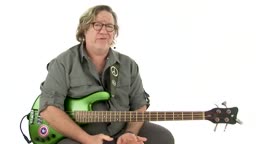
Hi, I'm Stu Hamm and welcome to Essentials: Jazz Bass Grooves.

Jazz is a uniquely American art form, musically grown out of blues and soul. Any versatile bassist needs to have a functioning knowledge of basic jazz form and styles.

In this edition of Essentials, I'll show you how to play bass lines over 10 commonly used jazz styles to give you a basic understanding of some of the many different forms and styles that make up the great American jazz songbook. We'll work on two-beats, walking jazz bass lines, bebop, rhythm changes, and even a few latin jazz grooves.

As we work through each of the 10 performance studies, I'll show you different strategies for fingerings, and when and where to play fills to create a melodic bass line. I'll first perform the bassline over a backing track, and then I'll break it down slowly for you, measure by measure. By the end of this course, you should be fluent in these diverse musical styles, and have the tools that you will need to start your journey as a "Jazz Bass Player".

Everything is tabbed and notated and you'll have all the backing tracks to work with on your own. You can loop and slow down the videos to work with the lessons at your own pace.

Grab your bass and let's get started!
Two-Beat or Not Two-Beat
When playing jazz standards, the bass player generally starts by playing a "two-beat" bass line. Let me show you what that is in this first performance! This is the perfect place to start your jazz journey, and get used to outlining the root notes of chord progressions commonly used in jazz.
Two-Beat or Not Two-Beat
Notice that the first time through the changes I'm just playing the root notes, occasionally jumping up an octave, but sticking to just the root notes. Remember, it's OK to play simply. And really, it's not just OK...it's your JOB!

The second time through the changes, we switch it up a bit by adding the 5th note of the chord on beat three instead of just repeating the root note.
Two-Beat or Not Two-Beat
Here I'll show you exactly how to play and fingering this first exercise in playing a two-beat bassline. Notice that in the beginning I talk about adding the "ghost notes" on beat 2. This is a subtle thing to learn and I suggest that you use discretion and don't use this technique too often...be tasty!
Walking & Outlining
The main job of a bass player is to establish the tonality of the music by playing the root of the chord on the beat that the chord changes. After the bass establishes the tonality with the root, you also can add the fifth and most importantly the major or minor third to establish if the chord being played is a major or minor chord.
Walking & Outlining
In this performance, I'll play the most simple way of outlining the chords that you're playing to create a walking bassline. It takes what we worked on in the previous exercise and fills in the holes by adding the third when playing the chords to establish major or minor tonality.
Walking & Outlining
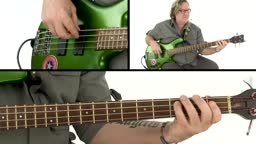
In this breakdown, I'll show you exactly how to play and finger this introduction to walking basslines by outlining the chords. We're not going to be concerned with the 7ths (we'll get into THAT later) by just playing the root, 3rd and 5th of the chord that you are playing. We're going to use a lot of open notes here, and you'll be introduced to the left positions of major chords that you'll use often.

+ 26 more lessons

Start Course

Reviews

11 results

johnnyduggan

Verified buyer

06/05/25

great tool for bass in blues and jazz

Great presentation and explanations, the modal jazz is excellent for playing So What, and other similar songs.

ianmitchell

Verified buyer

10/28/22

Good foundation

The course is well presented and easy to follow. It gives a solid foundation and enough information to progress further on your own.

jdamele

Verified buyer

01/18/22

Very creative.

luwiilumibao

Verified buyer

12/08/21

Easy to understand and follow.

jotka53

Verified buyer

10/03/21

Product image Essentials: Jazz Bass

Stu Ham is a great instructor

Stop searching. Start improving with All Access.

Try 14 days free. Cancel any time.