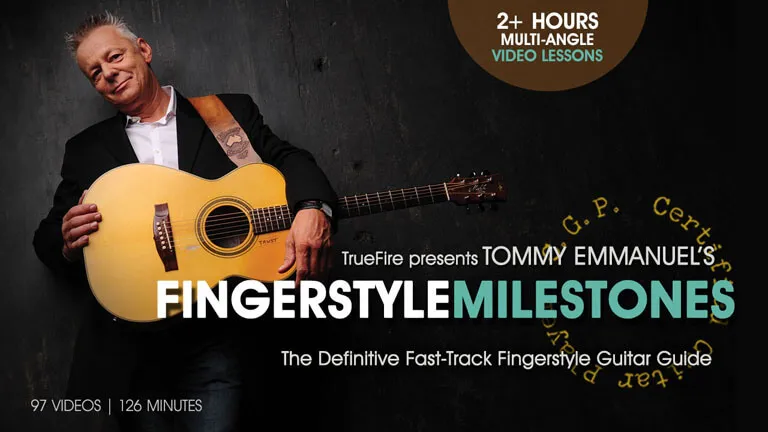
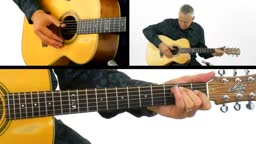
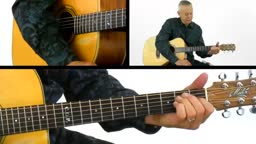
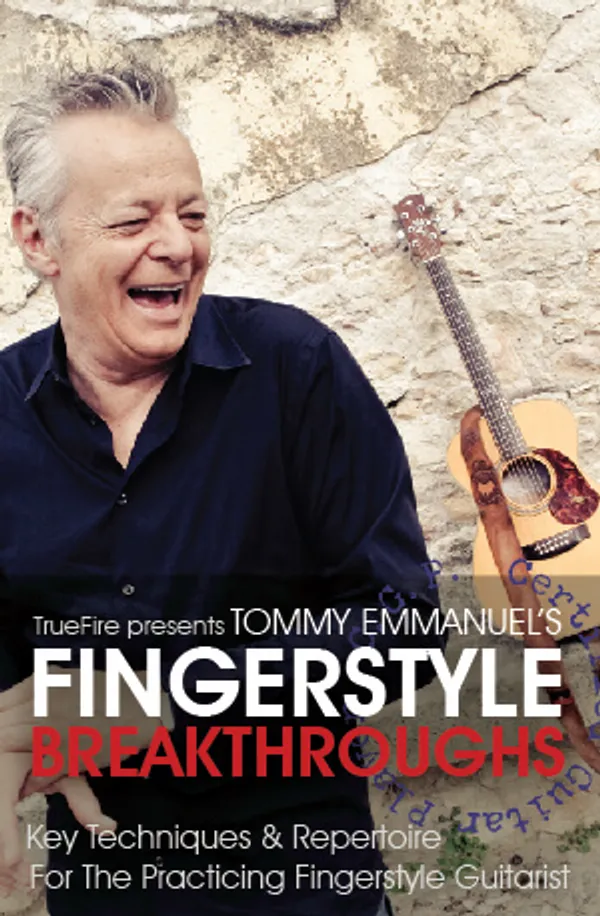
Tommy Emmanuel is indisputably one of the world’s most accomplished fingerstyle guitarists. His compelling musical performances, mesmerizing stage presence, jaw-dropping technique and beaming personality has attracted (if not outright converted) thousands of flat-picking guitarists, across all styles of music, to the art of fingerstyle guitar.
Tommy is also a gifted and passionate educator. For guitarists who are already skilled fingerstyle players, Tommy’s Master Series courses will lift you to the next level. But for those of you that already play guitar and are now anxious to swap your flat pick for a thumbpick, Fingerstyle Milestones is the accelerated learning experience that you’ve been waiting for.
The very first course of its kind from Tommy, Fingerstyle Milestones is ideal for early intermediate to advanced guitar players who are ready to develop finger and thumb independence and explore the polyphonic wonders of fingerstyle guitar.
Tommy’s engaging, hands-on ‘milestone’ teaching approach will guide you through all of the fundamental principles and techniques required to play bass, rhythm and melody parts simultaneously. You’ll play your way through the course material and Tommy will have you up and running quickly without tedious theory or boring exercises.
Tommy has organized the Fingerstyle Milestone curriculum into four sections, each section representing a major milestone in the learning process: ORIENTATION, THUMB & BOOMCHICK, ADDING THE FINGERS and LEARNING SONGS.
SECTION 1: ORIENTATION Types of Guitars, The Thumbpick, String Tuning & Gauges, Types of Fingerstyle, Hand Size, Memorizing Songs and Learning Timeline.
SECTION 2: THUMB & BOOMCHICK Bass Parts, Palm Mutes, Angle of the Thumbpick, Open Position Etudes and Playalongs in E and C, Barre Chord Etude and Playalong in G, Inversion Etude and Playalong in E.
SECTION 3: ADDING THE FINGERS Accompanying with Lead, The Melody Finger/Hand Posture, Timing: Being in the Pocket, Chords on Beat Etudes and Playalongs in E, C and E7, Syncopated Chords Etudes and Playalongs in E, C and E7, Arpeggios on Beat Etudes and Playalongs in E, C and E7, Anticipating the Beat, Syncopated Arpeggios Etudes and Playalongs in E, C and E7.
SECTION 4: LEARNING SONGS Learning Songs, The Method: Beat by Beat, Hammer-ons, Pull-offs, Using a Capo, Blues, Buffalo Girls, Pinkie Etude in D, Creole Belle Etudes, Thumb-over Etudes in A, Just Bass Thumb-Over Etudes, With Chords Thumb-Over Etudes, Yankee Doodle Dixie Etudes, Stretching Etudes.
Tommy also takes full advantage of TrueFire’s interactive learning tools to put everything you need at your fingertips: multi-angle interactive video lesson player features looping, zooming, keyboard shortcuts, standard tab, standard notation, Guitar Pro files, text narrative and other handy learning tools and controls. Viewing angles include wide, right-hand, left-hand and composite views.
Put the flat pick down and take Fingerstyle Milestones to the shed for a bit. You will emerge as a fingerstyle player quicker than you could have ever imagined.
What you'll learn
Navigate a blues progression in the key of E
Apply hammer-ons and pull-offs in a musical context
Combine thumb bass playing with fingerstyle technique
Maintain a steady groove while playing multiple techniques
Hi, I'm Tommy Emmanuel. Welcome to Fingerstyle Milestones. In my travels I meet people of all levels who play guitar. I meet people who have already been playing guitar for a long time, I meet some players that are good and some players that are just starting out. At whatever level you are at this course is going to be the one that will help you get started in fingerstyle. Learning fingerstyle is a series of milestones. The most important ones are those early milestones, the ones where you learn the skills to really get the thumb going and to get the independence in your right hand. I've organized this course into four sections. The first section is orientation. Here we are going to talk about different guitars, and the reasons why we use different guitars, and also strings and thumbpicks. All of the things I think are important for you to have knowledge of before you get started. The second section is boomchick. Boomchick is the sound that the thumb makes. So I'm going to show you the importance of the angle of the thumb. where you put your thumbpick, and how you put your hand. All of that stuff. It's all important in getting the right sound with boomchick. Section three is a bit more difficult. Keeping the thumb going, bringing the fingers in, all that kind of stuff. You're going to love it. Section four is about learning songs and learning exercises. These exercises that I've come up with for you are specifically designed to give you the skills with which to play these kinds of songs and these arrangements. The exercises are hammer-ons, pull-offs, thumb exercises. A lot of things that you're going to need to develop the skill to play these songs. Everything is tabbed and in music notation for you. There's interactive tab as well, where you can go in and slow things down, you can loop sections. I'm sure with this course that all of your questions will be answered and all the road blocks that you think are in front of you are just going to slowly disappear because we're going to explain everything and everything will be answered. Okay, enough talk now let's get to work. Grab your guitar.
In this first section we're going to cover guitars, strings, picks, styles, all the things that you need to know before you get started.
Hello thrill seekers! We are going to be talking about many things today. First of all I want to talk about your guitar, and what kind of guitar you play. A lot of people think that playing fingerstyle they have to have a certain kind of guitar. That's not true. The best guitar for you is the one that you love playing. That's all that matters. It doesn't matter where it was made, what it costs, what name is on it. If you like playing it, that is what is important. I'm playing a steel string acoustic guitar. This is a Maton guitar. I like this particular guitar because it suits me. The neck is nice and fine, it has a good feel to it. The reason I'm bringing guitars up is because a lot of the stuff that I play, and that fingerstyle players play, we sometimes bring our thumb over the top. So if you're playing nylon string or a classical guitar, they have a much wider neck. So unless you've got fairly big hands you're going to struggle to get your thumb over the top. So what I'm hoping to show you in this course is alternative ways of being able to play the things that I would normally play with my thumb, but with your finger, to bar it across. So that's going to be important for you to know that. If you haven't bought a guitar yet and you're just getting started don't spend a fortune on a guitar. Just get a decent guitar. Something that's a well-proven brand like Fender, Yamaha, Ibanez, Maton, Martin, Gibson, any of those, they are all good. They will all do the job for you. It's your choice whether you go steel string or nylon string. The reason I don't play nylon string too much is that I don't play with my nails. This is something that is your choice as well. You can either choose to grow your nails and play like so many fingerstyle player do. They either use their nails or they use the acrylic nails. I play with calluses that I've developed on the tips of my fingers. You could do that as well. Some people play with finger picks instead of nails. So there are a lot of choices out there.
I'd like to talk about thumbpicks and how to use them and the different kinds. The thumbpicks that I like are the Jim Dunlop thumbpicks. I also have other thumbpicks that are made by Jim Dunlop that have my signature on them. I like this plastic, strong, thick thumbpick. There are a lot of different kinds of thumbpicks and you have to find what works for you. Make sure that it's not too loose, that it sits nice and tight, yet doesn't give you the blue finger. If a thumbpick is too tight, it will cut off the circulation and the end of your thumb will go cold and sometimes they go blue. I think that's why Jerry Reed wrote the song Blue Finger because he was wearing a thumbpick that was too tight. You've got the Fred Kelly picks, which are softer. They don't suit me, but a lot of people use them. The Jim Dunlop are the ones that I like the most. These work for me. They shouldn't be too long and they should just sit nicely. There's also a lot to be said for playing without a thumbpick. Quite a lot of the songs that I play, I take the thumbpick off and just use the flesh of my thumb. The reason I do that is because it gives it a softer, gentler sound. In the Robert Johnson blues style or Eric Clapton - you can see that he doesn't use a thumbpick. What he does is gets his thumb under the string and pops it out and give it that funky kind of edge. So that's another way of using your thumb. That's what I wanted to tell you about thumbpicks, experiment, go to music shops and try twenty different thumbpicks until you feel it is sitting good. Sit and play some songs and get it to where you feel where you can rely on that thumbpick to be sounding good and sitting in the right spot. So it's up to you. Some people have small hands. My wife has very small hands. She wants to play fingerstyle the same as I do. In order to find her a thumbpick that's small enough - she just found this thumbpick in a store and then put a little electrcal tape on it to make it tighter. So if you find most thumbpicks are too big for you, find one that is close and then put a little bit of tape on it and make it tight on your finger. It's a way of being clever and inventive to help you play better and play your music better, so that's a good idea.
I get asked a lot about the tunings that I use. Most of my songs are in normal guitar tuning. A lot of people associate fingerstyle guitar with open tunings. It's true, there are a lot of players who play in unusual tunings. Like a drop C tuning, or a DADGAD tuning, or an open G. The guitar sounds wonderful tuned in these open tunings. I don't play many songs in open tunings. I have a couple of songs. some songs that I've written because of the actual tuning. I guess the most unusual tuing that I use is normal guitar tuning and then the A string is down to G, and the E string is down to D, then the rest of it is normal. When you play it open, technically it's a G 6th tuning with a D base. I got that tuning from Chet Atkins. I wrote songs like The Tall Fiddler, The Cowboy's Dream, The Mystery - I wrote those songs in that tuning becasue I love that tuning. As far as strings go, I use uncoated strings because my hands don't sweat. If you have sweat or clammy hands you need to wash your hands more. You can buy coated strings and they will last a lot longer if you're the type of person that sweats battery acid. Too many hamburgers! The gauges of these strings, they are a light gauge, Martin strings. They are 12 to 54. That is right in the middle. The guitar is nice and comfortable, the action is nice and comfortable and the strings have just enough bite-back for me to enjoy playing it and for me being able to dig in. A lot of people start out with lighter strings, like 11-52. That's fine. You just have to know that you're not going to get the volume and the punch out of your guitar, but you will when you use a slightly heavier string. Some of my other guitars I use medium gauge strings which is 13-56. I keep an eye on the neck, you have to have the neck nice and straight. When the neck is straight there's not as much pressure to push the strings down, not as much hard work to get the clarity. Make sure your guitar is set up nicely with good strings on it, you've got your thumbpick, you've got the right attitude, you're all ready to go.
There are many different kinds of fingerstyle. Classical guitar is a type of fingerstyle. There are jazz players out there like the great Martin Taylor who play in a fingerstyle. You've got the bluegrass approach. You've got folk players. You've got a guy like James Taylor who has a beautiful style. His way of playing is so economical and so suits his way of singing but is really just as complex as any other style. You've got guys like Don McLean who have their own kind of style as well. John Mayer, Eric Clapton, so many great players out there and they all play fingerstyle as well as regular plectrum style guitar. I'm hoping to give you the tools to get started. It's a very physical skill playing fingerstyle. What you've got to understand right from the start is that first of all you've got to go slowly, you've got to meticulously work things out carefully and then practice them up. It's skills that you are learning. When you've practiced these skills enough they start to sound like music, and it's a beautiful thing. This is what we live for. Starting out learning these skills, and then they turn to music. But remember that you are learning skills first. You've got to stick at it and keep at it until those skills turn to music. The different styles that you'll experience are styles where the guitar player is playing everything himself, and there's no singing. Then you've got other styles there is a singer and he's backing himself, that's another style as well. Then you've got the Jerry Reed funky rhythms using amazing technique stuff that I'd be happy to show you. So fingerstyle is very complex and yet when you break it down you can understand it and that's what we're hoping to do with you. para. Let me give you some examples of some different kinds of fingerstyle. You've got the Merle Travis almost Honky Tonk sounding where the thumb is playing really what the left hand on the piano plays. Then you bring the melody in. Then you've got the Chet Atkins style where everything is neat and in its place. You've got the folk style. You've got the style where you play the rhythm with your fingers and the bass with your thumb. You've got a more funky style. And you've got a more classical type style. So you've got all different styles of fingerstyle. All of it is good fun and all of it is challenging and all of it is good music.
A lot of people come to me and say that they can't play that type of song because I don't have big hands like yours, or that they don't have guitar player hands. I don't buy any of that. I'll tell you why. Because there are people in this world who have tiny little hands, like little children. I've seen so many young children, six, seven eight years old, who are playing guitar and pulling off these things and reaching the stuff that adults have come to me and said they can't play because they don't have big hands. I tell them that it's no excuse. Small hands means more you have to be more determined. What happens with your hands is that if you keep trying it you will get it. And your hands will shape to what you need them to do. When someone tells me they can't get their thumb over I tell them to find another way of doing it. Don't let anything stop you. Don't let the fact that you have small hands stand in your way. I've always had fairly big hands even when I was a little boy. I guess I was lucky in that respect. However there are people around who can play a lot more complicated stuff than me and their hands are a lot smaller. It's really a matter of how determined you are and how committed you are to getting the job done.
I'm a longtime fingerpicker and bar room blues musician who would like to get a little of the TE magic. The maestro delivers and breaks things down cleanly and concisely and I plan on getting his two follow up courses when I finally wade through this one. He starts slow but I believe if you diligently work your way through this you'll emerge at a much higher level when you're done.
B
bruce501
Verified buyer
08/25/26
Excellent. . of course!
Y
yb27042000
Verified buyer
08/25/26
מושלם!!!!!!!
C
Carvymes
Verified buyer
08/18/26
Le clé d'un jeu solide
C'est un excellent cours pour solidifier son jeu et corriger le positionnement de la main.