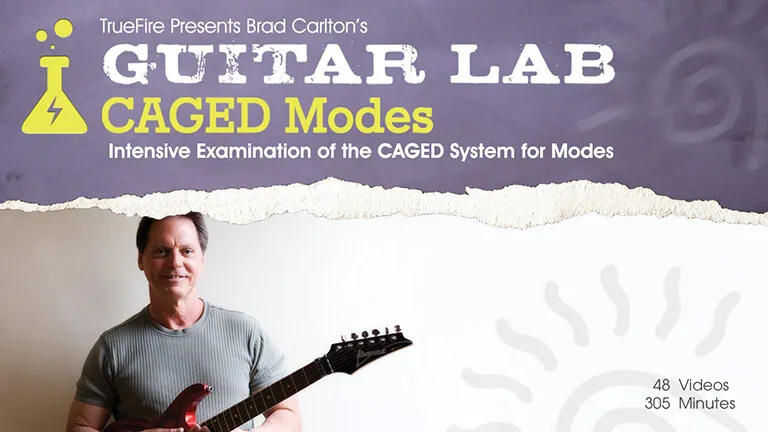
Guitar Lab: CAGED Modes

Intensive examination of the CAGED system for modes

Marty FriedmanTommy EmmanuelSteve VaiEric GalesEric Johnson

Get this course and 1,000+ more with All Access

Try 14 days free. Cancel any time.

Purchase Individual Course for $5.00
Guitar Lab: CAGED Modes

About this course

This course presents commonly used modes over each of the five chord forms of the CAGED system. For the major chord forms, the following modes are presented: Ionian, Lydian, Mixolydian, Lydian b7, and Phrygian dominant. You will learn how to reference one mode against another by seeing what notes change which will translate to a clearer perception of the color of each mode. Your understanding of the theory behind the modes will be reinforced by viewing them in terms of scale degrees which will reveal the harmonic options available in each mode.

You will receive five jam tracks in the following keys: C, A, G, E, and D. Each of these will be presented with and without rhythm guitar. You will be given many practice schemes involving both musical and technical concepts. You will also receive 35 diagrams which are color-coded with the arpeggios in red and the remaining scale tones in black. This will further aid you in seeing the modes over each of the chord forms of the CAGED system.

What you'll learn

  • Navigate between positions using extensions efficiently
  • Use pedal tones for ear training and improvisation
  • Visualize scale degrees across the fretboard in multiple positions
  • Construct chord voicings directly from scale patterns
  • Build minor chord extensions (6, 7, 9, major 7)
Release date: 05/25/2012 • 5h 05m runtime
Start Course
Sample lessons
C Form
C Form
Mixolydian
C Form
C Form
Parallel Mode Workout
A Form
A Form
Ionian
G Form
G Form
Lydian

What's included

48 lessons • 9 charts • 5 Jam Tracks

CAGED Modes
This course presents commonly used modes over each of the five chord forms of the CAGED system. For the major chord forms, the following modes are presented: Ionian, Lydian, Mixolydian, Lydian b7, and Phrygian dominant. You will learn how to reference one mode against another by seeing what notes change which will translate to a clearer perception of the color of each mode. Your understanding of the theory behind the modes will be reinforced by viewing them in terms of scale degrees which will reveal the harmonic options available in each mode.

You will receive five jam tracks in the following keys: C, A, G, E, and D. Each of these will be presented with and without rhythm guitar. You will be given many practice schemes involving both musical and technical concepts. You will also receive 35 diagrams which are color-coded with the arpeggios in red and the remaining scale tones in black. This will further aid you in seeing the modes over each of the chord forms of the CAGED system.
C Form
This lesson presents the Ionian mode over the C form of the CAGED system. Diagram one shows the C form arpeggio in red. The three notes that form this major arpeggio are: 1, 3, 5. The formula for the Ionian mode is: 1, 2, 3, 4, 5, 6, 7. If you view the arpeggio as a skeletal framework of the mode, you can then perceive the remaining four notes as color tones or chord extensions. These are presented in black. It is very important that you memorize the scale degrees and to aid you in this process you will learn to organize the tones in each position in terms of octaves.
C Form
This lesson presents the Lydian mode over the C form of the CAGED system. Diagram two shows the C form arpeggio in red. The three notes that form this major arpeggio are: 1, 3, 5. The formula for the Lydian mode is: 1, 2, 3, #4, 5, 6, 7. If you view the arpeggio as a skeletal framework of the mode, you can then perceive the remaining four notes as color tones or chord extensions. These are presented in black. It is very important that you memorize the scale degrees and to aid you in this process you will learn to organize the tones in each position in terms of octaves.
C Form
This lesson presents the Mixolydian mode over the C form of the CAGED system. Diagram three shows the C form arpeggio in red. The three notes that form this major arpeggio are: 1, 3, 5. The formula for the Mixolydian mode is: 1, 2, 3, 4, 5, 6, b7. If you view the arpeggio as a skeletal framework of the mode, you can then perceive the remaining four notes as color tones or chord extensions. These are presented in black. It is very important that you memorize the scale degrees and to aid you in this process you will learn to organize the tones in each position in terms of octaves.
C Form
This lesson presents the Lydian b7 mode over the C form of the CAGED system. Diagram four shows the C form arpeggio in red. The three notes that form this major arpeggio are: 1, 3, 5. The formula for the Lydian b7 mode is: 1, 2, 3, #4, 5, 6, b7. If you view the arpeggio as a skeletal framework of the mode, you can then perceive the remaining four notes as color tones or chord extensions. These are presented in black. It is very important that you memorize the scale degrees and to aid you in this process you will learn to organize the tones in each position in terms of octaves.
C Form
This lesson presents the Phrygian dominant mode over the C form of the CAGED system. Diagram five shows the C form arpeggio in red. The three notes that form this major arpeggio are: 1, 3, 5. The formula for the Phrygian dominant mode is: 1, b2, 3, 4, 5, b6, b7. If you view the arpeggio as a skeletal framework of the mode, you can then perceive the remaining four notes as color tones or chord extensions. These are presented in black. It is very important that you memorize the scale degrees and to aid you in this process you will learn to organize the tones in each position in terms of octaves.
C Form
This lesson will give you a parallel mode workout involving the five modes presented in the previous lessons. Your ability to pre-hear the color of each mode will be enhanced by applying this mixed mode improvisational concept as you solo over the jam tracks. Your understanding of the formulas of each mode will also be reinforced as you think in terms of scale degrees.

+ 41 more lessons

Start Course

Reviews

12 results

Calabiyau

Verified buyer

10/11/25

Amazing teacher! Spoken by a lecturer who teaches students to be teachers.

FredRothe

Verified buyer

01/07/25

stillhavent got around to this course all Brads courses are great I have a number of his courses, great guy , fred

JBurgess_64b7b20233ff5

Verified buyer

10/29/24

Too soon

I’m sorry, I haven’t had the chance to look at it yet.

Filippo2010

Verified buyer

10/12/24

Guitar lab caged Modena

Great

ibanezjs20

Verified buyer

06/15/22

This is an excellent course, a must have to understand how the modes works

Stop searching. Start improving with All Access.

Try 14 days free. Cancel any time.