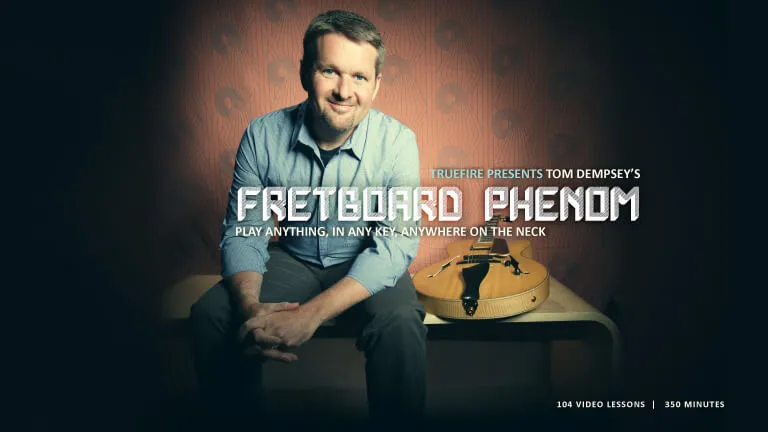
Do you remember when someone handed you the keys to your very first car? It probably wasn’t brand-spanking new, maybe struggled a bit going up hills, and might have even been older than you at the time, but that ear-to-ear grin plastered on your face for months to come had little to do with the car itself — it was all about your new-found freedom to do anything and go anywhere, anytime you wanted to. Freedom — that was the rush.
Tom Dempsey is handing you another set of keys with Fretboard Phenom. These keys will bring you a different form of freedom — fretboard freedom. And just like that first car, you’ll enjoy the rush of freedom to play anything, anytime and anywhere on the fretboard.
Guitar players naturally tend to favor certain positions and certain fingerings for scales in relationship to that scale’s parent key. Think G minor pentatonic for example; 3rd position, right? But there are many other positions to play that scale on the fretboard of a guitar. Maybe we know one or two more of them but that still leaves all of the other positions completely in the dark, forcing us to jump around the fretboard to play over changes. This holds true for every scale!
Deep down inside we all know this to be true but we remain handcuffed to the familiar because we’re creatures of habit, a little bit lazy, and mostly because we haven’t yet discovered an easy, fool-proof way to unlock the fretboard for us.
As you might imagine, we’ve seen a lot of great fretboard navigation systems over the years. They all work IF the student is willing to put in the time and energy to grasp their logic and then embed that logic in their muscle memory. And therein lies the rub — our students simply do not have ample time to invest in these more elaborate, time-consuming approaches.
That’s why we freaked when Tom presented his method to us — it took no time at all to grasp the logic, and all a student has to do is commit just five ‘tonality shapes’ to memory and they’re off and running. Sure, it’ll take time becoming comfortable and fluid improvising within those shapes, but certainly not as much time as the other methods we’ve seen.
Another significant distinction with Tom’s method is the learning process itself - you’ll learn and practice ALL of the tonality shapes with video playalongs and practice rhythm tracks. You’ll play your way through the course rather than struggle through charts of boring exercises.
In the first section of the course, Tom guides you through the entire Major Pentatonic, Minor Pentatonic, Blues Scale and Major Scale systems. Each of these systems features an overview, a presentation of the correlating tonality shapes, a series of playalongs covering the entire neck, a creative application demonstrating the system in an improvisational and musical context, and a discussion on transposing the system to any key.
In the second section, Tom shows you how to connect multiple tonality shapes and multiple positions, which empowers you to play in any key, anywhere on the neck, over any given set of changes. This section also features overviews, the full series of playalongs covering the entire neck, creative applications and more guidance for transposition.
Fretboard Phenom includes over 100 video lessons and playalongs, PLUS Tom also includes a massive 721-page Reference Manual featuring all of the Fretboard Phenom material in ALL 12 keys and in ALL positions. You’ll also get 192 additional single and multi-positional practice rhythm tracks.
Jump in Fretboard Phenom, roll down the windows down, and speed your way to fretboard freedom!
What you'll learn
Improve fretboard fluency with blues scale
Develop fretboard familiarity with major pentatonic scale
Understand and apply five movable shapes across the entire fretboard
Welcome to Fretboard Phenom! My name is Tom Dempsey and I'm really excited to take you on a journey that I hope will unleash a new way of looking at the fingerboard of the guitar. Through this method my intention is to help you gain greater familiarity and ease of playing the guitar. Most guitar players, including myself, go through periods of feeling like they don't know where certain things are on the guitar. How do I play a G triad in 7th position? Or people feel handcuffed and limited by where they can play certain things. They can play an A minor pentatonic scale in 5th position but can they play a C minor pentatonic scale in that same position without moving their hand. Then of course there is sight reading. I can read a little bit in open position but how can I learn to read in 5th position. In this course I want to share with you the way I have learned to look at the fingerboard. Once I began looking at it this way I was able to make connections. These connections allowed me to gain greater ease and understanding of all the notes in all twelve keys. It also gave me a method for being able to play any chord anywhere on the neck in any key. This method also helped me to move from reading in two positions to reading all over the neck of the guitar. It also helped me to play melodies in multiple positions. Through looking at the guitar I was able to move from playing in single positions to be able to make connections up an down the neck of the guitar. It simply helped to unlock the geography of the guitar neck allowing me to feel equally comfortable playing melodies, comping chords and reading music all throughout the neck. I hope that this will be your experience too. So lets begin by introducing the key to all of this which is Tonality Shapes.
In this section you will be introduced to the foundation of the entire course which is based on the idea of tonality shapes. Tonality shapes are a way to organize the fingerboard that allow you to do two specific things. First is to be able to grab any key wherever you are on the neck of the guitar. The second is to connect your ideas up and down the neck with a lot more ease. We're going to do this while learning the major and minor pentatonic scales, the major scale and the blues scale. We will also connect this concept to the major and minor triads and arpeggios. I'll demonstrate each of these concepts. Each scale, chord and triad will be applied to a specific exercise. You will also have the opportunity to jam using this material. Make sure you use all of the resources. The pdfs, the reference manual, jam tracks should all be used in conjunction with this course. There's a lot of material here. Take your time by focussing on a little bit at a time. Let's begin this journey!
Let's start to get accustomed to this idea of tonality shapes. Tonality shapes are the way that I use to organize the fingerboard and will be the foundation of this course. In connecting all of the concepts here to these five shapes you will begin to unlock the fingerboard. There are three one octave shapes and two, two octave shapes. They will always follow the order presented. Here I will present the tonality shapes in C and then see how it translates to F. In doing so you will be presented with the foundation of this course.
This lesson will explore the fingerings of the C major pentatonic scale in all the tonality shapes. You will learn the fingerings in this section. But you will also learn a new methodology for studying the pentatonic scales that relates the sound of the scale to the root. You will play them within each individual tonality shape and then play them beginning on the lowest note of each tonality shape and play all the notes ascending in that position followed by descending in that single position using all the notes of the scale. Once you reach the lowest note you will then reverse direction and resolve to the lowest tonic of each position. This will help you to get the sound of the scale in your ears while reinforcing the fingering of the scale.
In this lesson we are going to learn the parent harmony for the major pentatonic scale. That is the major triad and its corresponding major arpeggio. You will learn the fingerings for these chords and arpeggios and connect them up the neck through the use of tonality shapes.
When practicing this material we need to combine the scales with the arpeggios and chords. Here I'll show you a way to practice this material that should be replicated in future iterations of this material in other keys as well as other scales.
Here you will put into practice all the material presented in this section. You will see a demonstration of the C major pentatonic scale played in open position along with the corresponding major arpeggio. Practice these examples as presented in this lesson.
This is a really great fretboard introduction. It makes the subject easy to understand, and provides truly useable guidance.
5
5rrqztk7vn
Verified buyer
11/28/23
Great outline of things missed over 40+ years of guitar playing.
Great instructor who understands most visual ques guitarist's need to visualize how all scales overlay others,
and breaks it all down with scales, triads,
arpeggio's, and exercises as he walks you through each exercise,...
... I only wish I had started here some 44
years ago for getting the entire fretboard
layout under my hand and memory!
D
Darren J.
12/04/21
Phenomenal!
Ever heard of B.B.’s Box? The truth is there are several boxes on the fretboard. Through the power of inversions, Tom Dempsey takes you on a phenomenal journey in this course. He shows you where the boxes are, and how to manipulate them into music. If you are looking to increase your fretboard knowledge then buy this course!
B
Bill
09/08/21
Fluent if not Phenom - Great Course
There are a lot of courses that touch on the topics of minor pentatonic, major pentatonic, blues scale, major scale, triads and CAGED. This course methodically steps you through all of it with many play alongs to embed the shapes, fingerings and sounds into your ear and muscle memory. This is a great course to get you on the road to fretboard mastery.