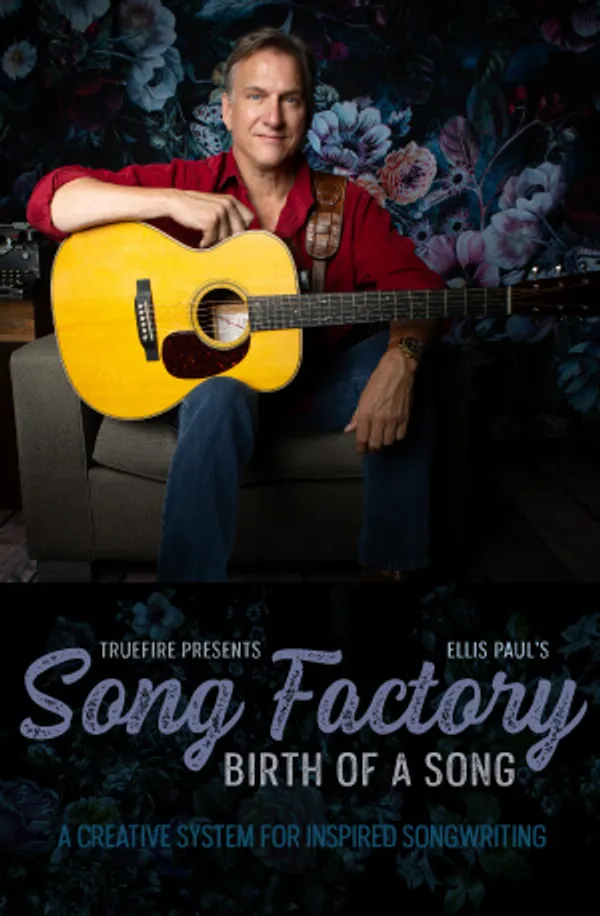
The resonance, bass response, and chord coloring possible with open tunings not only produce a lusher, more dynamic sound from your guitar, they also greatly expand your palette of creative options when composing original songs, arranging cover tunes, or just jamming with friends.
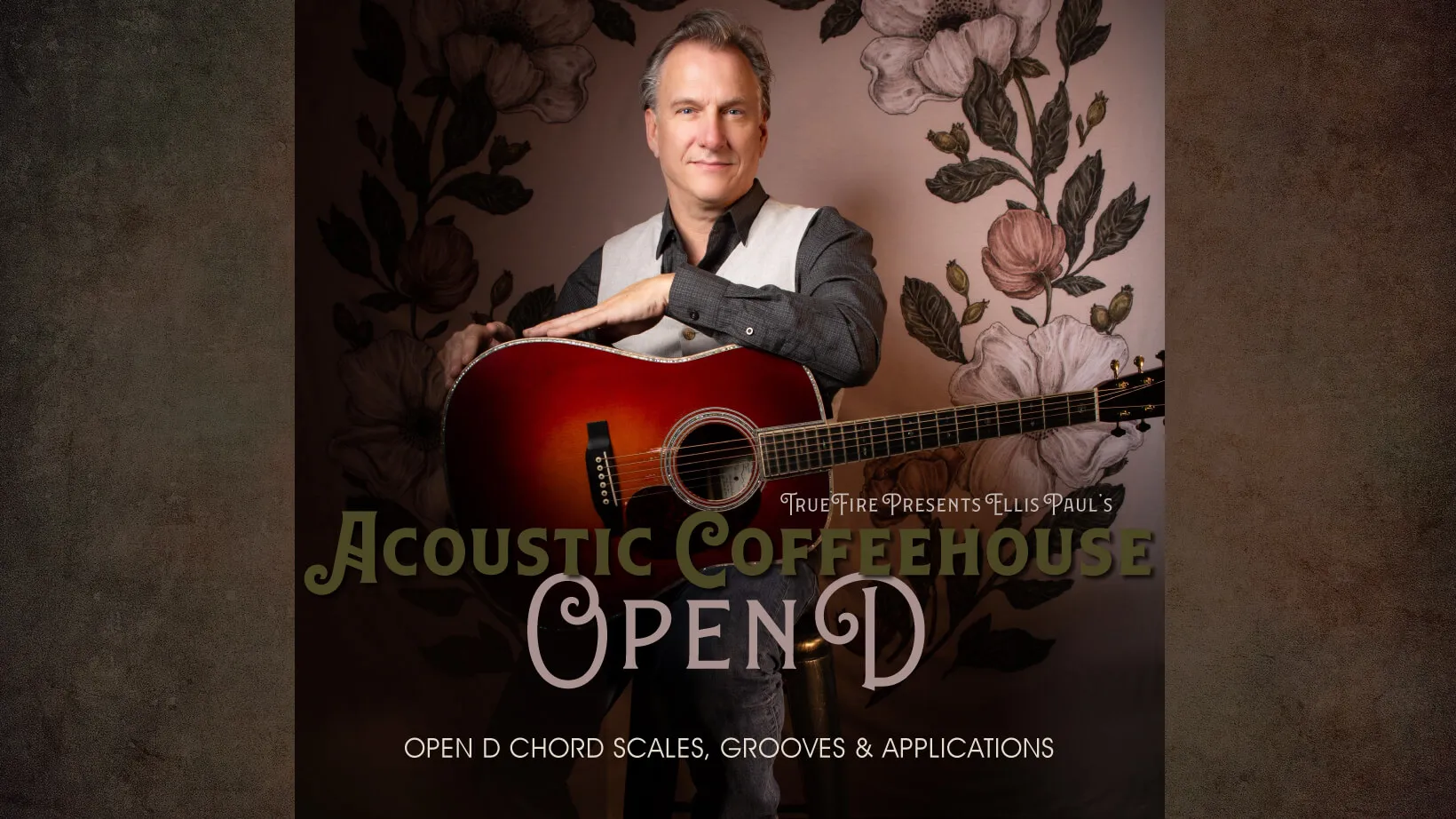
In this Open D edition of Acoustic Coffeehouse, Ellis Paul teaches you 64 open D chord shapes and voicings, which form 8 versatile chord scales in the tuning. You’ll be able to mix any combinations of them in your grooves and arrangements, you can strum or fingerpick them, and Ellis shows you how to easily embellish them to pull out harmony notes, guitar hooks, fills, and melody lines.
”Joni Mitchell, Steven Stills, Curtis Mayfield, Keith Richards, Mississippi John Hurt, Jimmy Page, Duane Allman, and Robert Johnson are just a few of the artists that have incorporated open tunings into their music. There are so many benefits to using an open tuning and I’ll demonstrate all of them in this Open D edition of Acoustic Coffeehouse.
We’ll explore the resonance of the droning strings in an open tuning; how open tunings simplify the neck of the guitar for chord shapes; how you can visualize chord formations more like a piano; how the harmony strings and octave strings are easy to access and ride against the resonance of the ringing strings; how bass lines are more resonant because the low E is tuned down to D, and how percussiveness is increased by the floppier tension on the down-tuned strings.”
In the first section of the course, Ellis guides you through a thorough primer on Open D tunings including What is an Open Tuning?, Benefits of Open Tunings, Open D Tuning, Major & Minor Chord Barre, Scales on All Six Strings, and Octave Shapes.
Chord scales and chord voicings are focused on in the second section of the course. For each of the Chord Scales, Ellis will teach you all of the scale’s chord shapes and then show you a variety of creative applications you can access within the shapes and scales.
In the third and final section, you’ll apply your Open D chord vocabulary and all of the creative applications by learning three full-length songs; Innocence and The Afterlife, Maria's Beautiful Mess, and The Storyteller's Suitcase. Ellis will first perform the song and then break down all of the parts (intro, verse, bridge, chorus, etc.) move by move.
Ellis will explain and demonstrate all of the key concepts and approaches along the way. You’ll get standard notation and tabs for each of the performances, both of which are synced to the video. In addition, you’ll be able to loop or slow down any of the videos so that you can work with the lessons at your own pace.
Grab your guitar, tune to open D, and let’s hit the coffeehouse with Ellis Paul!
What you'll learn
Play a complete song arrangement that combines fingerpicking and groove-based rhythm
Combine fingerpicking with percussive elements for groove
Apply chord scale patterns in musical context
Play the intro groove to 'Maria's Beautiful Mess' with proper technique
Create percussive groove using hand slaps and thumb snaps
Hi I'm Ellis Paul. Welcome to the Open D edition of Acoustic Coffeehouse!
The resonance, bass response, and chord coloring possible with open tunings not only produce a lusher, more dynamic sound from your guitar, they also greatly expand your palette of creative options when composing original songs, arranging cover tunes, or just jamming with friends.
Joni Mitchell, Steven Stills, Curtis Mayfield, Keith Richards, Mississippi John Hurt, Jimmy Page, Duane Allman, and Robert Johnson are just a few of the artists that have incorporated open tunings into their music.
In this course, I'll show you 8 easy-to-play chord scales and 64 chord shapes and voicings in Open D. You can mix any of them in your grooves and arrangements, you can strum or fingerpick them, and I'll show you how to easily embellish them to pull out harmony notes, guitar hooks, fills, and melody lines.
I'll also play and then break down 3 full song performance studies so you can see how the chord scales, forms, voicings, and embellishments can be used to craft grooves, songs, and arrangements.
Everything is tabbed and notated. You'll also get chord grid charts for all of the chord scales and voicings. You can loop and slow down any of the videos so that you can work with the lessons at your own pace.
Grab your guitar and let's tune to Open D!
In the next few chapters, I'll define open D, and its array of unique personalities, then show you how to navigate the length of the neck with easy to understand chords shapes.
An open tuning takes a standard tuned guitar and shifts its tuning to a chord. Open D is DADF#AD, with three Ds and two As, which makes it very resonant at those frequencies. It's a wall of Ds and As with an F# thrown in.
In the video, I speak briefly about one of the many artists who have used open D, Richie Havens, who taught me some of the nuances of the tunings almost twenty years ago in Philadelphia at a place called The Tin Angel. Here's footage of how Richie uses the tuning to rearrange the Beatles' "Here Comes the Sun".
There are many benefits to using an open tuning. Here are some of them:
Resonance: I play a simple three chord pattern in standard versus one in open D to demonstrate the difference of the droning strings in the tuning.
Simplifying the neck of the guitar for chord shapes: I demonstrate how you can visualize chord formations more like a piano.
Harmony strings and Octave strings are easy to access and ride against the resonance of the ringing strings. Bass lines are more resonant because the low E is tuned down to D.
Percussiveness is increased by the floppier tension on the down tuned strings.
Here's a quick demonstration on how to roll down your tuning from standard to open D string by string: DADF#AD.
Here I walk you through a demonstration of to show the simplicity of major chord and minor chords in open D. Their place on the neck is easier to visualize than in a standard tuning.
I'll show you how a simple single note scale on the neck can lead to a chordal scale that will give you access to the entire length of neck of your guitar in open D. The tabs and charts below will help you become familiar with the neck.
You don't need to go to all the way to Bagdad to learn DADF#AD.
Open tuning (DADF#AD) - a secret magic method to delve into new hooks. In other words an approach to look at the 6-stringer in a new way. Ellis Paul's approach explaining what opening tuning is, the advantages as well as how to use opening tuning is very clear.
The course seems to be packaged into three parts. The first part, Ellis Paul explains what Open D tuning is and its key benefits. In the second part of the video, Ellis Paul supplies demonstrations of which scales work best and how to apply them with the Open D tuning. Finally, in the third part, he delves into performances that he wrote (w/ the tabs and the breakdowns of course).
I feel this is a very fine course for anyone who wants to explore open tuning.
I haven't experimented on electric yet, but I didn't watch the lessons to jam on a solid body.
G
Gwyhir
04/26/20
Acoustic Coffeehouse Open D
Interesting and useful, but I wish the tutor would just stay in Open D .. that's what it says 'on the tin'
N
NicolaasBond
11/01/19
Beautiful D
I think every guitar player will underline that Open D is a wonderful tuning. Everytime I noodled with this one, I ´felt´ there was a range of possibilities, but somehow I never really got a grip on it. But Now Ellis Paul showed me the scales, chords and the ways to use them, I am glad that Open D has founds its place in my musical toolkit.
D
David S.
09/04/19
Amazing content! Needs a fix on the tuning.
Ellis Paul is a master player and instructor. This thoughtful course opens up a full tool box of Open D possibilities. Truly wonderful content and well worth the time and money. My only complaint is that half the examples are Open D tuning and the other half are Open D#. It had to be just an accident in the filming that no one realized until after. However, it might drive you a bit nutty as the lesson videos bounce back and forth between Open D and Open D#. Keep a capo handy. TrueFire really should just drop the D# videos into an audio program and bring them down a half step. Otherwise, it's a 5 star lesson!
D
dougbrown
Verified buyer
07/12/19
Acoustic Coffehouse Open D.
EXCELLENT,Ellis Paul,gives you all you need to know to start playing,from scales to chords.First time through it i was playing,and enjoying,new ides flooded my mind.
Ellis Paul,is easy to listen to talks from his heart,gives you insight from his experience,i would say a real gem video,as i never cared for drop turnings now ,explained easily i actually enjoy,thanks Truefrire another great coarse