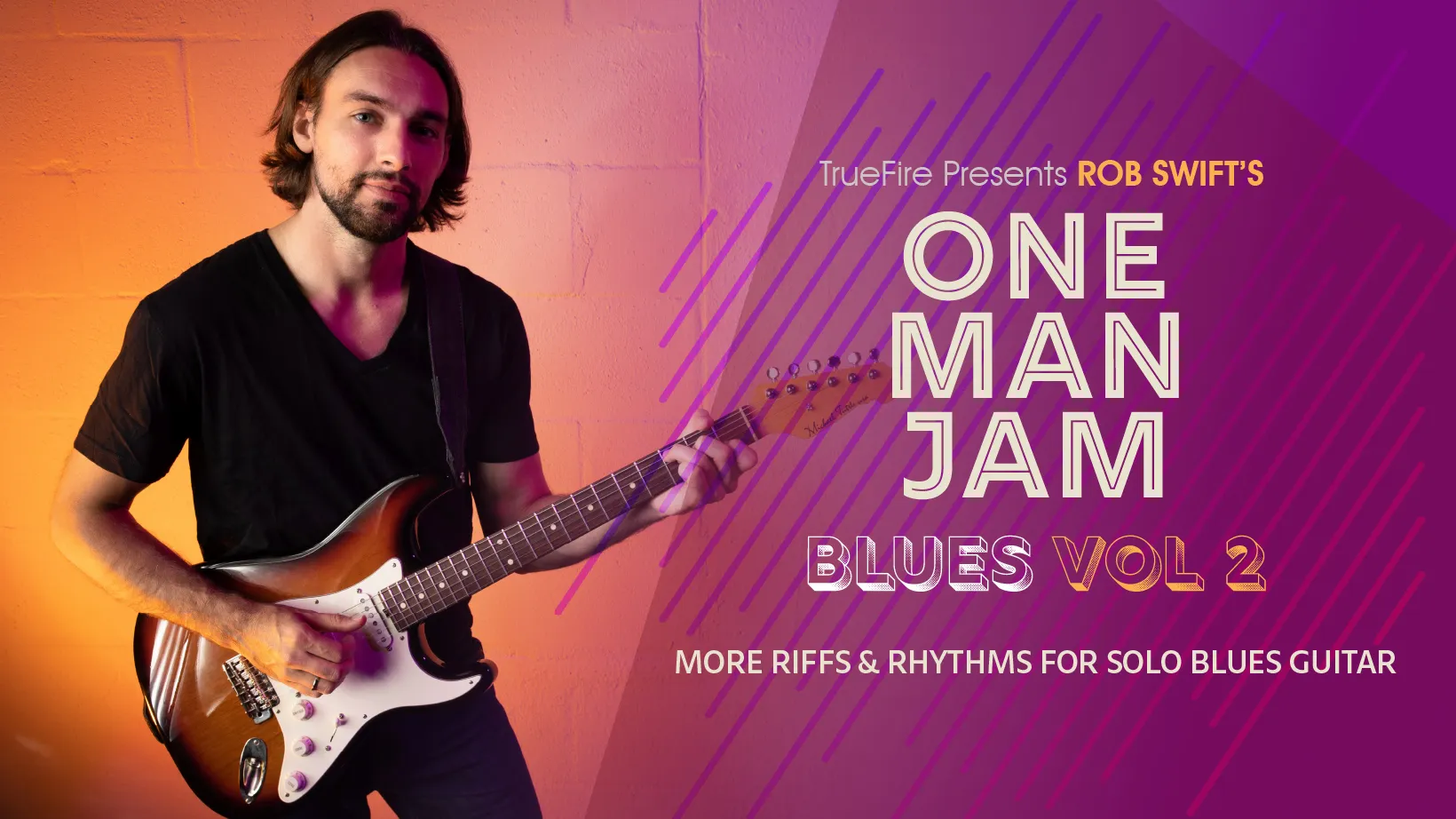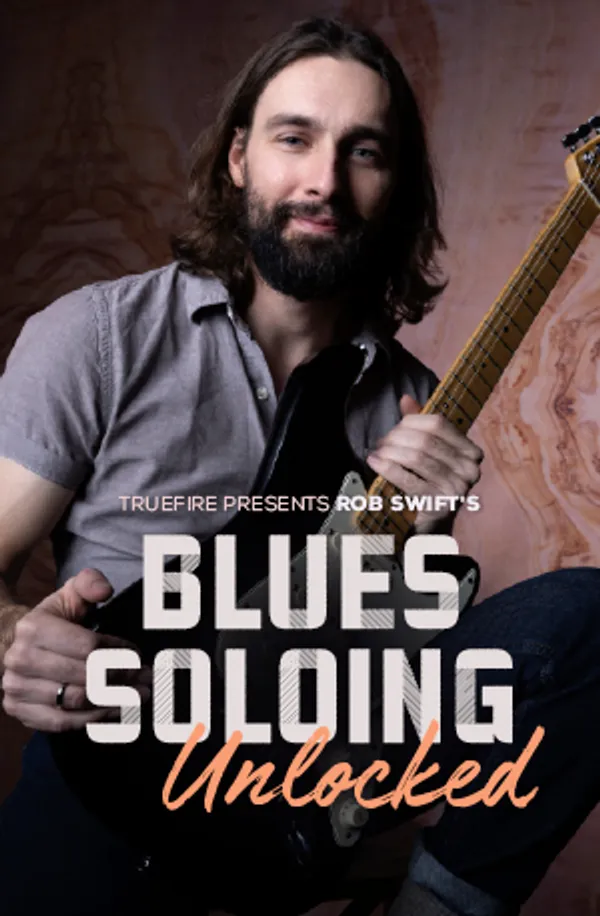
One Man Jam: Blues, Vol. 2

Stylized Riffs & Rhythms for Solo Blues Guitar

Marty FriedmanTommy EmmanuelSteve VaiEric GalesEric Johnson

Get this course and 1,000+ more with All Access

Try 14 days free. Cancel any time.

Purchase Individual Course for $19.99
One Man Jam: Blues, Vol. 2

About this course

Every guitar player loves having a repertoire of solo guitar pieces they can play for family, friends, or on the gig. Rob Swift’s first Blues edition of One Man Jam expanded your solo blues repertoire with Country Blues, Funky Blues, Jazz Blues, a classic R&B feel, and a melodic tribute to Hendrix and Mayfield.

In this second edition of One Man Jam, you’ll learn five more solo blues styles, covering Minor Blues, Soulful Gospel, Down Home Blues, Rock n’ Roll, and the classic Highway Blues.

”Whether you play for a living or love, learning more solo jams keeps things interesting for your listeners — it takes your chops to a new level. Everything you’ll learn in this course can also easily be applied in a band setting.

I’ll show you the core elements, you’ll play through a practice routine, and then I’ll break it all down part by part. Once you’re comfortable with the approach and style, you can create your own versions in your own voice!”


Gifted guitarist, expert audio engineer, and passionate educator Rob Swift has dedicated his life to music education, helping countless thousands of aspiring players reach their goals on the guitar.

One of the top guitar educators on Patreon, Rob also has 750,000+ subscribers on his very popular YouTube channel, which has racked up over 110 million views and still counting.

You’ll have TrueFire’s interactive learning tools at your fingertips to personalize your workspace and learn at your own pace.

The performances are tabbed, notated, and synced to the video with controls for looping, slow motion, fretboard animation, and many other helpful tools. Backing tracks, Guitar Pro files, printable tab and notation are also included.

Grab your guitar, and let’s dig in with Rob Swift!

What you'll learn

  • Execute shuffle rhythm with power chords using the L-shape pattern
  • Use double stops from minor pentatonic for authentic early rock feel
  • Throw in authentic Chuck Berry and Stray Cats style licks between chord changes
  • Understand how chords and melody connect in solo playing
  • Learn five complete solo blues arrangements
Release date: 12/22/2023 • 1h 04m runtime
Start Course
Sample lessons
Minor Thing
Minor Thing
Core Elements
Minor Thing
Minor Thing
Performance
Minor Thing
Minor Thing
Breakdown

What's included

18 lessons • 10 charts

One Man Jam: Blues, Vol. 2
In this second edition of One Man Jam, you’ll learn 5 more solo blues styles covering Country Blues, Funky Blues, Jazz Blues, a classic R&B feel, and a melodic tribute to Hendrix and Mayfield.

Whether you play for a living or play for love, learning more solo jams not only keeps things interesting for your listeners — it takes your chops to a whole new level. Everything you’ll learn in this course can also easily be applied in a band setting.

I’ll show you the core elements, you’ll play thru a practice routine, and then I’ll break it all down part by part. Once you’re comfortable in the style, create your own versions, in your own voice!

Ready to get started? Dig in!
The 5 Tenets of Mastery
Before we start learning new techniques, I want to share my philosophy on optimizing your practice. We'll focus on five key tenets of skill acquisition. The first is perfect repetitions. In my teaching experience, I've found that sloppy practice is a major progress killer, leading to adverse muscle memory. To optimize progress, train yourself to execute slow, meticulous repetitions. Practicing with a metronome or a loop, and gradually increasing BPM as you gain proficiency, is an excellent method.

The second tenet is embracing the fundamentals. While they may not seem as exciting as learning advanced riffs or licks, dedicating time to basics like scales, music theory, and the names of the notes on the fretboard will strengthen your foundation and facilitate skill acquisition. It also allows you to internalize and creatively use techniques you observe.

The third tenet, intervallic learning, involves revisiting new skills at expanding intervals. This approach tricks your brain into viewing these concepts as essential. We will continuously revisit theoretical concepts, scales, chord changes, and melodic ideas in this manner throughout the course.

The fourth tenet advises against over-diversifying. Beginners and intermediates often jump between lessons or practice a wide range of techniques simultaneously. Focus on a single goal until you achieve it, reflecting Bruce Lee's philosophy of mastering one technique thoroughly.

Lastly, the fifth tenet states that composition is key. For me, composition has been the main driver of progress. Writing original songs or practice routines helps in applied learning. Use the techniques covered in this course as raw material for your creations. Recording and critiquing your work is an excellent way to advance as an artist and technician.

So, let's begin with the first routine!
Highway Blues
In this lesson, we'll focus on a Key to the Highway inspired routine, played over an 8-bar 1-5-4 progression in the key of A. The progression includes an A dominant 7 (or A major), the V chord E7 (or E major), and the IV chord D major. We'll also incorporate a D# diminished passing chord, previously covered in our lessons.

This 1-5-4 progression with A major, E major, D major, and the D# diminished chord, serves as a foundation. The diminished chord effectively transitions us back to the I chord, making it an excellent passing chord. We'll continue to use the minor blues scale in the key of A, as explored throughout this course.

Moreover, we'll transpose our scales to fit over different chords. For instance, over the E chord, we'll use the major pentatonic scale. Remember, you're playing the major pentatonic scale correctly if it resembles the tune "My Girl". We'll also visualize our chords in various CAGED positions. For example, the A major or A7 can be played in its D shape, and the same applies to the E chord. This is particularly useful for lead elements, as we'll often be outlining and arpeggiating the D shape.

Now, let's practice the chord progression without lead fills to grasp the rhythm. We'll play the A dominant 7, then move to the V chord, down to the IV chord, add the optional passing chord, and cycle through this progression. Understanding the chord progression and rhythm is crucial before adding fills.

Finally, we'll integrate everything into a full routine, starting with a demonstration. This will include the chord elements, the rhythm, and the introduction of lead fills to enhance the routine.
Highway Blues
In this performance and breakdown, we delve into a Key to the Highway inspired routine, set in the key of A over an 8-bar 1-5-4 progression. You'll learn to play and understand the significance of an A dominant 7, E7, and D major chords, along with a D# diminished passing chord. We will also revisit the minor blues scale in A and explore transposing scales to match different chords, using the major pentatonic scale over the E chord as an example. The lesson includes a focus on CAGED positions for chord shapes, particularly the D shape for A major/A7 and E chords, essential for lead elements. By the end of this lesson, you'll have a comprehensive understanding of this progression and be ready to incorporate both rhythm and lead elements into a full routine.
Highway Blues
In this performance and breakdown, we delve into a Key to the Highway inspired routine, set in the key of A over an 8-bar 1-5-4 progression. You'll learn to play and understand the significance of an A dominant 7, E7, and D major chords, along with a D# diminished passing chord. We will also revisit the minor blues scale in A and explore transposing scales to match different chords, using the major pentatonic scale over the E chord as an example. The lesson includes a focus on CAGED positions for chord shapes, particularly the D shape for A major/A7 and E chords, essential for lead elements. By the end of this lesson, you'll have a comprehensive understanding of this progression and be ready to incorporate both rhythm and lead elements into a full routine.
Minor Thing
In this next routine, we'll delve into minor techniques in the key of A minor, playing a 1-4-5 progression with A minor 7, D minor 7, and E dominant 7 chords. It's common in minor blues to use a dominant 7 chord for the 5 chord. We'll explore different voicings of these chords across the fretboard.

Next, focus on the minor blues scale. We've already memorized it, but now we need to understand how to use it in the keys of A minor and D minor. Additionally, we'll explore two other techniques. Over the E7 chord, we can create a diminished sound using a diminished arpeggio or pattern based on the major third of the 5 chord. This technique adds an interesting tension to your performance.

We'll also learn a captivating arpeggio for the D minor 4 chord, another powerful technique. Once you're familiar with the chords and lead elements, we'll work on the basic rhythm, playing over A minor or A minor 7, D minor 7, E7, and A minor 7 in various positions. To conclude the routine, we'll use an A minor add9 chord, known for its melancholic sound and stretch requirement.

Having outlined the components of this routine, we'll start with a demonstration. I'll play through the entire sequence and then break it down bar by bar.
Minor Thing
In this lesson, we will explore minor blues techniques in the key of A minor, focusing on a 1-4-5 progression using A minor 7, D minor 7, and E dominant 7 chords. You'll learn to find different chord voicings across the fretboard, use the minor blues scale effectively in A and D minor, and apply unique techniques like diminished arpeggios over the E7 chord for added tension. We'll also cover a special arpeggio for the D minor chord and conclude with the emotionally rich A minor add9 chord. The lesson culminates in a comprehensive demonstration, followed by a detailed, bar-by-bar breakdown of the routine.

+ 11 more lessons

Start Course

Reviews

6 results

CliveR

Verified buyer

03/26/25

Really useful course

This course has extended my solo playing. It is an excellent investment.

merrilles

Verified buyer

01/27/25

This course is one of the best.

Rob is one of my favorite instructors. His teaching style is excellent. His explanations and techniques are of the best. I highly recommend this course and any course he is giving.

Kevin O.

01/25/25

Great stuff

This course and the first volume are fantastic. They are perfect to build a list of things to play when you need a few things that sound cool and are short and sweet.

dwa79

Verified buyer

06/13/24

Volumn 2

Great follow up from Volumn 1. I recommend both!

Florian

12/28/23

Great gratifying learning

Just what I needed. Thanks again for a great collection of manageable pieces for my level. Lots to take away and prep me for these embarrassing "play something" or guitar shop moments ;)

Stop searching. Start improving with All Access.

Try 14 days free. Cancel any time.