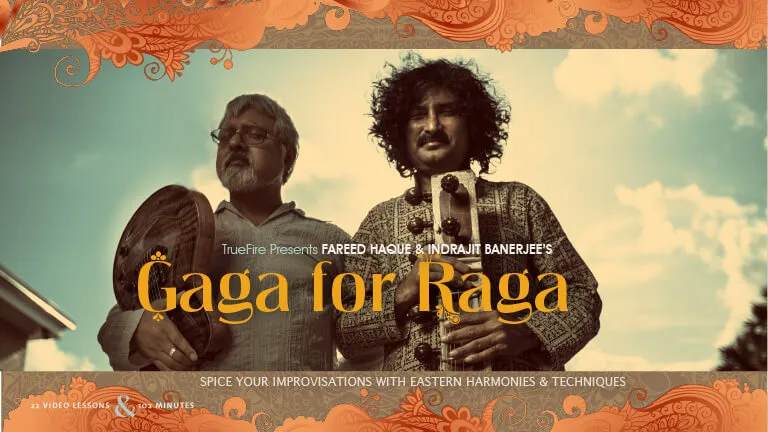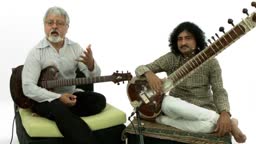
Gaga for Raga

Spice up your improv with eastern harmonies and techniques

Marty FriedmanTommy EmmanuelSteve VaiEric GalesEric Johnson

Get this course and 1,000+ more with All Access

Try 14 days free. Cancel any time.

Purchase Individual Course for $9.99
Gaga for Raga

About this course

In classical Indian music, ragas are the melodic foundations for improvisation and composition. Similar to scales in Western music, ragas consist of a specific series of notes (in some cases differing in ascent and descent) but they also call for characteristic musical motifs and embellishments.

The word raga translates to color or passion and the performer sets out to create a mood or atmosphere (rasa) that is unique to the raga in use. Traditionally, ragas are associated with specific times of day and seasons of the year, and there are hundreds in present use today. John McLaughlin, Derek Trucks, George Harrison and John Fahey are just a few of the guitarists whose music has been influenced by Indian music and ragas.

Why will you go Gaga for Raga? Fareed Hague and Indrajit Banerjee have cooked up one of the most unique learning adventures that we've ever produced here at TrueFire, and you'll be fascinated with their curriculum whatever your level or preferred style of music. You will also graduate their course with a palette of new harmonic and expressive approaches that you can spice your blues, jazz and rock solos with.
"I play the Sitar and I play the guitar, but because of some brain blockage of my own, I was never able to transfer one technique to the other. Fareed in just the first example opened up a new world for me and let me transfer some of my love of sitar to the guitar. I think most guitarists are afraid of Indian classical music because they have the mistaken impression that it is based on micro-tones and completely different scales than western music. These lessons help show in an easily understandable way, how some of the concepts of Indian classical music can be transferred to the guitar, within the context of what most guitar players are already familiar with. Besides letting me explore some ragas now on the guitar, it certainly expanded my knowledge of the guitar fretboard which will add some more individuality to my playing. Thanks Fareed and Indrajit!"
- Dickie N., TrueFire Student
Fareed and Indrajit have organized the course into five sections. Each section features one of five ragas: Hamsadvhani Raga, JOG Raga, Bairagi Bhairav Raga, Bhairavi Raga and Todi Raga.

For each of the five ragas, Fareed and Indrajit will first demonstrate the raga, give you some background on the raga and then Indrajit will perform the raga in a traditional format, on the sitar.

After the performance, Fareed will show you how translate the raga and their fingerings, notes and ornaments (embellishments and expressions) to the guitar. Following those demonstrations, Fareed and Indrajit will then improvise over a traditional track composed for that particular raga.
Understanding the background, harmonic make-up and ornaments of each raga equips you with the toolbox that you'll need to 'raga-ize' your blues, jazz and rock solos. To demonstrate how to do just that, Fareed includes three Raga-Ize Tips throughout the course demonstrating a variety of approaches for spicing your improvisations with your Raga toolbox.

"While there are hundreds of different Ragas, in this course we'll show you five essential ragas and some of the sounds that are very useful in western music applications. First, we'll demonstrate the sound of each Raga thru a simple melody that typifies that Raga, composed by Maestro Banerjee. Then we'll show you how to ornament that melody with a few typical bends, glides and shakes. Lastly, we'll play the melody with ornaments, over a groove, and jam!"

Fareed and Indrajit generously include many charts, transcriptions, tab and notation for all of the key examples, plus you'll also get all of the jam tracks to work with on your own.

Grab your guitar and get your click on to go Gaga for Raga now!

What you'll learn

  • Apply raga concepts to Western musical contexts
  • Integrate Indian musical influences into jazz, rock, and funk playing
  • Understand the fundamental difference between ragas and Western scales/modes
  • Understand the structure and character of Raga Jog
  • Understand how ragas use different notes ascending vs descending
Release date: 12/15/2014 • 1h 46m runtime
Start Course
Sample lessons
Essential Ornamentation Styles
Overview
Jog Raga
Jog Raga
Demonstration
Jog Ornaments
Jog Ornaments
Demonstration
Jog Jam
Jog Jam
Performance

What's included

22 lessons • 19 charts • 20 Jam Tracks

Gaga for Raga
Welcome to Gaga for Raga! This course is unique in that it will not only present to you some essential elements of Indian music but also translate those ideas to the guitar and apply them to 'western music' styles.

The influence of Indian music is felt every day all around us. However we still treat it as an exotic foreign influence.

It's time for us all to embrace the fullness of music and culture from around the world.

In order to guarantee the authenticity of this Indian music primer, I have teamed up with my good friend sitar virtuoso indrajit Banerjee.

In this course you will learn five essential ragas, learn five original compositions in those ragas, learn how to ornament them in the traditional manner, and learn to play those ornaments to the guitar.

Last we will play the composition with ornaments and improvisation on a typical western groove and put all of these elements into practice.

Indrajit will explain and demonstrate these ragas authentically and traditionally on the sitar. In addition he will demonstrate the ornaments that are so typical of South Asian music. Finally, I will play them on the guitar and show you my approach to going Gaga for Raga!!
What is a Raga?
It is an honor and a pleasure to be presenting this course with master musician and my good friend Indrajit Banerjee.

Over the years I've performed with many Hindustani musicians and I've learned that, as with all musicians and all artists, each individual is unique – there are many mere technicians, there are plenty of truly fine musicians and then finally there are few great artists.

Maestro Banerjee is in this last category of true artists.

Indrajit is unique in the melody, soul, beauty and blues which naturally come through his music. His technical command is phenomenal, his phrasing impeccable, and his musical ideas are truly inspiring!

Make sure to check out http://indrajitbanerjee.com/

I first fell in love with the music of India and Pakistan through the recordings my parents played around the house when I was a little boy.

I never really studied Hindustani music formally, but growing up around it and having a dad from Pakistan - visiting Islamabad, Rawalpindi and many other cities and villages to see family definitely seems to have had its effect.

It was at the encouragement of the great master Ustad Zakir Hussain, the world’s preeminent tabla virtuoso, that I faced my trepidation and tried my hand at this music.

Primarily I am a jazz and classical musician, so throughout this course I will demonstrate some of the ways that I've incorporated Hindustani and Carnatic - Indian - elements in my own music.

My examples will serve as a model, but these are only my simple ways of incorporating South Asian elements into my music. There are many, many ways that raga can be incorporated in western music and I hope this course will open the door for you to find your own path.

What is a raga? There are hundreds of books written on the subject, but I can say that the Indian music system is essentially the same as our ‘western’ musical systems. A Lotta folks talk to me about quarter tones in Indian music and while there is some use of that, the real use of quarter-tone pitches comes mostly from Arabic music not Indian music.

In South Asian music typically we are still we dealing with a seven-note scale. However instead of labeling these 7 notes “Do-Re-Mi-Fa-So-La-Ti-Do, South-Asian musicians use the syllables Sa-Re-Ga-Ma-Pa-Da-Ni-Sa.

So what makes Indian music sound "Indian"? It’s not just the notes, since they are pretty much the same as our Western system of notes, but the ornaments, the bends and the phrasing.

While there are hundreds of different ragas, in this course we will show you five essential ragas and some of the sounds that are very useful in western music applications. First we will demonstrate the sound of each raga through a simple melody that typifies that raga, composed by Maestro Banerjee. Then we will show you how to ornament that melody with a few typical bends, glides and shakes. Last we will play the melody with ornaments, over a groove, and JAM!!

I hope you have as much fun learning about these ragas as we did!!!
Essential Ornamentation Styles
Fareed:

There are a myriad ways of bending notes on the traditional guitar in order to capture that Indian music sound.

Traditionally the South Indian ‘Veena’ is plucked with the fingers. Check out

Rajhesh Vaidhya : http://rajheshvaidhya.net/profile.htm

https://www.youtube.com/watch?v=hcERM5MWpG0

One of the many traditional and authentic approaches to bending and ornamenting raga is to use a slide.

Through the 500 years of British occupation, many western instruments – violin, saxophone and the lap steel guitar have evolved Hindustani and Carnatic styles. Check out V.M. Bhatt. He uses an Alabaster egg shaped 'slide' on his own version of a slide guitar he calls the Mohan Veena.

http://www.vishwamohanbhatt.com/veena.htm

https://www.youtube.com/watch?v=PqAlV0DH8p4

and for more reading: http://www.premierguitar.com/articles/The_Secret_World_of_Hindustani_Slide

More recently players like Prasanna have done wonderful things playing Carnatic music on a traditional Gibson Les Paul. Prasanna is a fantastic musician who uses very low frets and even finger-ease lubrication to facilitate Carnatic ornamentation with very little bending.

http://www.guitarprasanna.com/

It's also worthwhile to check out Derek Trucks a blues guitarist who does some beautiful Indian phrasing as well as the incredible Steve Kimock. http://www.tedeschitrucksband.com/ http://www.kimock.com/

Finally and certainly most important is the great John McLaughlin. http://www.johnmclaughlin.com/

Check out the Mahavishnu Orchestra and especially Shakti.

In addition to these approaches there are certainly more I'm sure that I haven't thought of - A fretless guitar, a pitch bend pedal, a whammy bar, all can be used to create some of the ornaments that are typical in Indian music. Feel free to experiment!

Indrajit:

An ornamentation is an embellishment that is very characteristic of Indian music. Ornamentations can be divided into the categories of meends (glides), murki (three or more notes played in quick succession), gamak (heavy trill) and two types of hammering techniques, krintan and zamzama. The ways in which these ornamentations are expressed within the ragas will be explored in this course. 
Hamsadvhani Raga
Fareed:

I first heard this raga at a performance with the great Bansuri player Hariprasad Chaurasia.

The Bansuri is the Indian bamboo flute and it is a magical, mystical sound especially in the hands of a master like Hariprasad!

One tip I can give you from personal experience: As jazz musicians or rock musicians we tend to always add more spice to our scales. The essential idea of the raga is the mood it creates by staying absolutely in the raga. Any additional notes - even notes in the same key - can ruin the hypnotic character. Don't play any extra notes not the chromatic or diatonic until you really, really, really understand the sound and the spirit of each raga!!

Indrajit:

Hamsadvhani is a raga which is popular in both the Carnatic (South Indian) and Hindustani (North Indian) tradiitons, It is a pentatonic raga, using only natural notes. Hamsadvhani in an evening raga, that conveys the mood of happiness and well being. Some feel that it invokes a picture of ducks swimming across a pond. 
Hamsadvhani Ornaments
Fareed:

The technique of playing Indian ornaments on the guitar will take a little bit of practice and discipline. But most important - it takes loose hands! Try to keep your wrist straight, your fingers curved and all of the joints relaxed so that there's no jerkiness to your movements. Try to feel the weight of your hands and generally speaking move from the wrist. When bending into a note, always remember to mute the string with your right hand before you bend. Practice bending with all four of your fingers for different kinds of sounds.

Indrajit:

Here we present both meends and murkis that can be played in Hamsadvhani and translate well to guitar.  
Hamsadvhani Jam
Fareed:

Each of the jam tracks that we have created have a melody that contains the essential elements of the raag.

Make sure you spend some time really memorizing the melody and playing it in upper as well as lower octaves.

Try out different fingerings and different ways of playing the ornaments.

Once you really know that melody try making up variations - the better you know the melody the better you will improvise!

Indrajit:

In this section, we jam to a composition in raga Hamsadvhani, using the ornamentations learnt in the previous section. Learn the composition and jam along with us. 
Jog Raga
Fareed:

Raga Jog is one of the most useful Indian sounds in western music.

This raga gives you a scale with the major third, fourth, fifth, flatted seventh as well as the minor third when descending. It has a very bluesy sound and is very useful in funk, blues and rock contexts.

Indrajit:

Jog is an evening and night time melody. It is a very deep raga, and also can be bluesy. In fact, raga Jog sounds the most like the blues of any raga from India. We explore the structure of Jog (ascending and descending pattern), and introduce a composition with improvisation. 

+ 15 more lessons

Start Course

Reviews

8 results

ersaji639

Verified buyer

06/22/26

Amazing
maverickblazer

Verified buyer

04/04/26

Exceptional would be an understatement

Excellent. I loved how both the instructors slowly explain the 5 Ragas. Although I watched most of the course, I have been working on only one raga and there is an infinitude of possibilities from just one that I have explored so far. Banerjee’s energy is so meditative that it made me listen to each note and microtones going very slowly. This was. A big aha for me. And Fareed is an excellent translator from sitar language to guitar language. His bosa nova pieces on jazz guitar method are equally amazing. With just five Ragas and their ornamentations, I can keep exploring these ragas for a long time. The key is to have a high treble tone to simulate sitar’s brightness. For a few days I was so excited that I began to explore sitar. Eventually deferred the idea as my jazz knowledge gap is huge at this moment. I hope Fareed and Indrajit will collaborate more and build another deeper course on ragas. It would have been helpful if they added more theory and paradigmatic knowledge of the raga system. Finally, Fareed helps take this knowledge to blues and jazz. Overall, I would highly recommend this course.

ragamanga

Verified buyer

03/02/21

Be the Ravi Shankar of guitar!

I love this lesson. Its structure is perfect and easy to follow and the information and the tips given are beyond helpful. All in all, I'd say that these lessons are value-for-money, so they're recommended to anyone who wants to expand their knowledge on the guitar, experimenting with different approaches and various music genres.

yirdaki

11/18/20

Great introduction to Raga

This was a great find for me. I've played with sitar and tabla players of various levels, and I love Indian music. This course has given me many insights into Raga's structure overall and some strategies to take those structures and ornamentations to my guitar fretboard.

LinguaFranka

Verified buyer

11/14/19

Nice and Authentic

Good course; how one applies this information is very much up to the end user but the addition of an actual sitar player makes it all the more authentic.

Stop searching. Start improving with All Access.

Try 14 days free. Cancel any time.