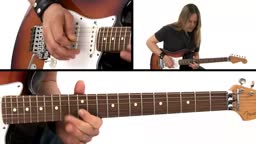
Play Rock Guitar 10: Advanced Soloing Principles

Electrify Your Rock Guitar Solos with this Rock Learning Path Core Course

Marty FriedmanTommy EmmanuelSteve VaiEric GalesEric Johnson

Get this course and 1,000+ more with All Access

Try 14 days free. Cancel any time.

Purchase Individual Course for $5.00
Play Rock Guitar 10: Advanced Soloing Principles

About this course

Welcome to Play Rock Guitar 10: Advanced Soloing Principles for late intermediate to advanced students of Rock guitar.

This Rock Learning Path core course is presented by 7 top TrueFire educators: Dweezil Zappa, Jon Finn, Andy Timmons, Carl Verheyen, Robbie Calvo, Angus Clark and Chris Buono.

The Advanced Soloing Principles curriculum is comprised of select Rock guitar lessons from the educators’ existing TrueFire course libraries.

The ability to improvise freely, and creatively, over any given groove or changes is one of the key skills that distinguishes the advanced and pro player. The insight and performance studies in this core course will advance your technical, creative, and improvisational skills. Learn the soloing examples note-for-note and then use the ideas and technical approaches to craft your own solos and improvisations.

Play Rock Guitar 10: Advanced Soloing Principles is organized into 3 sections. In the first section, you’ll work on implementing Modal approaches into your Rock playing. In section 2 you will look at several picking techniques like Economy picking. Then in section 3 you will work through many Performance Studies as you hone your soloing style.

When you’ve completed the lessons here in Advanced Soloing Principles, you’ll find more lessons focused on soloing in Advanced Soloing Approaches, also a Play Rock Guitar 10 core course.

The educators demonstrate all of the key examples over jam tracks (where and when applicable) to simulate a real-world application, in a musical context. All of the key examples are also tabbed and notated for your practice, reference and study purposes.

You’ll also get Guitar Pro files so that you can play, loop or slow down the tab and notation as you work through the lessons. Plus, you’ll have all of the available jam tracks to work with on your own.

Take as much time as you need to work through each video guitar lesson before moving on to the next lesson. If you want to dig deeper or wider into any of the topics covered in this core course, check out the recommended supplementary courses in your learning path where you’ll find more examples, techniques and insight from top TrueFire educators.

Grab your guitar and let’s get started!

What you'll learn

  • Master advanced picking techniques
  • Improvise creatively over different grooves
  • Enhance improvisation skills
  • Develop personal soloing style
  • Improve soloing techniques
Release date: 09/14/2016 • 2h 18m runtime
Start Course
Sample lessons
Economy Picking Pentatonics
Demonstration
Study 4: Rock Groove
Solo 2 Performance
Study 4: Rock Groove
Solo 2 Breakdown
Schon's Journey
Schon's Journey
Performance

What's included

40 lessons • 23 charts • 19 Jam Tracks

Play Rock Guitar 10: Advanced Soloing Principles
Welcome to Play Rock Guitar 10: Advanced Soloing Principles for late intermediate to advanced students of Rock guitar.

This Rock Learning Path core course is presented by 7 top TrueFire educators: Dweezil Zappa, Jon Finn, Andy Timmons, Carl Verheyen, Robbie Calvo, Angus Clark and Chris Buono.

The Advanced Soloing Principles curriculum is comprised of select Rock guitar lessons from the educators' existing TrueFire course libraries.

The ability to improvise freely, and creatively, over any given groove or changes is one of the key skills that distinguishes the advanced and pro player. The insight and performance studies in this core course will advance your technical, creative, and improvisational skills. Learn the soloing examples note-for-note and then use the ideas and technical approaches to craft your own solos and improvisations.

Play Rock Guitar 10: Advanced Soloing Principles is organized into 3 sections. In the first section, you'll work on implementing Modal approaches into your Rock playing. In section 2 you will look at several picking techniques like Economy picking. Then in section 3 you will work through many Performance Studies as you hone your soloing style.

When you've completed the lessons here in Advanced Soloing Principles, you'll find more lessons focused on soloing in Advanced Soloing Approaches, also a Play Rock Guitar 10 core course.

The educators demonstrate all of the key examples over jam tracks (where and when applicable) to simulate a real-world application, in a musical context. All of the key examples are also tabbed and notated for your practice, reference and study purposes.

You'll also get Guitar Pro files so that you can play, loop or slow down the tab and notation as you work through the lessons. Plus, you'll have all of the available jam tracks to work with on your own.

Take as much time as you need to work through each video guitar lesson before moving on to the next lesson. If you want to dig deeper or wider into any of the topics covered in this core course, check out the recommended supplementary courses in your learning path where you'll find more examples, techniques and insight from top TrueFire educators.

Grab your guitar and let's get started!
Modal Approaches
In this section you will learn how to take your Rock towards a modal feel. There are several modal studies where you will look at various scales and what you might be able to do with them.

TIP! The key to having great soloing and improvisation chops is continuing to build on your basic soloing foundation. So you should be working on things like targeting notes, making sure you are playing the best possible note you can. This requires you to be knowledgeable about what the chords are doing underneath your solo. That is one of the things beginning soloists don't do enough of is pay attention to the chord progression they are playing over. You also have to keep your technique sharp - it is not good knowing all the right notes to play if you are sloppy and can't get to them in time. So while you have to work on the knowledge side of music to really advance your improv, you still have to be spending some time working with a metronome and pushing your physical limits as well.
3 Ways To Think About Modes
3 Ways To Think About Modes - Overview is a video guitar lesson presented by Jon Finn and is sourced from Modal Rock Soloing.

One of the distinctions I want to make is the difference between a mode and a modal fingering. When the music, the melodies and chords center around one strongest note, that note is said to be the tonal center. When the tonal center is the 1st degree of a major scale (think "doe, a deer, a female deer"), then the mode is said to be Ionian. More commonly, it's just called the major scale.

If you take that same group of notes and phrase them in a way where the 6th degree (or "La") of that same scale seems to be strongest, then you're playing a minor scale (or relative minor). In these two examples, you could use the same fingering. What makes the difference is which notes are emphasized in the musical phrases.

Therefore, one fingering of a major scale can produce any mode based on a major scale.

Conversely, playing the correct modal fingerings does not NECESSARILY mean you're playing in a certain mode:

A MODE is when the tonal center (strongest note) of the meldody and chord progression comes from a major scale, but does NOT center on the 1st degree.

A MODAL FINGERING is when the scale comes from a major scale, but the lowest note of the fingering is not the 1st degree.

Because a lot of modern rock chord progressions are based on modes, it's important to understand their tendencies.

Let's start with these three definitions:

1) A MODE is a major scale starting and ending on any other degree other than the first.
Ex: A Dorian in a G major scale starting from it's 2nd degree

2) A MODE is a major scale with notes altered.
Ex: A Dorian is an A major scale with lowered 3rd and 7th degrees.

3) A MODE is a pentatonic scale with notes added.
Ex. A Dorian is an A minor pentatonic with the 2nd and 6th degrees added.

All three definitions are important because each gives a unique perspective. Your home looks different from the inside than it does from outside. Further, the back looks different from the front. But your mind accepts all of those perspectives as "your home" if you catch my drift. So it is with modes. Learning modes from all three points of view gives you a far deeper understanding.

This next set of modal fingerings all start from G, but are related to different keys. Further, the fingerings are simplified to one octave. This is done so that the fingerings are easy to learn. For now, focaus on how they're related, but also on how they're different in tone and character.

Soloing Study #3
Soloing Study #3 - Rhythm Track Overview is a video guitar lesson presented by Jon Finn and is sourced from Modal Rock Soloing.

The chords in Soloing Study #3.
Soloing Study #3
Soloing Study #3 - Section 1 Analysis is a video guitar lesson presented by Jon Finn and is sourced from Modal Rock Soloing.

Jon explains in detail how to play the chords in the rhythm track. Many guitarists know that when dealing with 5 chords, they're equally happy functioning as major or minor chords. Same with sus2 chords. Why? Because the 3rd of the chord isn't played. It's the 3rd of the chord that determines whether it's major or minor. But here's an interesting phenomenon: When a 5th interval is played on guitar with distortion, there's a beat frequency harmonic that creates the illusion of a major 3rd. It's soft enough that it doesn't interfere with minor chord sounds. But left to its own devices, the sound slightly favors a major chord sound. In the first section, the chords are D5, Csus2, and G5. The overall effect, because of the harmonics, creates a Mixolydian sound.
Soloing Study #3
Soloing Study #3 - Section 2 Analysis is a video guitar lesson presented by Jon Finn and is sourced from Modal Rock Soloing.

Here in section 2, the chords all come from the key of D, yet the tonal center (strongest note) is A. Since A is the 5th degree of the key of D, then we consider it to be A Mixolydian.
Soloing Study #3
Soloing Study #3 - Full Track Soloing Example is a video guitar lesson presented by Jon Finn and is sourced from Modal Rock Soloing.

Improvising over Soloing Study #3. Almost a southern rock vibe. Although, to Jon, south means South Boston! By now, you're probably figuring out that Jon doesn't always adhere blindly to the rules while improvising. There are plenty of instances in this example where out of key notes are played. Some are chromatic notes that set up the next note, while others are just mistakes. Jon felt it was important to really improvise over each example rather than plan out the solos. Cool in some ways, but can be confusing if you're looking for by the book examples. You're smart. You get it.

+ 33 more lessons

Start Course

Reviews

3 results

Sourav047

Verified buyer

03/02/25

Good course, go for it

Great!!

wholmer

12/31/20

Great licks to start out with!

Not really for the beginner. Some of these are quite a challenge. Then I just took them and made them my own and it made a world of a difference. By adding these licks my vocabulary has grown to where I can add more complex ideas to my playing. That's the next step after getting all these licks under your belt.

javierON01

Verified buyer

10/14/20

The best on the internet to learn guitar

Stop searching. Start improving with All Access.

Try 14 days free. Cancel any time.