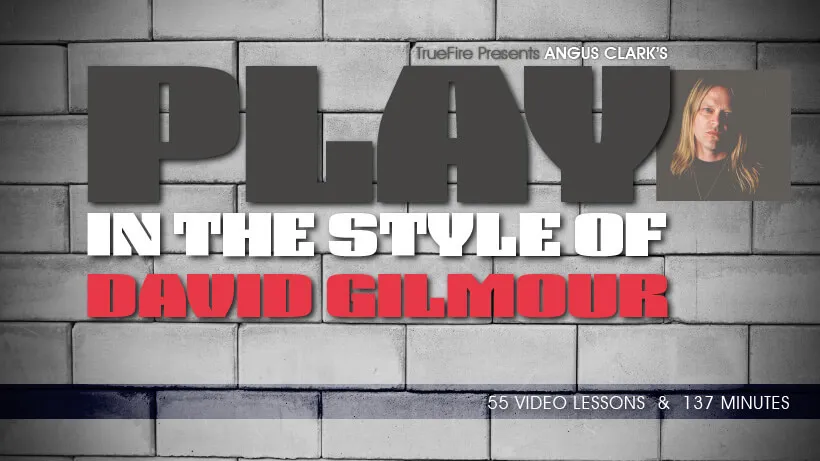
Play Like David Gilmour

Learn how to play rock guitar in the style of David Gilmour

Marty FriedmanTommy EmmanuelSteve VaiEric GalesEric Johnson

Get this course and 1,000+ more with All Access

Try 14 days free. Cancel any time.

Purchase Individual Course for $19.99
Play Like David Gilmour

About this course

Across the entire history of music, there are very few guitar players who we can point to as true innovators of a new style or technique of guitar. Not just truly gifted players, (so many of those!) but players who singlehandedly crafted an entirely new and fresh approach to the instrument, which in turn greatly influenced future generations of players. TrueFire’s Play In The Style series focuses on the unique stylings, techniques and creative approaches of these highly influential guitarists.

David Gilmour’s contribution to the art of rock guitar is undeniable. Any guitarist playing rock guitar today, including many of today’s big name contemporary artists, proudly pay homage to Gilmour’s influence in their own music and approach to the instrument.

”David Gilmour inspired me even before I picked up the electric guitar. I only had a few lessons (mostly on classical guitar), and my only exposure to rock music had been The Beatles, The Rolling Stones, and the Monkees. All great bands to be sure, but when I heard David Gilmour play with Pink Floyd, that was the first time I heard someone speak with such a unique voice on the guitar that I knew that the electric guitar was something I had to do.”

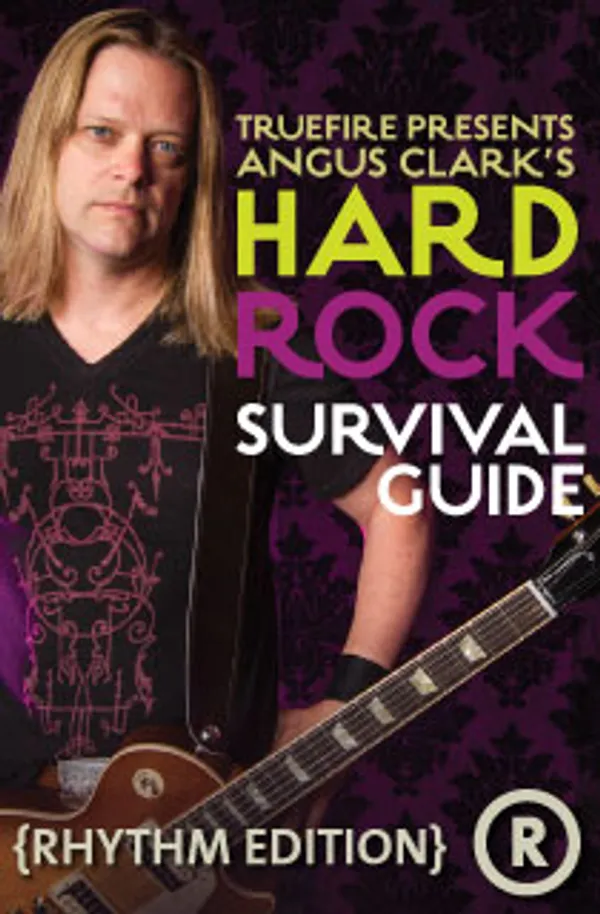
Angus Clark’s Play in the Style of David Gilmour is NOT about learning David’s signature licks or solos note-for-note. The course goes deeper than that — it’s a thorough exploration of the David Gilmour style of guitar so that you too can incorporate David’s harmonic, rhythmic and expressive approaches into your own playing. Understanding what’s under the hood allows you to to tap into his influence to power your own sound.
"This course is just brilliant. I have had a ball going through the lessons. It's a heap of fun jamming along to the Floydian style jam tracks. Whilst there are heaps of courses that teach you how to play David Gilmour note-for-note, none of them capture the essence of his style quite like this course. Well done!" - Gavin Dimmock, TrueFire Student
Angus organized the course into three sections. In the first section, you’ll examine David’s tone, gear and his go-to scales and fingerings. In the second section, you’ll expand your vocabulary with 30 lead and rhythm licks that are most characteristic of the David Gilmour style of guitar. Angus guides you through an essential palette of techniques: bends, slides, vibrato, arpeggio based lines, playing over chord changes, delay and effects, slide, pinch harmonics, vibrato arm and a variety of rhythm guitar approaches.

In the the third and final section, you’ll apply everything you learned in the first two sections across four full Performance Studies. In the first study, you’ll learn how to play a minor blues in a shuffle feel reminiscent of Money. In the next study, you’ll focus on arpeggio-based lines similar to Gilmour’s approaches on The Wall album. The third study is modeled on David’s solo on Another Brick In The Wall Part 2. And finally in the fourth study, you’ll learn to solo similar to David’s work on the ride out in Comfortably Numb.

Angus will demonstrate all of the Performance Studies for you and then break them down note-for-note. All of the key examples and solos are tabbed and notated, plus you’ll get all of the jam tracks to work with on your own. You’ll also get Guitar Pro files so that you can loop and/or slow any section as you work through the lessons.

Grab your guitar and lets climb the wall with Angus Clark!

What you'll learn

  • Play melodic solos following chord changes
  • Emulate David Gilmour's soloing style
  • Understand David Gilmour's signature guitar techniques
  • Learn expressive soloing approaches
  • Develop melodic improvisation skills
Release date: 02/05/2016 • 2h 17m runtime
Start Course
Sample lessons
Cash Stack
Cash Stack
Lick 1
Big Dogs
Big Dogs
Lick 4
Comfortable One
Comfortable One
Lick 11
Seagulls
Seagulls
Lick 17

What's included

55 lessons • 32 charts • 20 Jam Tracks

Play In The Style of David Gilmour
Hi, I'm Angus Clark and welcome to Play in the Style of David Gilmour. David Gilmour has been an inspiration to me since before I ever picked up the electric guitar. Before hearing Gilmour, I had only had a few lessons (mostly on classical guitar), and my only exposure to rock music had been The Beatles, The Rolling Stones, and the Monkees. All great bands to be sure, but when I heard David Gilmour play with Pink Floyd, that was the first time I heard someone speak with such a unique voice on the guitar that I knew it was something I had to do. I cannot escape what I was listening to when I was thirteen. It is a part of me.

While I don't advocate mimicry as the be-all and end-all refining one's craft, some experience with deconstructing and interpreting the styles of the greats is part of broadening one's self as a player. That's what we're inviting you to do with this course. I'll demonstrate all of the solos for you and then break them down note-for-note. Everything is tabbed and notated, plus you'll get the jam tracks to work with on your own. Ready to get started? Grab your guitar and let's dig in!
SECTION 1: Background
David Gilmour joined Pink Floyd after they were already pop stars in England. He had performed with Pink Floyd founder Syd Barrett previously, and knew the guys in the band through the scene in Cambridge. They were playing psychedelic pop, where the guitar was responsible for lots of atmospherics and was meant to generate a lot of space. It wasn't a traditional lead player's scene, it was more experimental.

These roots are interesting to look back on, as now Pink Floyd are considered a classic rock band, and David Gilmour is one of the most lyrical voices on the guitar that the genre will ever see. In this setting, the guitar takes a more traditional blues-based role as a lead instrument. That's what most of us think of when we think of playing like David Gilmour.

As with most British rock players, the roots are the same: They learned the formal elements of music in school or in choir, then learned pop tunes from America like the Everly Brothers and Elvis, and then they fell under the spell of American blues players, usually one of the Kings: Albert, Freddie, or BB. And while I may be simplifying and demystifying this legacy here, I do not intend to diminish it in any way. It is magical.

I can't speak to whether David was an amazing lead player taking a back seat while a “no solos” aesthetic pervaded the psychedelic pop scene in the late 60’s, who finally got to spread his wings when the Floyd eventually reinvented themselves on “Dark Side of the Moon”, or if he hadn't really developed the technique until the music they were making called for it. It doesn't matter. We have an amazing catalog to cherry pick from for this course. Enjoy.
Gear & Tone
There's a lot of material devoted to David Gilmour’s gear and tone choices. Be my guest, and visit gilmourish.com and revel in the minutia, it's fun. But don’t think for a second it’ll make you sound like David Gilmour.

He is most known for playing a Stratocaster, but a great deal of his work, particularly early work, was done on a Telecaster - which is what Syd Barrett used. Some of his most classic solos, including “Another Brick in the Wall Pt. 2” were played on a Gold Top Les Paul with p-90's. Most of the Fender guitars used traditional single coils, the only exception being the EMG's that he used during the “Momentary Lapse of Reason” phase. He has a custom Bill Lewis guitar that he used on a couple of cuts on Meddle and Dark Side, most notably the solo on “Money”.

It’s fair to say that David played what he liked when he liked, and over the span of his career he’s made choices for the same reasons most of us do: What feels right, what’s available, what suits the song, what inspires you. You have to consider to what degree a person in his position is enabled by having the means of keeping numerous guitars at the ready at all times. The fact that he will choose to play a whole concert on a stratocaster at this point tells you what the default position is, and we're keeping the focus there for that reason.

David’s amp and effect choices have gone through an even longer and more diverse journey than his guitar choices. One might say that his main live rig represents a hoarder mentality: he finds a new version of a chorus or distortion effect and never removes the old one. So at any one time he might have had three versions of a rotating speaker effect: Two real ones (both in stereo) and one fake one (like a uni-vibe). We're going to have to approach this in broad strokes.

The Amp: David mostly runs his amplifier clean. He started out using the Hiwatt 100 Watt amplifier through WEM cabs. And while he may have turned them up loud - he wasn't gaining them up. Most of his gain has always come from pedals. Over time he expanded the amplifier rig to include rotating speakers, either Leslie, Yamaha, or Doppola (a custom unit), and with that expansion came the need for a separate preamp. That preamp is an Alembic F2-B, which has been so extensively re-wired that it can be considered a custom-made amp, but the word is that it's almost indistinguishable from a Bassman preamp. Once the Alembic came in, they removed (or bypassed) the preamp circuitry from the Hiwatts altogether. The end result is essentially the same - the amplifier itself is being run clean with the gain is coming from pedals.

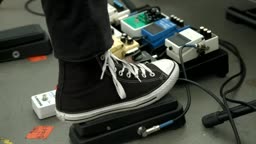
The Pedals: David uses a fairly classic effects chain - compressor, fuzz/overdrive 1, fuzz/overdrive 2, modulation, delay, amp. What is most open to interpretation is the choice in the fuzz/overdrive area. Over time he has used a variety of pedals in different combinations, you'll have to experiment with what you have available to see what gets you the closest. Some of the classics are an RK Butler Tube Driver, a Fuzz Face, a Big Muff, etc. For modulation, the two most classic ones are the Electric Mistress and the Uni-Vibe.
Scales You Should Know
Most of David's lead playing is blues-based, so the pentatonic scale that you know and love will get you through most of it. There are some interesting exceptions, and they'll get special coverage. He also uses certain intervals like 6ths to great effect, and his use of arpeggios in lead playing is one of the keys to some of his most memorable solos.
SECTION 2: Essential Licks
In this section, we'll look at some short licks that will get us in the "Gilmour Zone".
Bends, Slides & Vibrato Licks
Here are some licks just to work on your vibrato, bending, and slides.
Cash Stack
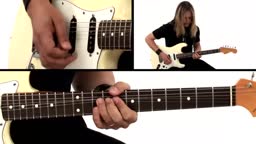
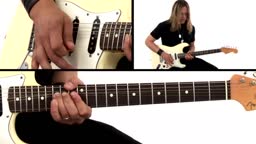
This lick is played over a groove reminiscent of "Money" by Pink Floyd and is in B minor. The objective here is to work on your bend from the A to B on on the B string, and your left hand vibrato on the final note, a D played on the G string. Try to keep the bend in tune, and keep the vibrato musical and fluid.

+ 48 more lessons

Start Course

Reviews

12 results

damackey11

Verified buyer

12/14/24

Gilmore’s phrasing is amazing !!!!

Gilmore’s phrasing stands alone from others this course is a must for those that not only follow phrasing but also feel the phrasing and go deeper into it
gabrieljansz

Verified buyer

03/30/24

A fantastic course that gets you playing in the David Gilmour style.

dahrothgar

Verified buyer

01/13/23

Tasty Licks

Great course. Well presented, easy to follow. I got a lot of tasty riffs to add to my repertoire.

Tom42

Verified buyer

03/03/22

Gilmour style breakdown

I’m a huge Gilmour fan. This was exactly what I was looking for. Not only shows you the techniques and some riffs, but explains why/how they work and why David’s style is so instantly recognisable.

ReefShark

Verified buyer

02/01/22

Great Start to Gilmour Tone

This is a nicely put together group of lessons to get you started to think, feel and play like David Gilmour.

Stop searching. Start improving with All Access.

Try 14 days free. Cancel any time.