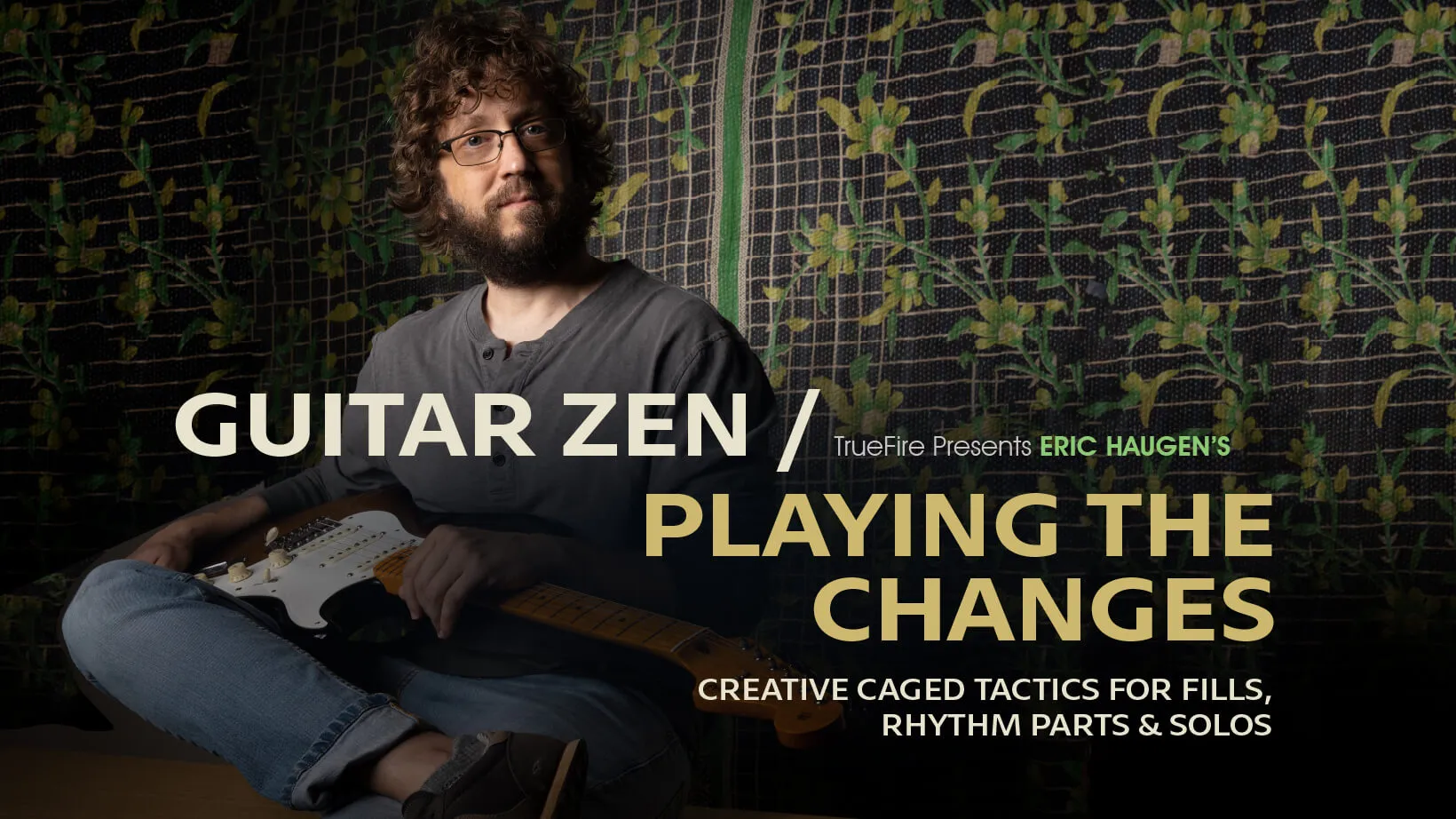

Guitar Zen: Playing the Changes

Learn How To Solo Over Any Chord Progressions

Marty FriedmanTommy EmmanuelSteve VaiEric GalesEric Johnson

Get this course and 1,000+ more with All Access

Try 14 days free. Cancel any time.

Purchase Individual Course for $24.99
Guitar Zen: Playing the Changes

About this course

Learning how to “play the changes” elevates your soloing, fills and rhythm approaches to an entirely new level. Despite what most players think, you don’t need to dig deep into theory or harmony to develop this essential skill.

Eric Haugen’s Playing the Changes edition of his Guitar Zen series reveals one of the most accessible approach for quickly learning how to “Play the Changes” over virtually any chord progression, across all popular genres.

”The key to “playing the changes” is as simple as getting a grip on the ‘right notes’ to play, over commonly encountered chord progressions.

I’ll show you how to play the changes over a 12-Bar Blues, an Andalusian cadences with minor chords, a Dorian progression, a Jazzy 8-Bar blues, a “Crossover” progression, the famous I-5-6-4 progression, and we’ll wind up with Line Cliche and Crossover Line Cliche progressions.

Play your way through the course and you’ll be a “playing the changes” and crafting tasty and melodic guitar parts over any progression you encounter.”


You’ll have all of TrueFire’s advanced learning tools at your finger tips to personalize your workspace and learn at your own pace.

You can loop, slow down, or speed up any section of a lesson. Plus, all of the tab and notation is synced to the videos for the optimal learning experience. You’ll also get tab and standard notation files to print out, Guitar Pro files, and all of the backing tracks to practice with.

Grab your guitar, and let’s dig in with Eric Haugen!

What you'll learn

  • Apply the concept of borrowing chords from parallel keys and modes
  • Learn to connect CAGED chord shapes with pentatonic scale shapes
  • Understand how to approach chord progressions with melody and rhythm
  • Understand what crossover/modal interchange means in songwriting
  • Develop mindset for playing over changes effectively
Release date: 06/05/2023 • 1h 25m runtime
Start Course
Sample lessons
Playing a "Crossover" Progression
Performance
This is the Most Famous Progression
Demonstration
Playing the I V vi IV Progression
Performance
Playing the I V vi IV Progression
Breakdown

What's included

25 lessons • 15 charts • 7 Jam Tracks

Guitar Zen: Playing the Changes
Hey, I'm Eric Haugen. Chord progressions are beautiful things. Our goal when playing changes is simply to trace that beauty with melody and rhythm.

There’s five CAGED shapes and five pentatonic shapes which means ANYWHERE you can play a chord, there's opportunity to do something cool with a solo, a fill or a rhythm guitar part.

The key to “playing the changes” is really about mindset. Take it slow, reach for things that you know you can get.

In this course we’ll explore some gorgeous changes, the music theory behind them, and how to adorn them with rhythm and leads. We’ll play through 12 and 8 Bar Blues, Modal, Major, and Minor Progressions, and most everything in between.

Ready to drop in? Let's roll!
Before We Begin...
Before we begin, let's quickly review some key terms that I'll be mentioning frequently. Firstly, we have "caged," "pentatonics," and "double stops." In a nutshell, each chord can be played in five different positions on the fretboard.By the way, I've created courses on these topics in collaboration with the great team at TrueFire. That's where you can find comprehensive lessons on them. So, let's talk about the G chord. There are various ways to play it, but ultimately, they all stem from the same fundamental G chord. Anything else you come across is just a variation of that. This concept applies to every triad, lick, and arpeggio—everything, in fact.In some way or another, they're all connected. Now, when it comes to embellishing these chords, I always take the simplest approach. This involves using the major forms. That's where the major pentatonic scale comes into play. And yes, I have a dedicated course on this subject.In fact, I have an entire class solely focused on the relationship between chords and the corresponding pentatonic scales. It's a crucial connection that I use extensively in my playing. Now, another term you'll hear me mention is "double stops." Essentially, it refers to playing two notes simultaneously—a technique that adds depth to your sound.So, these are the elements we'll be exploring throughout the examples of chord progressions. Now, let's dive right in.
Building Progressions from Scales
First, let's take a look at the G major scale.Always remember to practice scales in both ascending and descending order.I cannot stress enough how crucial this is for understanding everything. The formula for a major scale is all you need to know for now; no need to worry about intervals or extensive music theory. So, these are the notes that form a major scale. And here's the catch: the same set of notes also gives us the chords of the key. I have a handy PDF that provides the chord information, though I'm not sure where it will be located.You can hear how those chords correspond to the respective notes. It starts with G major, followed by A minor, B minor, C major, D major, E minor. Now, watch out for this one: F sharp minor seven flat five. Don't be intimidated by chords with long names; they are still chords.
Playing a 12-Bar Blues
First, let's take a look at the G major scale.Always remember to practice scales in both ascending and descending order.I cannot stress enough how crucial this is for understanding everything. The formula for a major scale is all you need to know for now; no need to worry about intervals or extensive music theory. So, these are the notes that form a major scale. And here's the catch: the same set of notes also gives us the chords of the key. I have a handy PDF that provides the chord information, though I'm not sure where it will be located.You can hear how those chords correspond to the respective notes. It starts with G major, followed by A minor, B minor, C major, D major, E minor. Now, watch out for this one: F sharp minor seven flat five. Don't be intimidated by chords with long names; they are still chords.
Playing a 12-Bar Blues
Alright, let's dive in. I won't be playing in the open position because I want to incorporate some of my favorite CAGED tricks and voicings. What I do falls somewhere between lead and rhythm guitar, which is what I love the most.
Cadences and Minor Key Chords
Now, let's shift our focus to the A minor scale.Here's the thing: when it comes to scales, we have the major and minor aspects. Everything else falls into that hazy middle ground of blues and modes, but those are the two extremes. That's why I thought it would be great to explore a G major concept earlier, and now let's delve into an A minor concept. And again, my advice to you is to simply memorize this scale.
Playing an Andalusian Cadence
Now, let's shift our focus to the A minor scale.Here's the thing: when it comes to scales, we have the major and minor aspects. Everything else falls into that hazy middle ground of blues and modes, but those are the two extremes. That's why I thought it would be great to explore a G major concept earlier, and now let's delve into an A minor concept. And again, my advice to you is to simply memorize this scale.

+ 18 more lessons

Start Course

Reviews

12 results

rapsidy

Verified buyer

06/26/26

Playing the changes

Eric has the ability to make hard concepts simple. . digestable

hoo852963

Verified buyer

05/01/26

Great laid back lessons

I like the laid back way he presents the lessons. He inspires to just relax while learning. A good patient teacher, good course.

slowdigits

Verified buyer

11/13/25

Guitar Zen / Playing the Changes

Just what I was looking for to upgrade my rhythm playing.

PSchwander

Verified buyer

09/23/25

This Course Rocks

As all of Eric’s courses, this one is very inspiring!

Paljo1

Verified buyer

09/14/25

Great course and a great teacher!

I recently purchased the 'playing the changes' course by Eric Haugen, and it has been perfect. Eric's teaching style is laid back with a clear focus on just sounding 'right' without being bamboozled with tons of theory! The video lessons and examples are easy to follow, and strike a good balance between understanding why the notes you are playing sound good, and then actually applying that knowledge. For me, as I say, Eric's approach is perfect, with plenty of encouragement and great resources to help you learn. I will definitely be back for more Guitar Zen courses for sure!

Stop searching. Start improving with All Access.

Try 14 days free. Cancel any time.