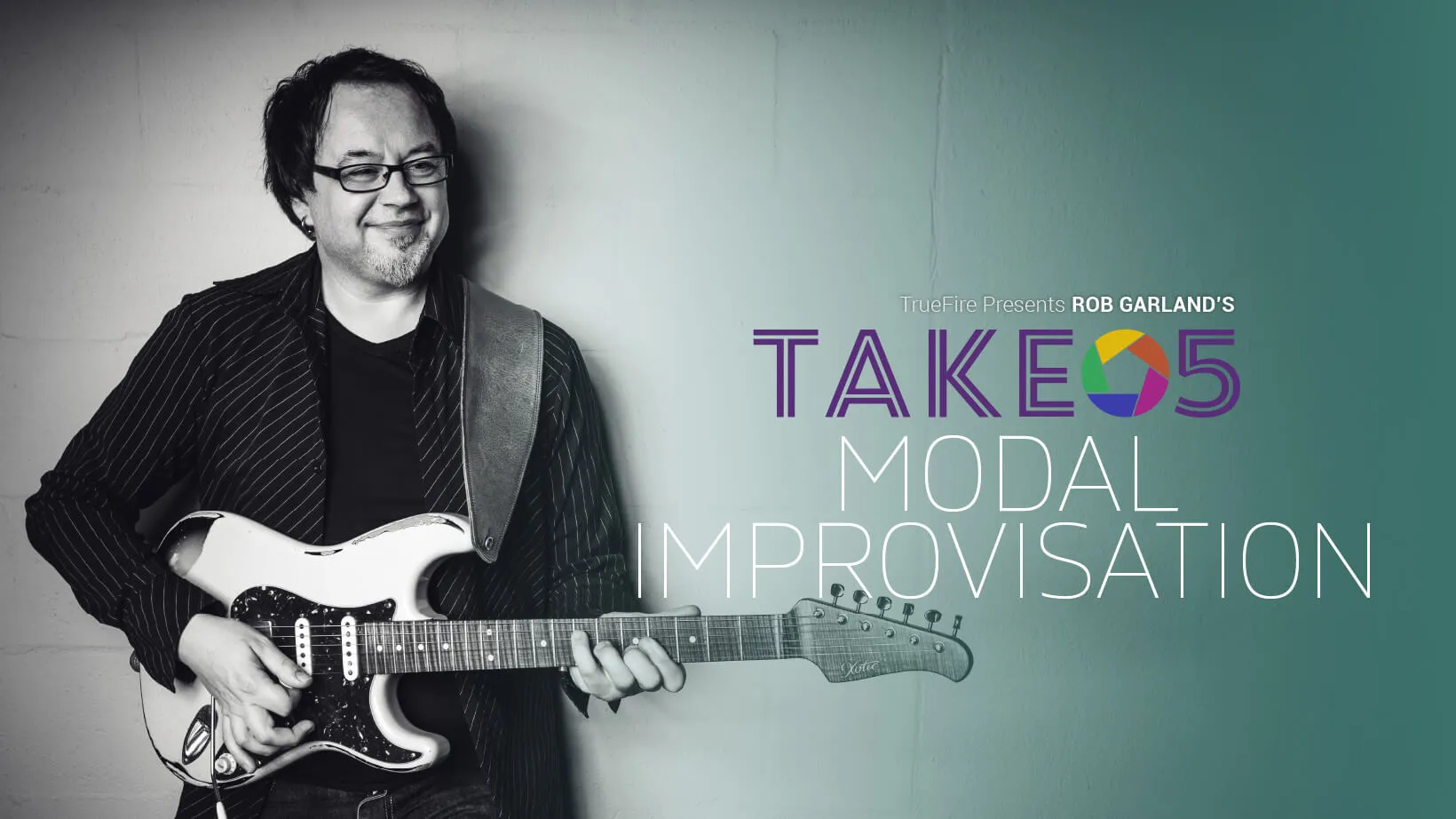
Take 5: Modal Improvisation

Unlock The Improvisational Firepower of Using Modes

Marty FriedmanTommy EmmanuelSteve VaiEric GalesEric Johnson

Get this course and 1,000+ more with All Access

Try 14 days free. Cancel any time.

Purchase Individual Course for $9.99
Take 5: Modal Improvisation

About this course

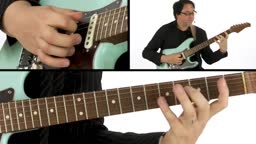
Understanding modes and how to unlock their improvisational firepower gives you more melodic options and a wider palette of colors at your fingertips. There is a lot of modal confusion out there, but in Take 5: Modal Improvisation, Rob Garland simplifies the process, helps you quickly understand the modes, and gives you 5 unique applications that will show you the way they can be used to bring your soloing to life.

Rob outlines 3 popular modes, explains in simple terms how they are formed and their signature sound, and then guides you through 5 modal soloing performance studies across a variety of musical styles, from basic to more sophisticated and challenging approaches, using one mode and then combining them in 2 examples of modal interchange.

"I’ve put together this course to help demystify the modes, and help make them part of your vocabulary right now. In this course, we’ll start with a modal improvisation primer. I’ll point out an easy way to internalize modes, we’ll talk about a few of their characteristic intervals, and I’ll also give you some tips for identifying which mode to play based on a quick analysis of the underlying chord progression. I’ll then guide you through 5 modal improv studies, ranging from a simple two-chord Lydian vamp to classic rock-style Mixolydian progressions, funky Latin Dorian sounds, and a sophisticated fusion jam via modal interchange."

Rob will explain and demonstrate all of the key concepts and approaches along the way. You’ll get standard notation and tabs for all of the performance studies. Plus, you’ll be able to use TrueFire’s learning tools to sync the tab and notation to the video lesson. You can also loop or slow down the videos so that you can work with the lessons at your own pace. All of the backing tracks are included to work with on your own as well.

Grab your guitar and let’s get modal with Rob Garland!

What you'll learn

  • Create a Mixolydian pentatonic scale by removing the 2nd and 6th from the full mode
  • Use half-steps (3-4 and 6-b7) for expressive bending and sliding
  • Apply Mixolydian mode over both modal chord progressions and dominant 7th chords
  • Understand how to identify which mode to play over specific chords
  • Learn to recognize modal characteristics by ear
Release date: 05/18/2020 • 1h 18m runtime
Start Course
Sample lessons
Level 5: Modal Improv
Overview
Level 5: Modal Improv
Performance
Level 5: Modal Improv
Breakdown

What's included

18 lessons • 5 charts • 5 Jam Tracks

Take 5: Modal Improvisation
Hi, I'm Rob Garland. Welcome to Take 5: Modal Improvisation!

There's a lot of modal confusion out there, so in this course I'll simplify the process, help you quickly understand the modes and give you 5 unique applications that will show you the way they can be used to bring your soloing to life.

I'll outline 3 popular modes, explain in simple terms how they are formed and their signature sound and then will guide you through 5 modal soloing performance studies across a variety of musical styles, from basic to more sophisticated and challenging approaches, using one mode and then combining them in 2 examples of modal interchange. All of the performance studies are tabbed and notated, and you'll have the jam tracks to work with on your own. You can loop and slow down the videos so you can work with the lessons at your own pace.

Grab your guitar, and let's get started!
Modal Improv Primer
A mode is simply a scale that is derived from a parent scale, meaning the mode is formed by beginning it on a specific note of the parent scale. The modes we'll be talking about in this course are derived from the major scale. Take the C major scale for example, CDEFGABC. If we were to begin the C major scale on it's second degree, D and play D-D we would get DEFGABCD. This is the D Dorian mode, but why is it different to C major? Because now D is our tonal center, our home and the other notes are now relative to that D, so the intervals change meaning we now have a minor 3rd: the note F from D, a 6th: the note B from D and a b7th: the note C from D. To hear what the mode sounds like we have to put it in the context of it's tonal center, meaning if D Dorian is a minor mode we have to hear it over a Dm chord to understand its characteristics.
Level 1: Modal Improv
Our first song is a two chord vamp consisting of two major chords a whole step apart, B and C#. Usually when you see two major chords a whole step apart, the assumption is they are the IV and V chord of a parent major key, so in this case that would be the key of F# as B and C# are the IV and V chords, a typical chord progression might be B-C#-F#.

However, the two chords do not resolve to F# and what's more, there is a static bass note, B, playing over both chords which is telling us that B is the tonal center or "home" to the ear. If you take an F# major scale and start on the note B, you get B Lydian and therefore the chord progression is the key of B Lydian. Here I'll use the scale of B Lydian to create a melody over the chords and then I'll explain how I used it.
Level 1: Modal Improv
Let's check out our Level 1 performance. Here we're creating a melody over the chord progression: | B | C#/B | using the B Lydian mode.
Level 1: Modal Improv
In this performance, we're using B Lydian to create a melody over the chords and also used the device of playing minor pentatonic a half-step below the major chord so A#m pentatonic yields a Lydian sound, because it contains the 7th-9th-3rd-#11-13. We're also experimenting with resolving the F note (or E# enharmonically speaking) on the second chord.
Level 2: Modal Improv
Our second song is based out of the D Dorian mode with the chords | Dm | Am | Dm |G F Em| D Dorian has the same chords as the key of C major, but the tonal center of the chord progression is not leading us back to a C, Dm is "home". Listen to the way the G F Em walks us back to the Dm chord.

The song is a i-v-IV-bIII-ii chord progression in D Dorian. By adding a 6th to a minor chord we can hear the Dorian sound, so in this example listen to a Dm6 chord. I will use the scale of D Dorian to create a melody over the chords and then I'll explain how I used it.
Level 2: Modal Improv
Here's our Level 2 performance study. We're creating a melody using the D Dorian mode over the chords | Dm | Am | Dm | G F Em |

+ 11 more lessons

Start Course

Reviews

6 results

dwa79

Verified buyer

10/07/23

Demystify Modes

Simplifies and explains the different modes with good demonstrations.
Dave58

Verified buyer

11/10/21

You can learn a lot from this!

Teaches you the way how you can create a very open character in your guitar playing with the learned modes. Nice fusion style easily learned note by note. clear tabs and backing tracks. Examples for every level. Good understanding teacher and fantastic guitarist.

Blackguitars

Verified buyer

05/25/21

MODES

Explore modes as they are such an important route to creativity.

JohnSmithers

Verified buyer

08/04/20

Finally using modes

After learning about modes:how use them? In this course the suggestions answer most questions posed ,and you will be prepared to add modes as a welcome addition to scales and pentatonics in any situation that calls for improvisation.

allblues4650

Verified buyer

06/19/20

Fantastic lessons and everything very clearly explained.

Rob Garland is one of the best educators on True Fire. All his teaching materials are clearly explained and everything can be put to practical use. The best materials on modal soloing I have come across.

Stop searching. Start improving with All Access.

Try 14 days free. Cancel any time.