Take 5: Jazz Super Arpeggios

Essential Arpeggios Concepts for Jazz Guitar

Marty FriedmanTommy EmmanuelSteve VaiEric GalesEric Johnson

Get this course and 1,000+ more with All Access

Try 14 days free. Cancel any time.

Purchase Individual Course for $24.99
Take 5: Jazz Super Arpeggios

About this course

One of the most elusive and complex concepts for jazz guitarists is figuring out how to express lush, modern jazz harmony using a simple melodic approach.   By understanding how to combine a few common arpeggio shapes as chord subs, we can imply elaborate super arpeggios for more colorful, harmonic hipness.

In this Jazz Super Arpeggio edition of Take 5, Sheryl Bailey dispels the myth that modern jazz harmony is complicated and elusive. By sharing a few approaches that utilize some very basic shapes and then simply shifting them around, Sheryl will show you how to produce a wide palette of modern jazz sounds for improvisation.

”We’ll start this course with a jazz super arpeggio primer where I’ll explain the 4 basic arpeggios and the way they can be related to different chords.  We’ll explore the shapes of the major 7, major 7-sharp-five, minor 7, and the minor-major-seven, and then we’ll experiment with how they can be layered on basic chords and crafted into contemporary jazz melodies.”

After the primer, Sheryl will guide you through 5 Super Arpeggio performance studies, from basic to more sophisticated and challenging approaches. Sheryl will first perform the study and then break it down explaining the applications in detail.

Sheryl will explain and demonstrate all of the key concepts and approaches along the way. You’ll get standard notation and tabs for all of the key examples and performances. Plus, you’ll be able to use TrueFire’s learning tool to sync the tab and notation to the video and can also loop or slow down the videos so that you can work with the lessons at your own pace. All of the backing tracks are included to work with on your own as well.

Grab your guitar and let's play some super arpeggios with Sheryl Bailey!

What you'll learn

  • Master the technique of playing major 7 arpeggios over minor 7 chords
  • Create altered dominant sounds using minor major 7 arpeggios
  • Apply multiple voicings and inversions of the same chord concept
  • Use symmetrical movement to develop solo ideas
  • Understand how to superimpose arpeggios over different chord types to create extended harmonies
Release date: 08/01/2019 • 1h 30m runtime
Start Course
Sample lessons
Level 5: Turned Up
Level 5: Turned Up
Overview
Level 5: Turned Up
Level 5: Turned Up
Performance
Level 5: Turned Up
Level 5: Turned Up
Breakdown

What's included

18 lessons • 11 charts • 5 Jam Tracks

Take 5: Jazz Super Arpeggios
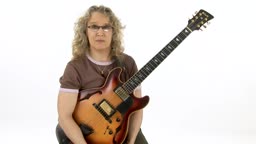
Hi, I'm Sheryl Bailey. Welcome to this Jazz Super Arpeggio edition of Take 5.

One of the most elusive and complex concepts for jazz guitarists is figuring out how to express lush, modern jazz harmony using a simple melodic approach. By understanding how to combine a few common arpeggio shapes as chord subs, we can imply elaborate super arpeggios for more colorful, harmonic hipness.

We'll start this course with a jazz super arpeggio primer where I'll explain the 4 basic arpeggios and the way they can be related to different chords. We'll explore the shapes of the major 7, major 7-sharp-five, minor 7, and the minor-major-seven, and then we'll experiment with how they can be layered on basic chords and crafted into contemporary jazz melodies.

I'll then guide you through five super arpeggio performance studies, from basic to more sophisticated and challenging approaches.

All of the performance studies are tabbed and notated and you'll have the jam tracks to work with on your own. You can loop and slow down the videos so you can work with the lessons at your own pace.

Grab your guitar and let's get started!
Moveable Shapes
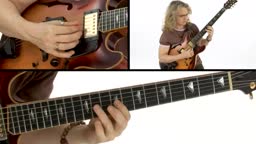
Modern and jazz harmony can seem so complicated and elusive, but I've discovered a few secrets over the years that utilizes some very common and simple basic shapes that most guitarists are familiar with, but didn't know how powerful they could be if they knew how to shift them around. You can create all the modern and lovely jazz sounds for improvising by using 4 basic arpeggios and changing the ways you relate them to different chords. The 4 arpeggios are: major7, major7#5, minor7 and min/maj7.

Please also note, that while I'm discussing these as melodic shapes, they can do wonders to hippify-ing your chordal knowledge by applying them as chord voicings. In fact, I encourage you to do so - to open your ears, at the very least to these powerful and colorful sounds.
Level 1: Killer Schmoe
Our first study is based on "Killer Joe", where I'll introduce you to the four moveable shapes:

Moveable Shape #1: Major7 as Dom7sus
Moveable Shape #2: Major7#5 as Dom79 #11 13
Moveable Shape #3: Minor 7 as Dom7sus9
Moveable Shape #4: MinMaj7 as Dom79#11
Level 1: Killer Schmoe
Our first study is based on "Killer Joe", where I'll introduce you to the four moveable shapes:

Moveable Shape #1: Major7 as Dom7sus
Moveable Shape #2: Major7#5 as Dom79 #11 13
Moveable Shape #3: Minor 7 as Dom7sus9
Moveable Shape #4: MinMaj7 as Dom79#11
Level 1: Killer Schmoe
This tune has two dominant 7 chords over a grooving shuffle. In this segment, I introduce the 4 moveable shapes: the maj7 arpeggio, maj7#5 arpeggio, min7 arpeggio and the min/maj7 arpeggio. With just these 4 basic patterns, you can create all of these different sounds: dom7sus9(13), dom7/9(#11/13), dom7sus9 and dom7/9(#11) - that's a whole lot of modern and hip harmony!
Level 2: Bossa Blue
This tune is a popular bossa nova 16-bar blues, based on the Kenny Durham tune "Blue Bossa". Working out on this will prepare you for any serious jam session. In this jam, I use moveable shapes #1 and #2: maj7 arpeggio and maj7#5 arpeggio, but in some new ways to create new chord sounds.
Level 2: Bossa Blue
This tune is a popular bossa nova 16-bar blues, based on the Kenny Durham tune "Blue Bossa". Working out on this will prepare you for any serious jam session. In this jam, I use moveable shapes #1 and #2: maj7 arpeggio and maj7#5 arpeggio, but in some new ways to create new chord sounds.

+ 11 more lessons

Start Course

Reviews

21 results

kyang2

Verified buyer

11/01/24

Great stuffs
6tringer

Verified buyer

01/07/24

Excellent primer on using easy arpeggios to create interesting Jazz lines with chord tones and extensions. Some chordal theory knowledge will help but the information is provided in a clear and concise way. The studies show applications across a variety of standards.

dwa79

Verified buyer

11/13/23

Lush Arpegios

Love the examples

Osokin

Verified buyer

10/28/21

Use Arpeggios Like Wes Did!

There are so many great instructors on TrueFire, and Sheryl Bailey is certainly one of them. Here she delivers a killer course of lessons on the application of four part arpeggios built from the chord tones of any given root chord - so with CMaj7 we effectively have an Em7 arpeggio (the third degree of CMaj7) outlining a non-root CMaj9 chord, a GMaj7 arpeggio outlining a non-root CMaj7#4 and so on. The explanation of the concept is really clear (Sheryl provides a 30 minute overview before digging into the playing examples) and if you like Wes Montgomery, your ears will quickly recognise that he made great use of this idea in the construction of his lines.

5peter5000

Verified buyer

10/21/21

Bebop & Jazz blues student inspiration!

Sheryl guides us through five super arpeggio performance studies that consist of bebop and jazz blues that are really cool and remind me a lot of those Wes Montgomery's interpretations. 100% inspiration! Well done Sheryl, you nailed it!

Stop searching. Start improving with All Access.

Try 14 days free. Cancel any time.