A common complaint among both beginning and intermediate jazz guitarists is that their solos have the tendency to sound more like scale and arpeggio exercises, and less like the compelling musical ideas in the tradition of the great jazz masters.
Sean McGowan’s Organic Jazz Improv presents a range of creative, organic, and effective ways to overcome this very common challenge by focusing less on scales and arpeggios and shifting your attention to chord tones, chromatic embellishment, rhythmic phrasing, and motivic development.
”Organic Jazz Improv is devoted to learning and understanding the fretboard in an organic way, and also to enhance your improvised solos with rhythmic, chromatic, and substitution strategies. To play over complex chord progressions found commonly in jazz styles, we need to be able to access any note and chord - anywhere on the neck. We don't ever want the continuity of our solo line or ideas to be interrupted because we get lost on the fretboard, or aren't sure which notes will work over any given chord.
Quite often, students of jazz spend a lot of time thinking about which scales or modes will work over chords typically found in a standard progression. While this is a worthwhile study - and certainly a valid approach to soloing when done in a musical way - players will spend an enormous amount of time learning and practicing scales, only to complain that their improvised solos sound like they're "running scales" up and down the neck.
Another common complaint is that guitarists don't really know what notes they're playing - they're just kind of stuck in a particular fingering pattern, ascending and descending, without making a lot of musical sense. In this course, we're going to take a deep dive into some concepts that will open up the entire fretboard, and fully address playing over chord changes without ever defaulting to scales or modes.
All approaches to improvisation are valid and worthy; it's all about diversifying and expanding your solo palette. My hope with this course is to guide your discovery of a whole bunch of new ideas with regard to rhythmic phrasing, vertical and chromatic approaches to soloing, and new substitution ideas to color your playing.“
In the first section, Sean unravels the inherent complexities of the fretboard. He’ll do this by organizing the fretboard into 5 distinct neighborhoods, each one consisting of familiar chord shapes and fingering patterns.
”The first section explores a concept I call "The Five Neighborhoods", which serves to open up the fretboard in order to learn the notes of each chord and how they affect the overall sound. We'll learn to "think vertically" and assertively establish the movement of the chord progression through single-note lines, adding chromatic embellishment along the way through the use of upper and lower neighbor tones.”
The second section examines a number of ways to create organic solo lines that incorporate rhythmic devices, define the chord progression, and add color using chromaticism.
” The second section will discuss ways to create exciting and musical solos by exploring elements of rhythmic phrasing, interpretation, and motivic development. We'll also build solo lines combining these rhythmic devices with the chord and neighbor tone concepts by working through a number of musical examples over backing tracks.”
Section three introduces the concept of chord substitution, which creates a variety of colors and textures simply by utilizing the basic chord shapes in new ways.
” Section 3 explores another improv device that incorporates chord substitution. Applying this concept will yield a treasure trove of colorful ideas to add to your solo lines, yet it is easy because it elaborates on the same concepts from the five neighborhoods in the first section. The result will be more musical and organic-sounding lines that are intentional and focused directly on outlining the progression.”
And finally, in the fourth section, you’ll put it all together by applying all of the previous section’s approaches across five soloing performance studios in a variety of keys and feels.
”We'll play through five études based on classic jazz progressions that feature tonally shifting ii-V-I movements. Each étude is performed at tempo, and then thoroughly analyzed in the breakdown.”
Sean will explain and demonstrate all of the key concepts and approaches along the way. You’ll get standard notation and tabs for all of the performance studies. Plus, you’ll be able to use TrueFire’s learning tools to sync the tab and notation to the video lesson. You can also loop or slow down the videos so that you can work with the lessons at your own pace. All of the backing tracks are included to work with on your own as well.
Grab your guitar and let’s get organic with Sean McGowan!
What you'll learn
Create blues-influenced lines over jazz changes
Superimpose arpeggios and triads over standard chord progressions
Handle fast-moving chord changes with single substitutions
Employ rhythmic variety through anticipation and delayed attacks
Hi, I'm Sean McGowan, and welcome to Organic Jazz Improv!
This course is devoted to learning and understanding the fretboard in an organic way, and also to enhance your improvised solos with rhythmic, chromatic, and substitution strategies. To play over complex chord progressions found commonly in jazz styles, we need to be able to access any note and chord - anywhere on the neck. We don't ever want the continuity of our solo line or ideas to be interrupted because we get lost on the fretboard, or aren't sure which notes will work over any given chord.
Quite often, students of jazz spend a lot of time thinking about which scales or modes will work over chords typically found in a standard progression. While this is a worthwhile study - and certainly a valid approach to soloing when done in a musical way - players will spend an enormous amount of time learning and practicing scales, only to complain that their improvised solos sound like they're "running scales" up and down the neck. Another common complaint is that guitarists don't really know what notes they're playing - they're just kind of stuck in a particular fingering pattern, ascending and descending, without making a lot of musical sense. In this course, we're going to take a deep dive into some concepts that will open up the entire fretboard, and fully address playing over chord changes without ever defaulting to scales or modes. The first section explores a concept I call "The Five Neighborhoods", which serves to open up the fretboard in order to learn the notes of each chord and how they affect the overall sound. We'll learn to "think vertically" and assertively establish the movement of the chord progression through single note lines, adding chromatic embellishment along the way through the use of upper and lower neighbor tones.
The second section will discuss ways to create exciting and musical solos by exploring elements of rhythmic phrasing, interpretation, and motivic development. We'll also build solo lines combining these rhythmic devices with the chord and neighbor tone concepts by working through a number of musical examples over backing tracks.
Section 3 explores another improv device that incorporates chord substitution. Applying this concept will yield a treasure trove of colorful ideas to add to your solo lines, yet is easy because it elaborates on the same concepts from the five neighborhoods in the first section. The result will be more musical and organic-sounding lines that are intentional and focused directly on outlining the progression.
Finally, we'll play through five études based on classic jazz progressions that feature tonally shifting ii-V-I movements. Each étude is performed at tempo, and then thoroughly analyzed in the breakdown.
Ready? Grab your guitar and let's get started!
In this first section of the course, we'll take a look at what I like to call, "The Five Neighborhoods of the Fretboard". This is simply a way of organizing the five repeating areas, or regions, of the fretboard. This method will really help develop your sensibilities of where the notes are located across the neck, enabling you to access all triad & 7th chord arpeggios, in any key.
First, we're going to learn how to navigate the fretboard. Any time you want to create an organic, musical line, you have to know where the notes are in order to access your creative ideas. This section will provide a brief overview of the CAGED approach to learning the notes through five common chord shapes, and then folding those CAGED shapes into each of the five neighborhoods across the entire fretboard.
Let's start exploring the neighborhoods of the fretboard! We can divide the neck into five distinct regions - or neighborhoods - that span about 3-4 frets and change position, before repeating the overall pattern at the 12th fret. In each neighborhood, all of the CAGED shapes co-exist, literally allowing you to play any chord in any key - anywhere on the fretboard, one neighborhood at a time. In this section, we're going to discover and learn the three notes in a basic major triad using the various CAGED shapes in each of the five neighborhoods on the fretboard.
Now let's take this same concept, and apply it to minor chords. Here we'll simply alter the major shapes by one note: the 3rd becomes a b3rd, dropping down by one fret. This way, you'll be able to easily relate the minor shapes and patterns to the major, and also know the function of each individual note, i.e. which note is the root, the third, and the fifth. This will help you profoundly when it comes time to improvise a solo over different, rapidly shifting chord progressions.
Now let's expand this basic concept to include four notes. We'll start by adding a major 7th to our major triad patterns, resulting in major 7th chord shapes in every neighborhood across the fretboard. Now you will have the tools to start improvising in a vertical way, or, by outlining the chord tones of each change, as opposed to thinking about scales.
If we add a b7 to our major triad shapes, we'll create dominant 7th chord shapes, spanning all of the neighborhoods. We'll start by learning and memorizing basic dom7th chords (1-3-5-b7) and then start altering one note at a time to create colorful dom7(b5) and dom7(#5) chord patterns. This will give you more options when playing over the V7 chord in a common ii-V progression.
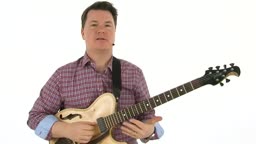
I'm curious what guitar is that? I've never seen one
L
leeofcalifornia
Verified buyer
11/04/24
I have several of Sean's courses. He is a very good teacher.
5
5peter5000
Verified buyer
05/29/21
Organic Jazz Improv
Sean shows how to release oneself from getting stuck in a particular fingering pattern along the neck and to have the guts and knowledge to add new notes to a given chord and make it work! Hopefully this will result in a start to a more personal and varied playing style when I interprete melodies I like