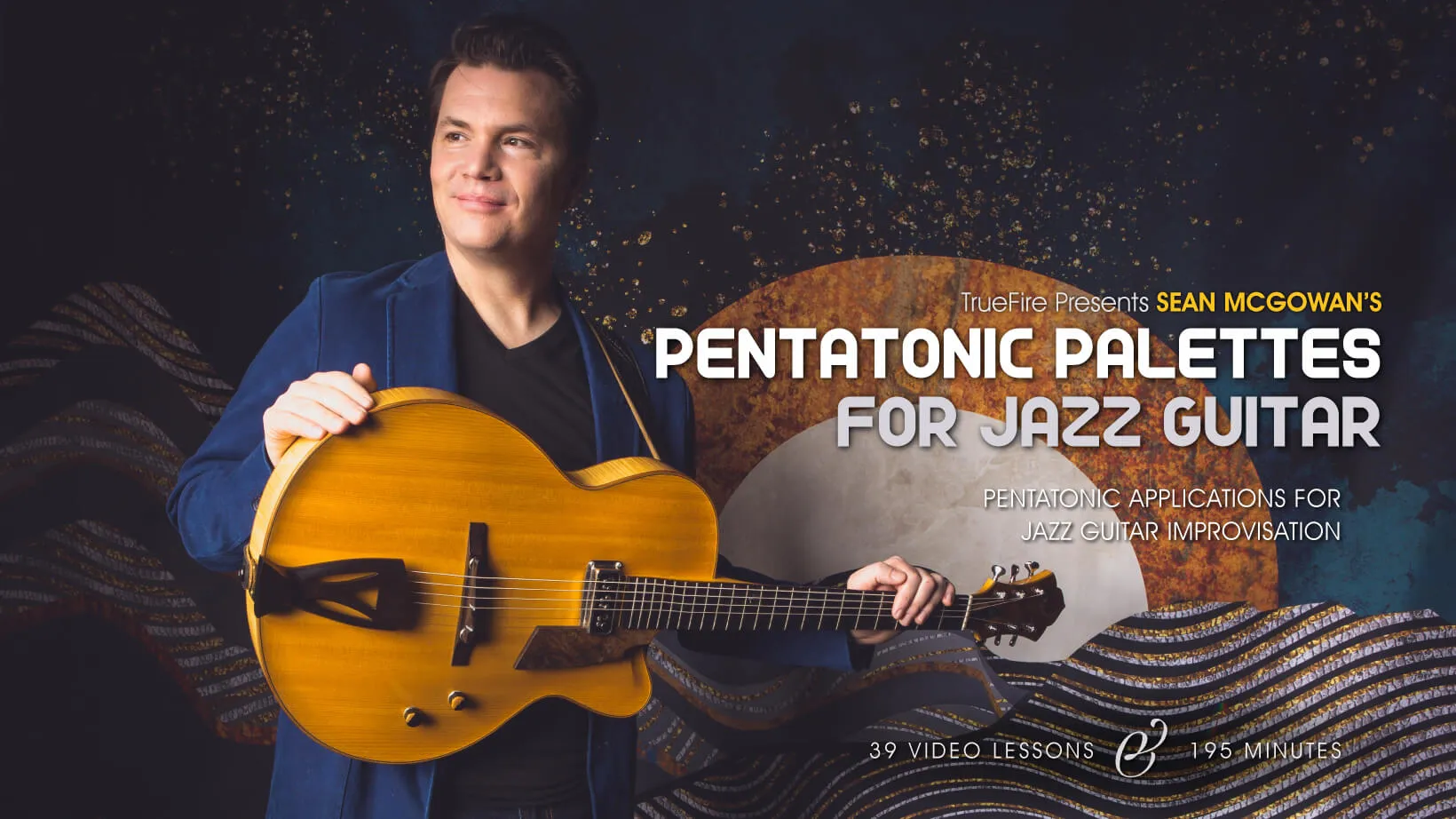

Pentatonic Palettes for Jazz Guitar

Pentatonic Applications for Jazz Guitar Improvisation

Marty FriedmanTommy EmmanuelSteve VaiEric GalesEric Johnson

Get this course and 1,000+ more with All Access

Try 14 days free. Cancel any time.

Purchase Individual Course for $14.99
Pentatonic Palettes for Jazz Guitar

About this course

The pentatonic scale is typically the first scale we learn to play on the guitar. It’s ubiquitous in rock, country, and blues soloing but unfortunately, many guitarists fail to recognize its potential for jazz, and they avoid using it altogether. However, integrating pentatonic scales into traditional bebop vocabulary is a powerful way to add vibrant colors and rich sonic textures to your jazz improvisation, AND it’s wicked easy to do. Sean McGowan’s Pentatonic Palettes for Jazz Guitar will show you how.

”The purpose of this course is twofold, first, we’ll learn the layout of the pentatonic scales on the fretboard and apply them to jazz harmony using substitution devices, chromatic sidestepping, and other concepts.  Secondly, we’ll learn and explore three additional pentatonic scales, closely related to the minor and major pentatonics we already know, that sound totally at home in a jazz context.”

Sean organized the course into 4 sections. In the first section, you’ll explore the major pentatonic and it’s five inversions (including the minor pentatonic) allowing you to seamlessly connect all the regions of the fretboard.

”You’ll learn how to map out pentatonic scales all over the fretboard, in all keys, and also how to apply them to contemporary jazz and ii-V-I progressions. You’ll learn a few minor pentatonic substitution devices that will work over static progressions and modal tunes. We'll also explore some chromatic side-stepping approaches, which will add tension and resolution over static chord progressions.”

Section 2 covers some lesser known pentatonics that will add a colorful dimension to your soloing. ”In the second section of this course, we’ll explore three lesser-known pentatonics, namely the Kumoi (Minor 6), Dominant, and Hirajoshi scales, and how to apply them in various contexts.”

In the 3rd Section, you’ll work with various ii-V-I progressions and pentatonic applications. ”In the third section of the course, you’ll play through a series of etudes and learn how these concepts apply to ii-V-I progressions, featuring both unaltered and altered dominant V7 chords.”

In the final section, you’ll put all the concepts to work over 6 etudes based on classic jazz standards, modern modal progressions, and traditional jazz blues. Sean will perform each etude and then break it down for you in detail explaining all of the core concepts and approaches.

Sean will explain and demonstrate all of the key concepts and approaches along the way.  You’ll get standard notation, tabs, and diagrams for the key examples and performance studies. Plus, Sean includes all of the rhythm tracks for you to work with on your own. In addition, you’ll be able to loop or slow down any of the performances so that you can work with the materials at your own pace.

Grab your guitar and let's get pentatonic with Sean McGowan!

What you'll learn

  • Navigate fourths patterns through different pentatonic scales
  • Use motivic development to create cohesive solos
  • Create less predictable resolutions using chromatic movement
  • Superimpose E minor pentatonic over D minor 7 for modal color
  • Employ triad substitutions for melodic variety
Release date: 03/26/2018 • 3h 15m runtime
Start Course
Sample lessons
Combining Inversions & Sidestepping
Demonstration
Minor 6 Kumoi Scale
Minor 6 Kumoi Scale
Demonstration
Exploring Hirajoshi & More Pentatonics
Demonstration
Two Five One Etude: 3
Demonstration

What's included

39 lessons • 21 charts • 13 Jam Tracks

Pentatonic Palletes for Jazz Guitar
Hi, I'm Sean McGowan and welcome to Pentatonic Palettes for Jazz Guitar! The pentatonic scale is typically the first scale we learn to play on the guitar, and integrating pentatonic scales into traditional bebop vocabulary is a powerful way to add vibrant colors and rich sonic textures to your jazz improvisation.

I've organized this course into four sections. In the first section, we'll begin exploring the major pentatonic and its inversions, including the minor pentatonic scale.

Section Two covers some lesser known pentatonics that will add a colorful dimension to your soloing. In the third section, we'll cover various ii-V-I progressions and pentatonic applications.

In the last section, we'll put all the concepts to work over six études, based on classic jazz standards, modern modal progressions, and traditional jazz blues.

I'll perform each étude and then break it down for you in detail, explaining all of the core concepts and approaches as we go. You'll have charts, standard notation, tabs, and all of the rhythm tracks to work with along the way. And, you can loop or slow down any of the performances, so you can work with these materials at your own pace. OK now, grab your guitar and let's get started!
Major & Minor Pentatonics
In the first section of this course, we'll be taking a detailed look at our beloved major pentatonic scale. It's such a wonderful and ubiquitous sound, however, many guitarists – especially when studying jazz - tend to ignore its potential in a jazz setting. And there's a little bit of a stigma, as many pentatonic lines are framed as rock licks and blues vocabulary. But, we're going to be learning how to map out pentatonic scales all over the fretboard, in all keys, and also how to apply them to contemporary jazz and ii-V-I progressions. We're also going to be looking at a few minor pentatonic substitution devices that will work over static progressions and modal tunes. We'll work through a number of exercises to reinforce these patterns and build speed and dexterity in the hands. We'll also explore some chromatic side-stepping approaches, which will add tension and resolution over static chord progressions.
The Major Pentatonic Scale
Chances are, this is the first scale you learned to play on the guitar, and there are several reasons why it's a great scale to use for soloing in all styles of music, including jazz. Because the tritone and half-steps are removed from a traditional major scale, there is no inherent dissonance in the major pentatonic. Also, the five notes of the scale lay out well on the fretboard using two notes per string patterns, also allowing for consistent alternate picking patterns.

However, guitarists typically don't spend as much time as other instrumentalists learning how to apply pentatonic scales to jazz progressions, perhaps because they are so strongly associated with classic rock and blues styles. Our first step will be to reacquaint (maybe reconcile?!) with the beautiful major pentatonic scale, and explore in detail each of its five regions and inversions.
The Five Regions
Let's take it to the next level by exploring the five regions, or inversions, of the major pentatonic scale. One reason why the pentatonic scale corresponds so nicely with the guitar is that there are five notes, and therefore inversions, of the scale. And there are five basic regions or positions of the fretboard that repeat after an octave (those familiar with the CAGED system will be familiar with this way of thinking). The first and fifth inversions (major & minor pentatonic) are very familiar; now let's learn and understand the second, third, and fourth inversions and regions.
Exercises for Learning Pentatonics
Now let's take a look at and work through some different exercises that will improve our ability to recognize and articulate each of these pentatonic regions. These exercises and patterns will also be extremely useful when it comes time to improvise.
Extended Fingerings
While the two note per string patterns are the most common and accessible, it's nice to have some different fingering choices when applying these pentatonic scales. Extended forms are great for combining regions and accessing the entire fretboard when playing long lines that move through multiple octaves.
The Minor Pentatonic Scale
Now, let's focus our attention on the minor pentatonic scale and different substitution formulas that will create a variety of colors over static chord progressions.

+ 32 more lessons

Start Course

Reviews

24 results

Shaolin61

Verified buyer

12/25/22

From palette to rainbow

Never mind if pentatonic means “5 notes” only: with this course sure you cross the rainbow of sounds


ERIVELTO

Verified buyer

11/29/22

New sounds

This course open a many possibilities and new horizons to pentatonics. Lessons are very simple to understand. The look and sound is good for me. And is the way to modify your sound!!!

Sockenfrank

Verified buyer

11/01/22

Next Step

Ich schreibe mal in meiner Muttersprache. Die Pentatonik verinnerlicht, was dann. Der Sprung zum Jazz scheint riesig, die ganzen Skalen, Umkehrungen, Alterierungen. Sean schafft es mit dieser Lesson in den amtlichen Jazz Sound einzutauchen. Und das mit relativ wenig Aufwand. Ich wusste nicht das die Pentatonik so vielfältig ist. Das Material ist sehr gut aufbereitet. Der Zusammenhang zwischen Akkorden und Skalen ist vorbildlich aufbereitet, praktische Übungen gibt es auch. Dieser Kurs ist sein Geld wert und hat mir Türen geöffnet. Schön fand ich auch die Hinweise auf Künstler im Jazz die viel mit der Pentatonik arbeiten.

cmarsman

02/24/21

Pentatonic Palletes for Jazz Guitar

If you like the CAGED system and want to use your knowledge and arsenal of pentatonic licks this if the course you want! I am quite new in the Jazz playing field, but Sean makes the Jazz concepts easy and accessible for people who are on an intermediate level like myself. Top notch material and highly recommended!

clemgael

Verified buyer

01/17/21

Super!

Stop searching. Start improving with All Access.

Try 14 days free. Cancel any time.