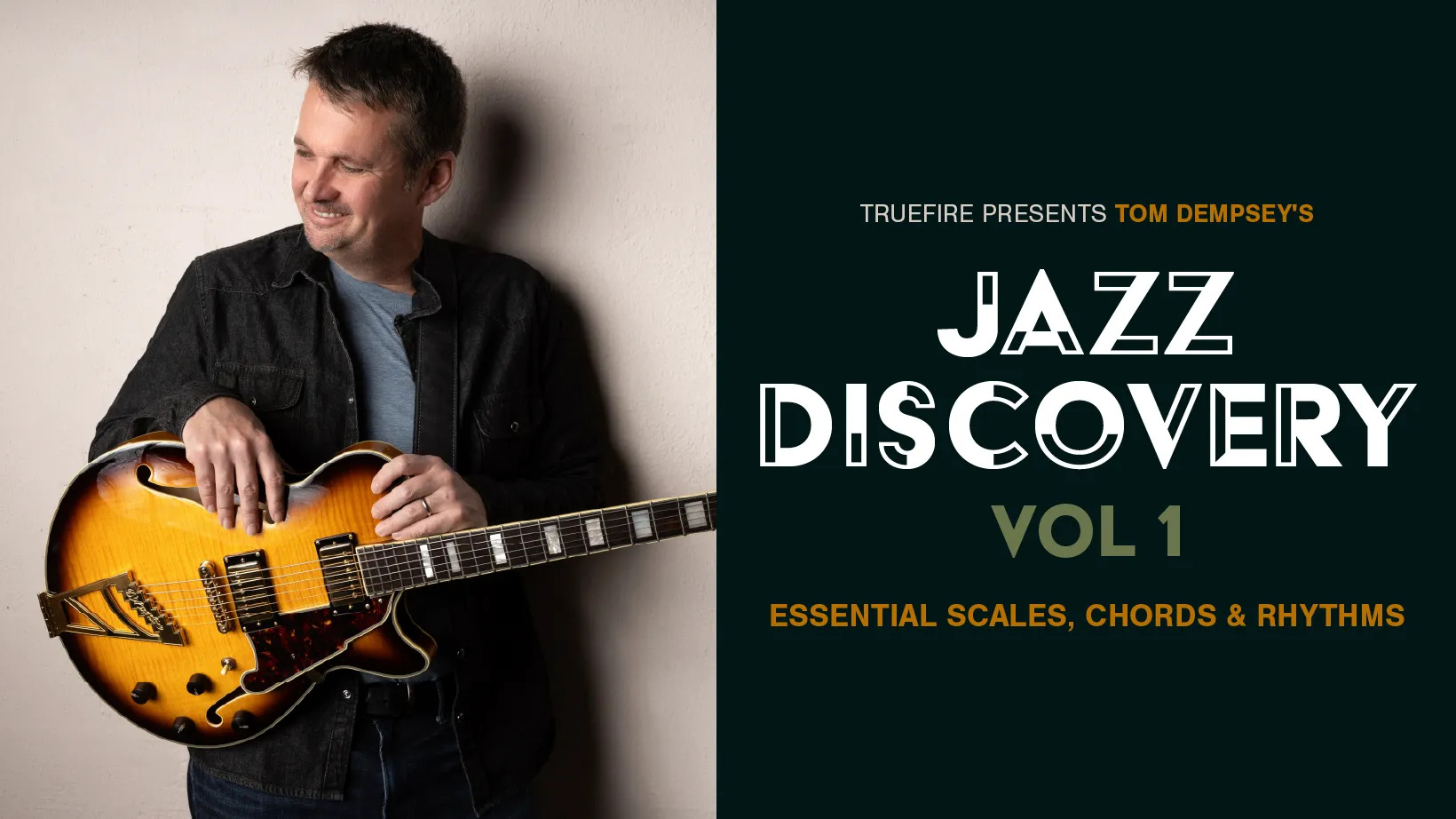

Jazz Discovery, Vol. 1

Improvisational Language of Jazz

Marty FriedmanTommy EmmanuelSteve VaiEric GalesEric Johnson

Get this course and 1,000+ more with All Access

Try 14 days free. Cancel any time.

Purchase Individual Course for $19.99
Jazz Discovery, Vol. 1

About this course

“I love his playing: great tunes, terrific solos, and careful listening. Tom Dempsey does it all and swings.” - Jim Hall

Tom Dempsey has performed and recorded with Wynton Marsalis, Jim Hall, John Abercrombie, John Scofield, Tal Farlow, Jack McDuff, Bobby McFerrin, Mel Torme, Dave Brubeck, and dozens of other marquee jazz artists. He is a music professor at NYC City University, has nine best-selling TrueFire courses, and has produced TrueFire’s critically acclaimed masterclass with Pat Martino, The Nature of Guitar.

Tom Dempsey’s three-volume masterclass series, “Jazz Discovery,” explores jazz's improvisational language, from its rhythmic nuances to the complex harmonies that provide limitless creative freedom. Tom’s engaging and enlightening curriculum builds that essential foundation to help you think, feel, and play like a seasoned jazz musician.

”In this first edition of the series, we're exploring jazz from the ground up, focusing on essential scales like the minor and major pentatonic, the soulful blues scale, and essential chords and rhythms you’ll need to know.

You’ll learn to play confidently over jazz blues changes and popular diatonic jazz progressions, with many practice sessions to help you learn to improvise, mix scales, understand harmony, and gain confidence in real-world jazz scenarios.”


You’ll have TrueFire’s interactive learning tools at your fingertips to customize your workspace and learn at your own pace.

The demonstrations and performances are tabbed, notated, and synced to the video lessons with controls for looping, slow motion, fretboard animation, and other tools designed to accelerate your progress.

You’ll also get the tab and standard notation files to print out, downloadable Guitar Pro files for editing, and backing tracks to record, practice, and record with.

Grab your guitar, and let’s dive deep with Tom Dempsey!

What you'll learn

  • Learn to think of scales as 'sonic colors' for improvisation
  • Develop ability to access different scales fluidly during improvisation
  • Understand the foundational improvisational language of jazz
  • Develop rhythmic variety in jazz comping
  • Build improvisational vocabulary using demonstrated licks
Release date: 11/21/2024 • 1h 47m runtime
Start Course
Sample lessons
Soloing with Minor Pentatonic
Improv Practice Session
Soloing with Major Pentatonic
Improv Practice Session
Jazz Blues: Blues Scale
Improv Practice Session

What's included

27 lessons • 25 charts • 18 Jam Tracks

Jazz Discovery, Vol. 1
Hey, I'm Tom Dempsey, and I want to welcome you to Jazz Discovery, Volume 1.

Success in jazz guitar isn't just about technical skill; it's about truly understanding the improvisational language of jazz. This series is designed to help build that foundation, helping you think, feel, and play like a seasoned jazz musician.

In this first edition of the series, we'll explore jazz from the ground up. We'll focus on essential scales like the minor and major pentatonic scales, the soulful blues scale, and essential chords and rhythms you need to know. You'll learn how to play with confidence over jazz blues changes and popular diatonic jazz progressions.

Through practice, you'll learn to improvise, mix scales, understand harmony, and gain confidence in real-world jazz scenarios.

So, are you ready to discover the world of jazz? If so, grab your guitar, and let's get started.
The Minor Pentatonic Scale
In this lesson, we focused on the minor pentatonic scale, a fundamental component of jazz improvisation. Understanding its intervals—the root, minor third, perfect fourth, perfect fifth, and minor seventh—is crucial for internalizing its distinctive sound. We used a system called "tonality shapes" to organize the fingerboard, involving five octave shapes (two two-octave shapes and three one-octave shapes) across a 12-fret span. By practicing the scale within each tonality shape and exploring all the notes in each position, we aim to solidify both the fingerings and the auditory recognition of the scale. Taking time to internalize these fingerings, practicing with a metronome, and ensuring consistency in sound will greatly enhance improvisational skills in future applications.
Soloing with Minor Pentatonic
In this lesson, we apply the A minor pentatonic scale to an improvisational setting over a static A minor vamp. The focus is on moving between different positions and fingerings to effectively represent the sound of A minor. By utilizing motifs, small phrases, and repetitive rhythmic figures that resolve to the tonic note A, we deepen our improvisational skills. Listening to the provided examples and learning the licks through the tabs helps internalize this musical language. Practicing with the track and improvising independently solidifies these concepts in preparation for the next lesson.
The Major Pentatonic Scale
In this lesson, you'll learn about the major pentatonic scale, an essential tool in jazz improvisation. We'll explore its intervallic makeup—the root, major 2nd, major 3rd, perfect 5th, and major 6th—to deepen your understanding of how to apply it effectively. Using the C major pentatonic scale, we'll start with the lowest tonality shape and progress through various positions on the guitar neck, including second, fifth, seventh, tenth, twelfth, and fourteenth positions. I'll demonstrate how to play the scale and all its notes in each position, discussing fingerings and shifts to make the transitions comfortable. By dedicating time to internalize these fingerings and understand where the tonic and intervals are, you'll build a solid foundation that will enhance your improvisational skills. Use the available tools to slow down and play along, and when you're ready, join me in the next lesson where we'll apply the major pentatonic scale in an improvisational setting.
Soloing with Major Pentatonic
In this lesson, we'll apply the C major pentatonic scale in an improvisational setting. I'll demonstrate how to use the fingerings we've learned to create a solo over a static C major sound, moving around the neck to explore different positions. By reviewing what I've played and using the provided tablature, you can internalize these ideas, learn them yourself, and let them inspire your own creativity as you capture the language of the major pentatonic scale. When you're ready, join me in the next lesson.
Intro to Blues Changes: Basic Progression
In this lesson, I'll introduce you to the blues, a fundamental aspect of jazz music that forms its very foundation. We'll begin by exploring the basic 12-bar blues progression in the key of C, focusing on the I, IV, and V chords—C7, F7, and G7. I'll guide you through the chord fingerings for these dominant seventh chords and explain their roles within the progression. We'll start by playing through the form using whole notes to get comfortable with the chord changes. Then, we'll incorporate the Charleston rhythm—a classic jazz rhythm consisting of a dotted quarter note followed by an eighth note—to add a rhythmic foundation to your comping. By the end of this lesson, you'll have a solid grasp of the 12-bar blues form, the essential chord voicings, and a foundational rhythm to enhance your playing as we continue our journey into jazz blues.
Intro to Blues Changes: Quick Four
In this lesson, we'll explore a variation of the blues known as the "quick four." Using the same chord voicings from our previous session, we'll start with the I chord (C7) in measure one, then move to the IV chord (F7) in measure two, and return to the I chord in bar three. The progression continues with two bars of C7, two bars of F7 starting at bar five, and then back to C7 for two measures. We'll conclude with one measure each of G7 and F7, followed by C7, and finish on bar twelve with G7—the turnaround chord to bring us back to the top. We'll practice this progression first with whole notes and then apply a Charleston rhythm. It's important to train our ears to recognize and play the quick four, as it's often used without prior discussion in musical settings. Spend some time mastering this, and when you're ready, join me in the next lesson.

+ 20 more lessons

Start Course

Reviews

6 results

CesarBenz

Verified buyer

10/11/25

Great

Tom is great. Very well organized course

gwcannon

Verified buyer

09/07/25

Excellent teacher

Outstanding. I can’t wait for Vol 2 and 3

justencimino

Verified buyer

08/11/25

Great Course

This is a great place to start learning some jazz and blues style ideas. You might be amazed if you are already familiar with lead playing that you never thought of phrasing lines this way. Tom Dempsey is a great player and this course starts to expand your ideas for lead lines almost immediately. If you like jazz, blues, swing and you want to start working in more of those blue notes this is a great place to start.

Mike

12/29/24

Jazz Discovery Vol 1

This course is fantastic for anybody looking for new approaches to outline chord changes using the major and minor pentatonic scales. The practical application of the concepts reviewed in the course are applied to blues and ii-V-I progressions. . Very innovative. . Tom is an amazing talent who really knows how to establish a groove. . Even though I have an all access pass, I am going to purchase the course to support his work!

Dave

12/03/24

Great for beginners

Great lesson for anyone interested in discovering jazz easily without getting overwhelmed.

Stop searching. Start improving with All Access.

Try 14 days free. Cancel any time.