Jazz Discovery, Vol. 3

Modal Approaches for Jazz Improvisation

Marty FriedmanTommy EmmanuelSteve VaiEric GalesEric Johnson

Get this course and 1,000+ more with All Access

Try 14 days free. Cancel any time.

Purchase Individual Course for $24.99
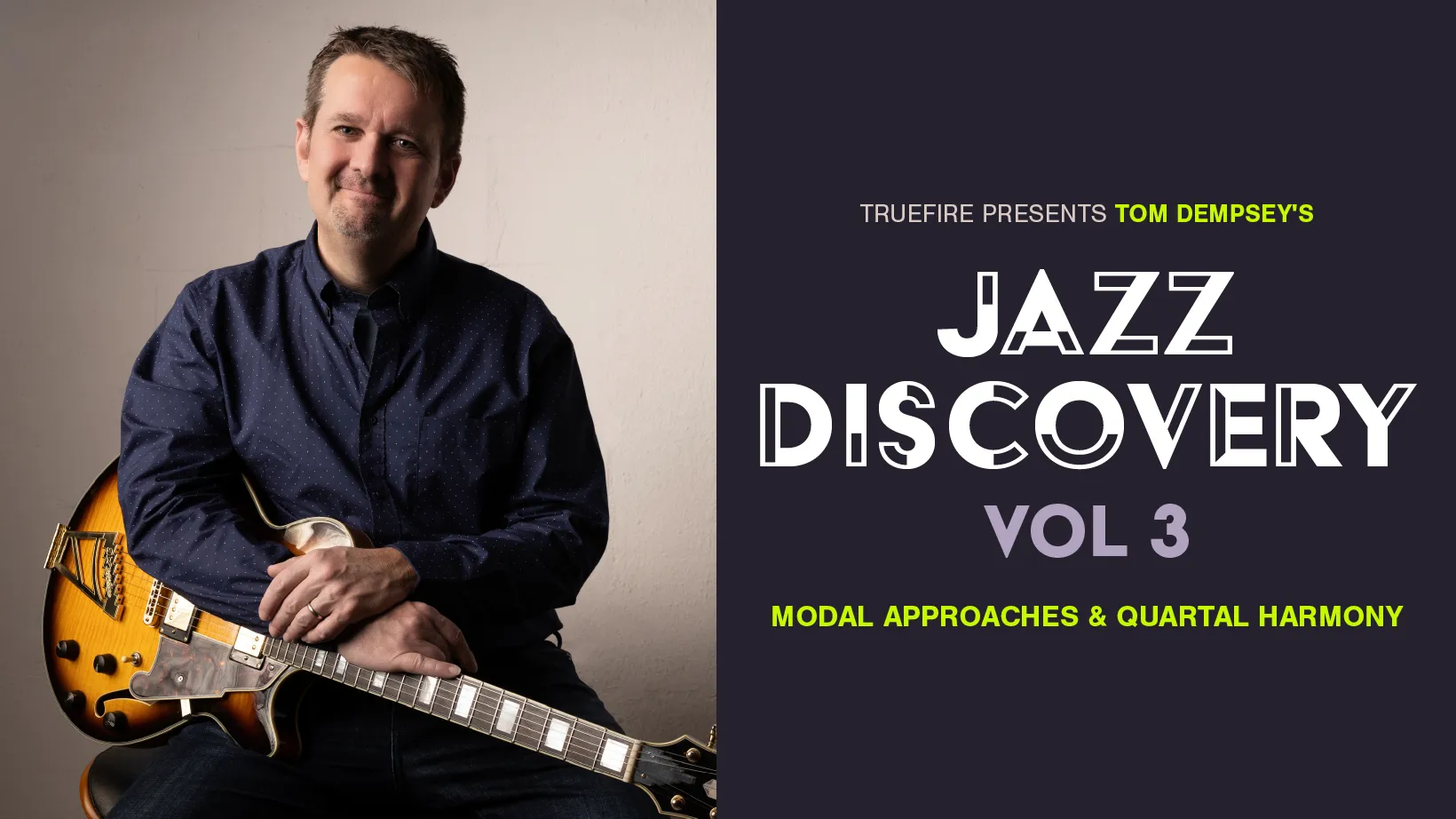
Jazz Discovery, Vol. 3

About this course

In jazz guitar, leveling up means deepening your understanding of harmony, refining your improvisation, and learning to comp with greater musicality and nuance. Whether you're working through standards, exploring bebop language, or building confidence over jazz blues changes, a strong command of jazz vocabulary is essential.

This three-volume masterclass series, “Jazz Discovery,” explores jazz's improvisational language, from its rhythmic nuances to the complex harmonies that provide limitless creative freedom. Tom’s engaging and enlightening curriculum builds that essential foundation to help you think, feel, and play like a seasoned jazz musician.

Jazz Discovery, Vol. 3 is where theory meets expression. In this final volume of the series, Tom guides you through the rich landscape of modal sounds. Building on the foundations from Volumes 1 and 2, he’ll show you how to bring new depth and character to your solos and comping.

“In this volume, we dive into the colorful world of modes, a crucial component of jazz guitar and the building blocks for creating dynamic, nuanced solos. We’ll also explore chordal harmony across the modes, using an approach that will dramatically expand your musical language,” says Tom.

You’ll explore:
  • The Seven Modes: Ionian, Dorian, Phrygian, Lydian, Mixolydian, Aeolian, and Locrian
  • Modal Soloing: Phrasing and improvisation exercises for each mode
  • Quartal Harmony: Modern chord voicings and comping concepts in a modal context
  • Substitution Concepts Upper structure ideas for expanding harmonic choices
  • Guided Practice: Hands-on sessions to help internalize modal tools and vocabulary
  • Real-World Application: Solo and comp over the classic modal jazz progressions “So What” and “Maiden Voyage”
You’ll also get access to Tom’s backing tracks and TrueFire’s learning tools including synced tab, slow-mo, looping, and fretboard animations so you can follow along at your own pace and deepen your understanding every step of the way.

Tom Dempsey has performed and recorded with Wynton Marsalis, Jim Hall, John Abercrombie, John Scofield, Tal Farlow, Jack McDuff, Bobby McFerrin, Mel Torme, Dave Brubeck, and dozens of other marquee jazz artists. He is a music professor at NYC City University, has nine best-selling TrueFire courses, and has produced TrueFire’s critically acclaimed masterclass with Pat Martino, The Nature of Guitar.

So grab your guitar, plug in, and let’s explore the modal side of jazz with Tom Dempsey

What you'll learn

  • Play quartal chord progressions using stepwise motion
  • Navigate quartal voicings across different string sets (6-5-4-3 and 5-4-3-2)
  • Solo effectively using each mode
  • Construct modern jazz chord voicings across the modes
  • Comp effectively using Lydian modal harmony
Release date: 06/25/2025 • 1h 59m runtime
Start Course
Sample lessons
The Phrygian Mode
The Phrygian Mode
Scale Shapes Lesson & Demo
Soloing With The Phrygian Mode
Improv Practice Session
Quartal Harmony in Phrygian Mode
Comping Practice Session

What's included

29 lessons • 25 charts • 15 Jam Tracks

Jazz Discovery Vol.3
Hey, I’m Tom Dempsey, and I want to welcome you to this third volume of Jazz Discovery.

If you’ve been with me for Volumes One and Two, you’ve already built a solid foundation in jazz scales, harmony, and improvisational concepts. In Volume Three, we dive into the colorful world of modes—a crucial component of jazz guitar and the building blocks for creating emotive, nuanced solos. From the bright and resonant Ionian mode to the mysterious and dissonant Aeolian, we’ll explore each mode in depth and learn how to solo effectively with them.

We’ll also dig into chordal harmony and modes using a modern approach to chord construction and voicings that will drastically expand your musical landscape. With hands-on lessons and plenty of practice sessions, you’ll learn how to apply these concepts over iconic modal jazz tunes like "So What" and "Maiden Voyage."

So, are you ready to take on the modal jazz challenge? Grab your guitar and let’s go.
Quick Review of Volume 2
Welcome to Volume Three! In this part of the journey, we’re building on everything we explored in the first two volumes. Back in Volume One, we got comfortable with major and minor pentatonic scales, the blues scale, and started working through some essential jazz progressions like 2-5 and 2-5-1, along with some basic jazz blues. Then in Volume Two, we dug deeper into the major scale, bebop major, minor, and dominant scales, and sharpened our skills improvising over those same progressions. If any of that still feels a little shaky, it might be worth revisiting Volumes One or Two to get the most out of what’s coming next—but if you’re feeling solid, then we’re ready to dive in together. Let’s get started.
Modes & Where They Come From
In this course, we’re diving deep into the world of modes—something you’re probably curious about if you’ve made it here. Modes aren’t new; they’ve been around since Gregorian chant, but in jazz, modal improvisation really took off with Miles Davis’ Kind of Blue in 1959. As guitarists, we often learn modes using the derivative approach—playing each mode off a different degree of the major scale, like starting from D for Dorian or A for Aeolian, all using the same C major notes, for example. While that can be helpful at first, it often ends up sounding like you're just playing a major scale. That’s why, in this course, we’ll focus on the interval approach—understanding the specific intervals that define each mode’s sound and color. Whether it’s the subtle differences between Ionian and Lydian (both major), or the unique flavors of Dorian, Phrygian, and Aeolian (all minor), we'll learn how these modes interact with their parent chords to create distinct harmonic and melodic identities. By connecting theory, intervals, and chord relationships, we’ll develop a deeper, more expressive understanding of each mode—and that’s the approach we’ll be using throughout the course. Let’s dig in.
The Ionian Mode
In this lesson series, we’re starting with the Ionian mode—essentially the major scale—which serves as the foundation for everything we're about to explore. We'll focus on understanding the specific intervals that define the Ionian sound and how they relate to the C major chord, especially Cmaj7. Together, we’ll walk through five key fingerings for the C Ionian mode across the fretboard—from open position all the way up to the 14th fret—using both stretch and shift approaches. The goal is to get comfortable playing these fingerings in single positions so we can eventually connect them across the neck and apply them in any key. For now, we’re sticking to C Ionian to build a strong foundation, and once we’ve got all five fingerings under our fingers, we’ll be ready to move on to the next step. Let’s get started!
Soloing With The Ionian Mode
In this lesson series, we’re starting with the Ionian mode—essentially the major scale—which serves as the foundation for everything we're about to explore. We'll focus on understanding the specific intervals that define the Ionian sound and how they relate to the C major chord, especially Cmaj7. Together, we’ll walk through five key fingerings for the C Ionian mode across the fretboard—from open position all the way up to the 14th fret—using both stretch and shift approaches. The goal is to get comfortable playing these fingerings in single positions so we can eventually connect them across the neck and apply them in any key. For now, we’re sticking to C Ionian to build a strong foundation, and once we’ve got all five fingerings under our fingers, we’ll be ready to move on to the next step. Let’s get started!
Intro to Quartal Harmony
In this lesson series, we’re starting with the Ionian mode—essentially the major scale—which serves as the foundation for everything we're about to explore. We'll focus on understanding the specific intervals that define the Ionian sound and how they relate to the C major chord, especially Cmaj7. Together, we’ll walk through five key fingerings for the C Ionian mode across the fretboard—from open position all the way up to the 14th fret—using both stretch and shift approaches. The goal is to get comfortable playing these fingerings in single positions so we can eventually connect them across the neck and apply them in any key. For now, we’re sticking to C Ionian to build a strong foundation, and once we’ve got all five fingerings under our fingers, we’ll be ready to move on to the next step. Let’s get started!
The Dorian Mode
In this lesson series, we’re diving into the Dorian mode, which is built off the second degree of the major scale and centers around the sound of a minor 7 chord—specifically D minor 7 for our purposes. We’ll walk through five key fingerings for D Dorian across the neck, exploring different positions and using both stretch and shift approaches to help us find what feels most comfortable. As we play through each shape, we’ll focus on how the mode fits within the sound of its parent chord, which is essential not only for theory but for training our ears to hear that connection. This mode is a major tool in jazz and beyond, so we'll take our time locking in the fingerings, building muscle memory, and practicing with a click to sharpen our internal timing. Once we’ve got these shapes down, we’ll be ready to keep moving forward.

+ 22 more lessons

Start Course

Reviews

1 result

awseyler

Verified buyer

07/09/25

Great!!!

Stop searching. Start improving with All Access.

Try 14 days free. Cancel any time.