In order to become a solid fingerstyle jazz player you have to develop a well-rounded variety of left and right hand techniques, harmonic concepts, and rhythmic approaches -- which, for most of us, is a process of continuous long-term growth.
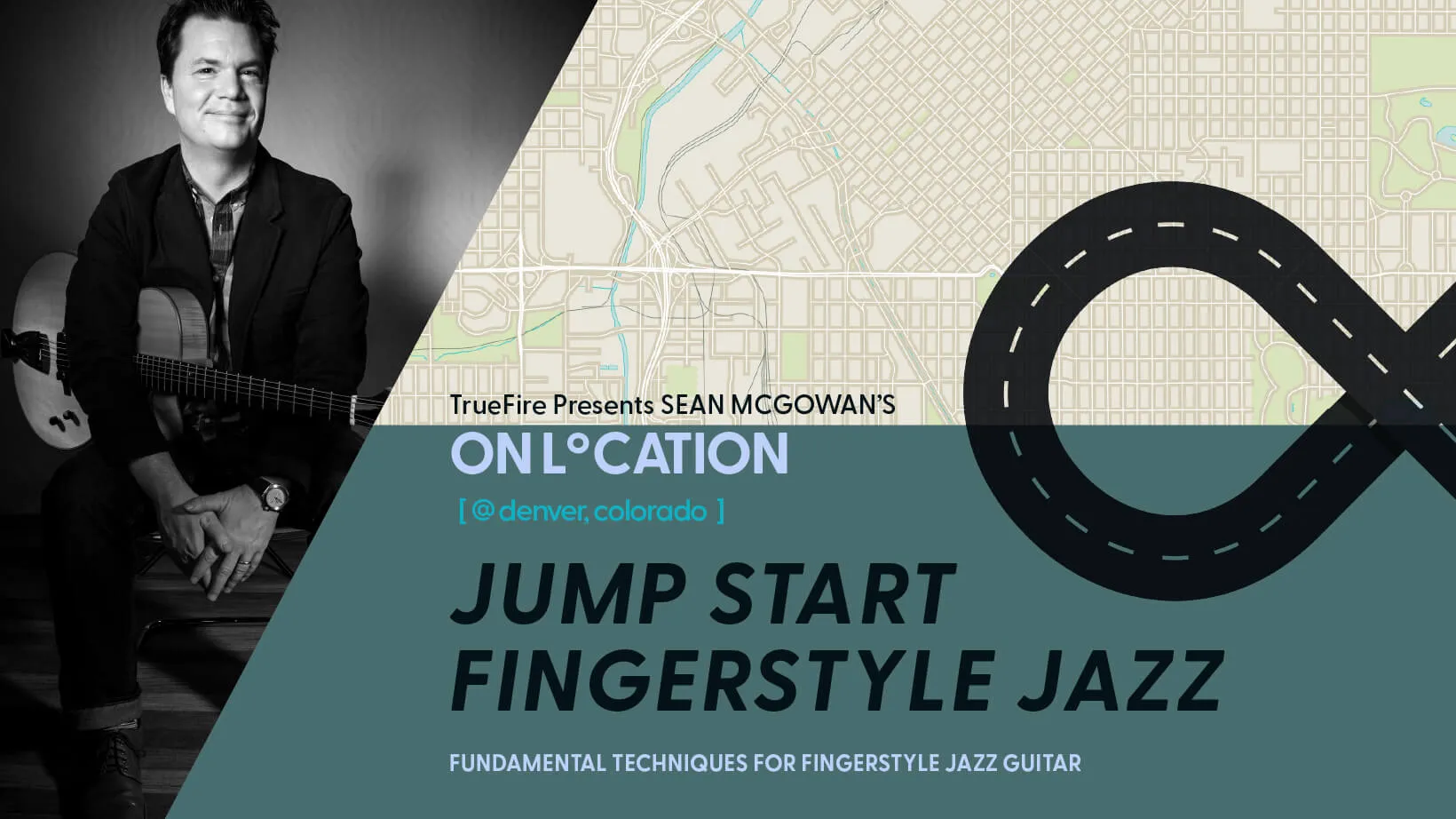
Sean McGowan designed this Jump Start Fingerstyle Jazz edition of On Location for newer fingerstyle jazz players. The course contains the concepts and approaches that a player needs to start playing fingerstyle jazz quickly and efficiently.
”I’ve organized the course into six distinct sections. Each section will feature a “Learn and Practice” lesson, which features several concepts that are key components of fingerstyle jazz guitar. Each lesson is followed by an overview, performance, and detailed breakdown and analysis of a full-length étude to play.
In the first section, we’ll examine how to plot out notes for a walking four bass line, using diatonic scale tone and chromatic approaches. Then we’ll learn how to bring a bass line to life using essential techniques such as skips with the picking hand and pull-offs with the fretting hand. We’ll also learn a dynamic octave triplet figure pattern that jazz bassists frequently use to propel the progression forward. Then we’ll put these techniques to use over a Bb blues progression based on Miles Davis’s “Freddie Freeloader” called, “Walkin’ and Skippin’”.
The second section will feature exercises designed to develop a strong fingerstyle foundation using pinch, and 2-, 3-, and 4-finger claw techniques. We’ll learn how to play with and against the thumb, creating independence to incorporate chord jabs over a moving bass line. Then we’ll work through another blues progression in Bb (“Freeloadin’ Fun”) that gradually integrates these fingerstyle techniques, building chords one note at a time while articulating a walking four bass line.
In the next section, we’ll continue working on jazz rhythms and articulation by focusing on the fretting hand. We’ll learn the ‘bounce’ technique, which is essential to creating a three-dimensional sound, plus planting and developing independence with each of the fingers of the fretting hand. We’ll check out the concepts of short (staccato) and long (legato) chord jabs, and how to play constantly moving ‘four to the bar’ chords in the style of legendary guitarist Freddie Green. Then we’ll play through several choruses of a blues progression in a Kansas City jump style that features the bounce technique in action over riff-like bass lines.
Section Four explores the bass and chord comping options over tunes in 3/4 time. We’ll learn and practice ‘quick jabs’ and how to incorporate open strings in your bass line to facilitate rapid position shifts. We’ll also learn a classic jazz waltz pattern and the floating concept to push and pull the time feel. We’ll put all of this together over a complex blues progression in 3/4 called, “Third Coast Blues”, based on Wes Montgomery’s classic “West Coast Blues”.
In Section Five, we’ll learn how to play and articulate a bass line with chords and percussion on a backbeat over a straight 8th note time feel. We’ll go over rapid shifts in chord fingerings and also how to transition from straight to swing feel in the style of great blues musicians such as Freddie King. Then we’ll apply all of this over a soulful Cm blues titled, “Ain’t No Thrill” (based on the perennial B.B. King favorite, “The Thrill is Gone”)
Finally, in Section Six we’ll put it all together: walking bass lines with articulations, full-bodied chord jabs, and classic harmonic substitutions. We’ll also learn some swinging triplet fills with chords against the bass, and left-hand chordal hammer-ons to spice things up. “The Gold Standard” is a 12-bar jazz blues progression that features complex chord subs and variations on familiar turnarounds and moves. The étude starts off with an articulated walking four bass, and gradually introduces more complex chords, turnarounds, and rhythmic moves to create the illusion of more than one player!”
Sean will explain and demonstrate all of the key concepts and approaches along the way. You’ll get standard notation and tabs for all of the performance studies. Plus, you’ll be able to use TrueFire’s learning tools to sync the tab and notation to the video lesson. You can also loop or slow down the videos so that you can work with the lessons at your own pace.
Grab your guitar, and let’s dig in with Sean McGowan!
What you'll learn
Play walking bass lines in 3/4 time with proper approach tone placement
Play effectively in solo jazz, duo, and small group settings without a bass player
Apply floating rhythm concept for more fluid jazz waltz feel
Create solid walking bass lines with convincing time feel
Develop various fingerstyle articulation techniques
Hi, I'm Sean McGowan and welcome to this On Location edition of Jump Start Fingerstyle Jazz. Filmed on location at my home studio in Denver, Colorado, this course is designed to introduce you to the style and practice of Fingerstyle Jazz Guitar. In the six Learn & Practice sections, you'll be introduced to and work through the most important concepts and techniques required to play walking basslines in different time signatures and feels, navigating the fretboard, playing fluid chord jabs, and sophisticated harmonic approaches throughout a variety of jazz blues progressions. You'll learn six full-length arrangements, each of which I will perform and then break down for you emphasizing the essential techniques and approaches you'll need that include muting, dynamics, syncopation, and counterpoint. Everything is transcribed and you'll be able to sync the tab and notation to the video using TrueFire's learning tools. You can also loop or slow down the videos so you can work with the lessons at your own pace. Ready to get started? Grab your guitar, and let's get swinging!
The first step to improvising walking basslines is to understand how to plot out notes on the lower strings of the fretboard, using a variety of scale tone and chromatic approaches to target notes that outline the chord changes while building continuity with an overarching melodic line. Then, we'll learn some effective techniques and articulations such as open string pull-offs and doubling up the thumb with the index finger to create skipping 8th notes and triplet figures to propel the time forward with a strong swing feel.
Our first étude works through a blues progression in the key of Bb, based on Miles Davis's classic, "Freddie Freeloader" from the landmark Kind of Blue album. Focusing only on a walking bassline, you'll play through the chord changes using all the different approaches to plot out the notes, while bringing the bassline to life by incorporating the techniques of open string pull-offs, skipping with the thumb and index, and the classic triplet "mowin' the lawn" pattern.
Here we'll perform the tune.
Now let's break it all down!
In the second section, you'll start to add the index, middle, and ring fingers (i-m-a) of the picking hand to create double-stops and syncopated chord jabs using the ‘pinch' and ‘claw' techniques. You'll build independence in the picking hand by working through a number of exercises that match chord jabs with and against the constant bassline using the thumb. You'll also learn some essential chord voicings and rhythmic patterns that are integral to the style.
This is another blues progression in Bb, however in this étude we'll build momentum and complexity by gradually adding one-, two-, and three-note chord jabs on various beats of the measure - all over a walking bassline in four! You'll learn to recognize common and important chord moves on the fretboard, and how to find a chord voicing that will match your bassline, wherever you are on the fretboard.