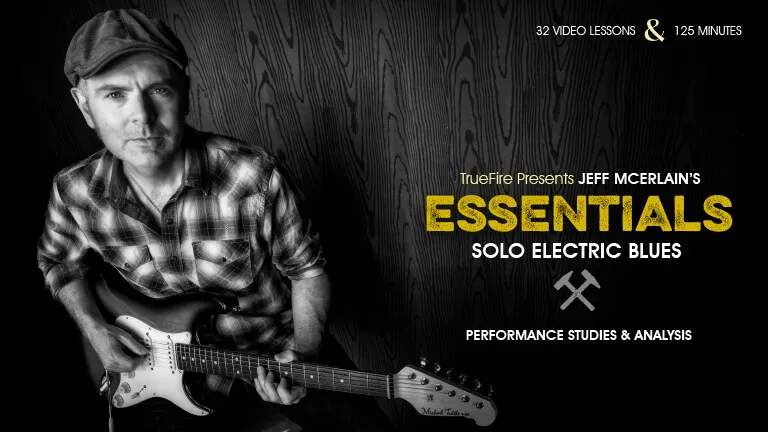
Essentials: Solo Electric Blues

Performance studies focused on the essential harmonic and technical characteristics of solo electric blues

Marty FriedmanTommy EmmanuelSteve VaiEric GalesEric Johnson

Get this course and 1,000+ more with All Access

Try 14 days free. Cancel any time.

Purchase Individual Course for $19.99
Essentials: Solo Electric Blues

About this course

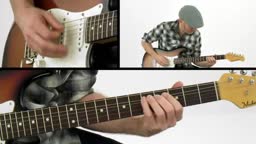
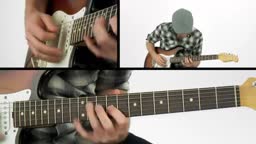
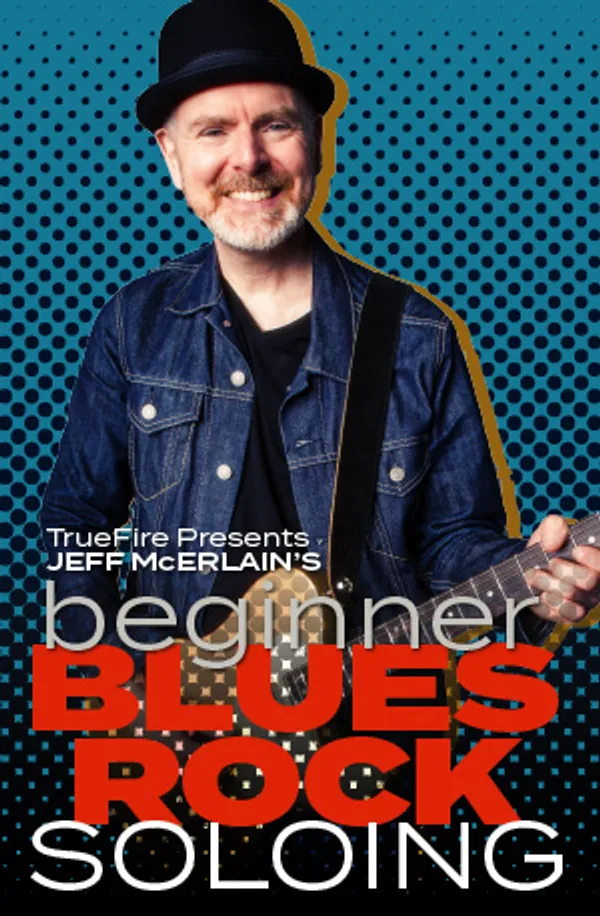
Jeff McErlain guides you through a diverse collection of 10 solo blues guitar Performance Studies designed specifically for electric guitar. Most of the studies are played with a pick making them very accessible for non-fingerstyle players. Jeff covers all of the solo blues guitar “essentials” in this highly engaging, hands-on curriculum.

“Playing solo blues instrumentals is a long-held tradition dating back to the Mississippi Delta with guys like Charlie Patton, Robert Johnson, Skip James along with pretty much all of the other forefathers of blues guitar. You’d be hard pressed to name any accomplished blues guitarist, throughout the decades, that hasn't kept that tradition very much alive and well.”

Each study equips you with a distinct set of techniques, rhythmic approaches and stylistic options that you can call on to craft your own solo blues improvisations. Jeff’s 10 Performance Studies range across a wide variety of keys, tempos and blues grooves: Slidin’ 6ths, Jimmy Reed Shuffle, Big Slide, G Man, My Heart is Kind, Man Of The World, Band of Jimi, Double-Stop, Jazzy Jeff and The Rev.

“Learning to play a solo blues helpful in many ways. First, it’s an excellent way to build up your repertoire. Second, it’s a fantastic way to improve your sense of time, feel and groove. Third, solo blues are excellent springboards for improvisation. And finally, it's a heck of a lot of fun!”

For each Performance Study, Jeff introduces you to the basic chord progression, describes its harmonic and rhythmic characteristics, and then performs the study. In the breakdown section of each study, Jeff steps you through all of the techniques and rhythmic approaches required to perform the study.

While the studies are designed to serve as springboards for you own solo blues improvisations, all of the Performance Studies are tabbed and notated so that you can first learn them as performed by Jeff.

Grab your electric, give the band a break, and take center stage with a full set’s worth of solo blues improvisations!

About the Series

Designed for intermediate and advanced students, TrueFire’s Essentials courses feature Performance Studies focused on the ‘essential’ harmonic and technical characteristics of a particular style of playing. Educators first perform the study for demonstration purposes and then break it all down section-by-section, technique-by-technique. Performance Studies include tab, notation and practice rhythm tracks when applicable.

Jeff McErlain's Preferred Gear

Below is a list of Jeff McErlain's preferred gear including guitars, amps, pedals, accessories, and more. What you see in Jeff's lessons may or may not be this actual gear, but if you are trying to capture Jeff's sound and tone, the gear listed below is recommended by Jeff and it's a great place to start!

Guitars

Amps

Pedals

Accessories & More

What you'll learn

  • Play a complete Robert Johnson-style blues in standard tuning
  • Play ten complete solo electric blues pieces in various styles
  • Perform the 'long A' blues progression
  • Apply chromatic voice leading in blues context
  • Develop independence and self-contained playing ability
Release date: 02/09/2015 • 2h 05m runtime
Start Course
Sample lessons
Slidin' 6ths
Slidin' 6ths
Performance
Band of Jimi
Band of Jimi
Performance
Double-Stop Jam
Double-Stop Jam
Introduction
Double-Stop Jam
Double-Stop Jam
Performance

What's included

32 lessons • 10 charts

Essentials: Solo Electric Blues
Every guitar player should be able to play a number of solo blues pieces. This is a long-held tradition dating back to the Mississippi Delta with guys like Charlie Patton, Robert Johnson, and Skip James to name a few. This tradition has been upheld by guys like Peter Green, Eric Clapton, Stevie Ray Vaughan, Jimmy Page, Jimi Hendrix, and basically any other blues player we can mention. Learning to play a solo blues is helpful in many ways. First, it is an excellent way to build up a repertoire. Second, it is a fantastic way to build up your time, feel, and groove. Third, a solo blues is an excellent springboard for improvisation. And finally, it's a heck of a lot of fun! I have provided you with 10 solo blues pieces in different styles and feels, take your time and work through each one. These are all springboards for further improvisational explorations. Above all have fun!
Slidin' 6ths
This first blues uses a number of important techniques and ideas like, as the title says, sliding the interval of a 6th. The other technique is hybrid picking which is basically where we use both the pick and fingers of the pick hand. This blues is a great introduction to this essential technique. We are taking a 12 bar boogie blues in E and expanding on the basic theme that we are all familiar with. Like all of the examples in this course, this is just a springboard for your own playing.
Slidin' 6ths
A little theory, in music the term interval means the distance between two notes. In this blues we are using the interval of a 6th quite a bit. What that means is the two notes we are playing are 6 notes apart from each other within the key. That's important to understand as we are changing keys ever so slightly here for each of the three chords. The riff uses scale tones (notes from the scale) to embellish each chord. The first chord is E7 and the corresponding scale for that chord is E mixolydian, EF#GABC#D. Our first use of the 6th is between the B and G# notes which is contained in the E7 chord itself. If you count using B as the first note, we can see that G# is six notes above in the key, giving us a 6th of course. For the riff we move that interval up to the next notes in the scale, C# and A. Our next set of notes is the D and B. As you can see, all of these intervals are 6ths within the key. The A7 chord uses an A mixolydian scale, ABC#DEF#G and the B7 take a B mixolydian scale BC#D#EF#G#A. To properly outline each chord we must stick to the notes of the proper scale. Once you get this idea down it really opens up doors.
Slidin' 6ths
The basis of this blues is the basic old boogie woogie riff we all probably know at this point. Also as we know, that can get a bit boring at times so I have expanded the idea by using 6ths. But if we look at the low notes of each chord we can see it is just a dressed up version of the classic style boogie woogie blues. The hybrid picking is important to playing this one correctly, we can see that the picked notes is just that basic blues pattern. This gives us the option to apply this basically anywhere on a blues. Very cool! The most difficult part here is getting used to hybrid picking itself. It will take some work but it is well worth it, I cannot imagine playing guitar without it. The intro of the tune is kind of tricky but it is not essential to playing the blues, so if it is sticking you up, skip it and come back. It is a fun one for sure and I threw it in as a cool bonus and hopefully it will inspire you to check out Earl Hooker if you don't already know his work.
Jimmy Reed Shuffle
Jimmy Reed was born in 1925 in Dunleith, Mississippi and became one of the most influential blues musicians until his death in 1976. His work is mostly electric guitar based and had a huge influence on Stevie Ray Vaughan, Billy Gibbons, The Rolling Stones, Van Morrison, and Elvis Presley. Some of his hits include "Big Boss Man", "Bright Lights, Big City", and " Baby What You Want Me To Do". He is also one of my favorite blues musicians as well. Not only do I love his songs but I also love his feel, vocals, lyrics, and harmonica playing. He was the whole package. I highly recommend checking out some of his music and watch him play as well. When you do, pay close attention to the groove and where it sits. That's where the magic is!
Jimmy Reed Shuffle
This one is tricky because it requires a lot of coordination between the right and left hands, and a whole lot of muting. One of the key elements here, as we can see in the video, is to keep the right-hand playing steady eighth notes. While maintaining a strong swing eight feel. A cool little trick is to keep a somewhat of oval shape going with the right hand. This interestingly enough helps get the swing eighth feel to sit a little better. It also looks pretty darn cool. On the original recordings there are usually two going at once, here I mixed the two parts together as SRV would to create a solid rhythm guitar part. When I play a groove like this, and basically any groove for that matter, I think about what a drummer would play. On any solo blues we must keep the groove and time together or it all goes out the window! Practice with a metronome to help build up your own sense of time. Not only is it well worth it, it is essential!
Jimmy Reed Shuffle
This is a basic 12 bar blues in E with a simple walking bass line. I am combining what would have been two guitar parts on the original Jimmy Reed recordings to make a cooler, more full part. One that can stand nicely on its own. First I suggest learning the walking bass part before adding in the second guitar part. This way you can lock in the notes and feel. Next I would practice just the second guitar part and lock in that feel and groove. On each of these pay close attention to your right hand as that is acting like the rhythm section of an imaginary band. The rhythm section is the bass and drums. Keeping the right hand playing the steady swing eighth note rhythm is key to this, and countless other blues tunes. This same technique can, and is, used in many different styles, most notably, funk guitar. The right hand acts as the propellant for the groove, or the drummer if you like. It is a great idea just to practice locking in with a metronome or drum machine just with the right hand and mute the strings with the left hand. This way your focus is solely on the groove. When listening, even when you are away from the guitar, try to imagine your right hand laying that groove down. The right hand motion will also help internalize and feel the groove in your body. That's where is needs to be!

+ 25 more lessons

Start Course

Reviews

22 results

bloos66

04/01/23

Essential blues skills

I seem to be coming back to this course a lot, Jeff's material is excellent and his presentation first class. I will make it my goal for the next 6 months to learn these songs, classic blues material and not too difficult to play. Thanks Jeff, it's an "old" course but nevertheless timeless.

BluesDawgUT

06/11/22

New possibilities

I believe this is a great course for anyone that has been playing acoustic fingerstyle for years, and the blues in particular. I wanted to take my playing electric, and after trying a number of courses, I found this to be a great introduction to solo electric guitar. I particularly enjoyed the "Big Slide" lesson. Being somewhat familiar with acoustic slide, it made the electric guitar seem less alien. I have taken several of Jeff's courses, and while I can recommend all of them, this is my favorite so far.

mbmark3

09/05/21

Something for everyone

from fingerstyle with thump bass to Hendrix style to jazzy blues with a great counterpoint turnaround. Way more here than I expected.

rjaleman

Verified buyer

06/29/21

Build your song repertoire

Great collection of pieces to add to your repertoire. Nice to change it up from licks series.

ranmeda

06/20/21

Prepare to miss out on a lot of sleep/TV/regular life time events!

Fair warning - this course is highly addictive. Jeff McErlain is a brilliant teacher, and the course is laid out in such a fun way, it's really tough to stop. That's how you find yourself "trying just one" lesson when you have a few minutes, then suddenly you lift your head up and it's 3am, you've been through 7 of these and you keep trying one more time to get it just right. This is exactly the sort of teaching I expected to receive when I started on Truefire. It's fun, and you grow as a player every time you try out one of the lessons. Absolutely 100% recommended - assuming you have some self-control. I'm not sure I have enough... OK enough typing, I'm gonna try to finally master "Band of Jimi"!

Stop searching. Start improving with All Access.

Try 14 days free. Cancel any time.