Beginner Blues-Rock Soloing

Essential Building Blocks & Creative Approaches for Soloing

Marty FriedmanTommy EmmanuelSteve VaiEric GalesEric Johnson

Get this course and 1,000+ more with All Access

Try 14 days free. Cancel any time.

Purchase Individual Course for $24.99
Beginner Blues-Rock Soloing

About this course

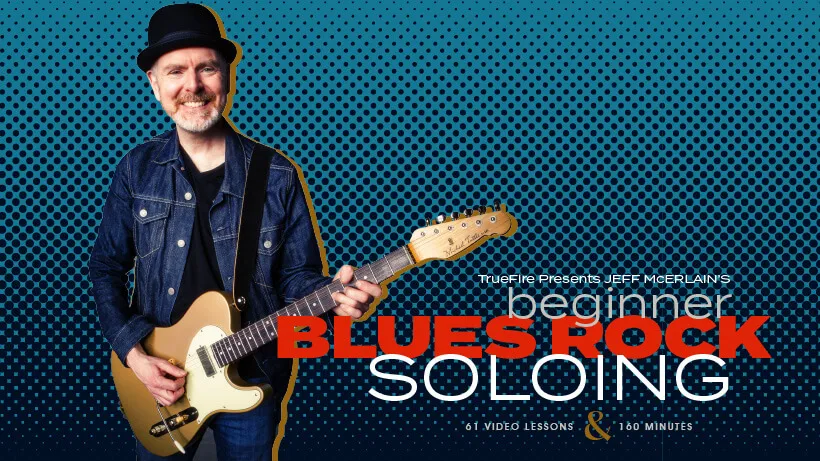
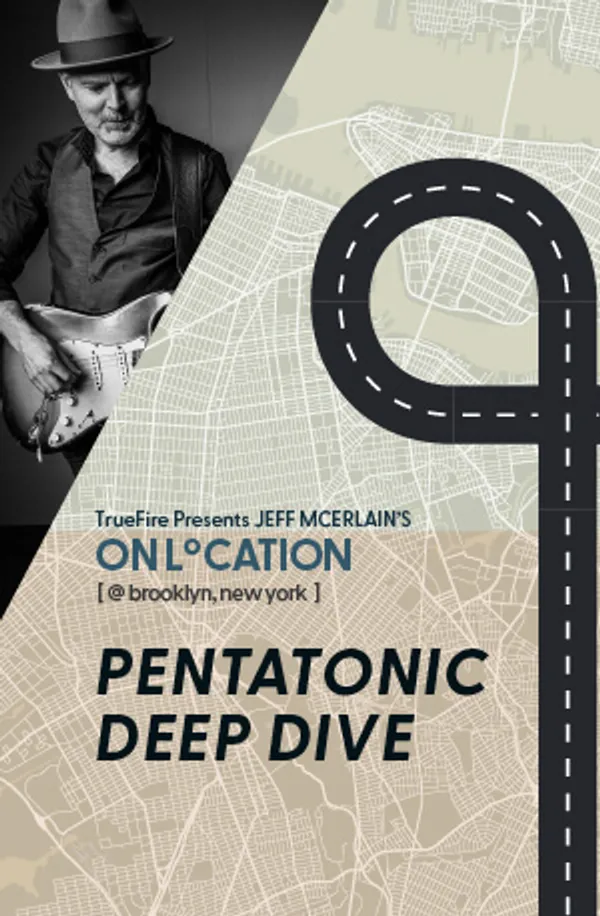
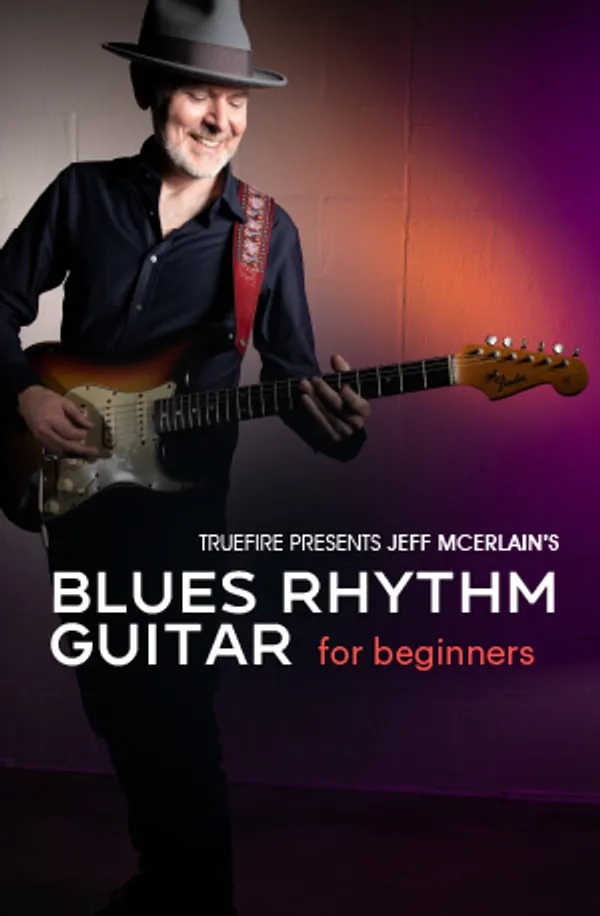
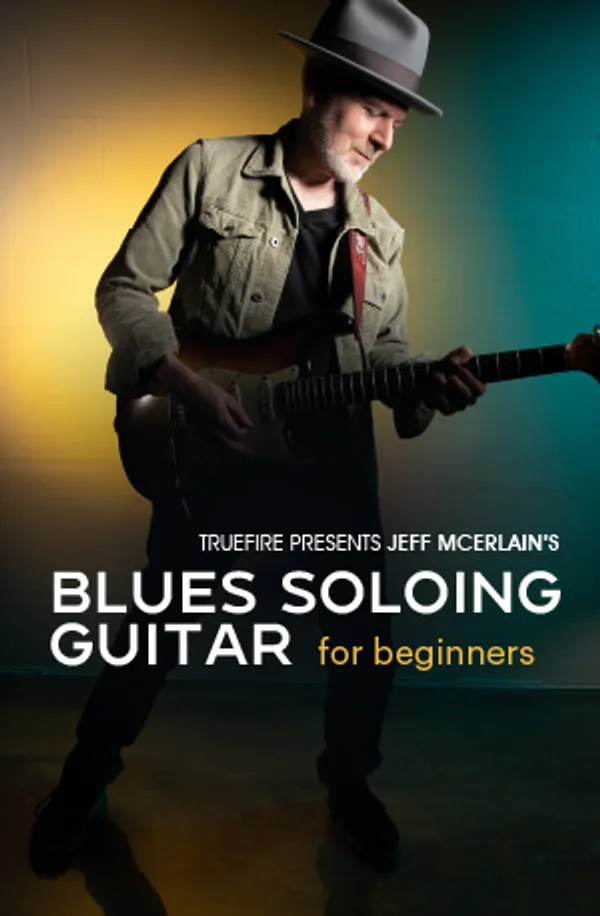
You’ve got a grip on a handful of chords, can play a few blues rock rhythm patterns, and you might even know a few tasty licks, but can’t yet pull off an engaging solo. No worries — you’ve done a great job getting here but it's now time for you to push through to the next level with Jeff McErlain’s Beginner Blues Rock Soloing.

Music is a language and a solo is just like telling a story with notes and phrases instead of words and sentences. And just like any language, you need to first understand the fundamentals of the language before you can start telling your stories. Jeff’s hands-on curriculum will equip you with all of those fundamentals, stoke up your vocabulary of licks, and then have you playing full-length solos by the end of the course.

”In the first part of the course, we’ll work on the building blocks of your soloing skills, with a series of playalong exercises to help you develop techniques like bends,vibrato, slides and other essential techniques. Next, we’ll apply those techniques across 10 vocabulary-building blues rock licks. In the final section of the course, you’ll learn how to connect the licks into full solos, in different feels and keys, just like you would on a gig.”

You’ll play your way through the entire course — no tedious theory or boring exercises to struggle through. Plus, Jeff includes playalong practice sessions throughout all six sections of the course to help guide your practice regimens and maximize results.

Jeff demonstrates all of the solos and key examples over backing tracks and then breaks them down by stepping you through the key concepts, techniques and creative approaches that he used in the demonstration.

All of the key examples, licks and performance studies are tabbed and notated for your practice, reference and study purposes. You’ll also get Guitar Pro files so that you can play, loop and/or slow down the tab and notation as you work through the lessons. Plus, Jeff generously includes all of the backing tracks for you to work with on your own.

Grab your guitar and let’s start soloing with Jeff McErlain!

Jeff McErlain's Preferred Gear

Below is a list of Jeff McErlain's preferred gear including guitars, amps, pedals, accessories, and more. What you see in Jeff's lessons may or may not be this actual gear, but if you are trying to capture Jeff's sound and tone, the gear listed below is recommended by Jeff and it's a great place to start!

Guitars

Amps

Pedals

Accessories & More

What you'll learn

  • Master half-step bending technique
  • Apply legato technique in pentatonic scale
  • Create emotional expression through note manipulation
  • Control string muting and ringing
  • Develop precise pitch control during bends
Release date: 07/11/2016 • 2h 38m runtime
Start Course
Sample lessons
Pentatonic Picking Exercise 1
Demonstration
Pentatonic Picking Exercise 1
Playalong
Legato Exercise 4
Legato Exercise 4
Demonstration
Legato Exercise 4
Legato Exercise 4
Playalong

What's included

61 lessons • 29 charts • 5 Jam Tracks

Beginner Blues Rock Soloing
Hi, and thank you for picking up this course! I'm Jeff McErlain and welcome to Beginner Blues Rock Soloing. This course came about from working with my students over the many years both privately and in my online classroom here at TrueFire. Honestly, I found I took many things for granted when teaching, such as basic techniques. This course is designed to help with the fundamentals of blues and blues rock soloing.

I feel confident that if you practice the lessons in the exercise section, you'll become much more confident in your guitar playing. I'll cover bends, vibrato, hammer-ons, pull-offs, slides, scales, and position changes. For the final section, I put together four performance studies utilizing all the techniques we learned in the course. I hope you enjoy it, I had great time doing putting it together!
Tips, Tricks & Approaches
For the sake of simplicity, I've put all the licks and techniques in the first section in the key of D minor. I look at this course as a lick and technique builder. With each example, I start off with a metronome between 60 and 70 BPM, nice and slow. The idea here is to learn how to practice properly, and the only way to do that is slowly with a metronome.

Once you feel you've achieved a given tempo, say, 90 BPM, slowly start to increase the tempo up a few clicks. Maybe keep a little journal of where you were tempo wise, as it's great to look back and see your improvement. There is one guarantee I can make to you on any instrument: if you practice with a metronome you will get better. It can be painful at first, but it is well worth it. I actually love practicing with a metronome.
SECTION 1: Picking
In this section, we're going to look at basic pentatonic picking patterns and melodic phrases. These patterns are essential to any musician's vocabulary, going all the way back to basic piano studies, Renaissance music, and beyond. Melodic patterns are the cornerstone of any form of music, so the more we know the better!

Melodic phrases also help us understand the instrument and develop the fingerboard memory, knowledge, and intuitive skills that are essential. One of the first pentatonic patterns I learned was from Jimmy Page's solo in "Good Times Bad Times". You know the lick I'm talking about, the one that comes in right after the break at the top of the solo. I'll show you that one, because I still play it!
Pentatonic Picking Exercise 1
As promised, here's that Jimmy Page pattern that I stole off of Led Zeppelin I. This is a great pattern to get you going because it's instantly usable. It's based off of triplets, which means each beat gets three notes. The easiest way for me to remember triplets is the phrase "um-pa-pa", with each beat getting one "um-pa-pa". Think of that waltz feel as you play along with the metronome.

It's really important to always think about sitting in correctly with the metronome and always be thinking about the music. What I mean by this is that I'm always trying to have anything I play sound pleasant. Are my notes cleanly played? Are they rushed? Am I dragging? Do the notes sound warm and full? etc. So when you're practicing anything, whether it is a song or a technique, always think about creating music. Every time you pick up your instrument think about creating music.
Pentatonic Picking Exercise 1
I must admit this first exercise at 60 BPM may be a little fast for you with triplets. I highly suggest that you learn the pattern first before using the metronome. Just very casually learn the notes, get the feel of them under your fingers, pay attention to the picking, and take your time. If you don't, you'll most certainly have problems playing along with the metronome!

One of the most important pieces of information that I can pass along to you is that if you cannot sing what it is you're trying to play in your head, you cannot play it. More simply put, if you don't know what it is you're trying to play, how can you expect it to come out? I honestly forget this lesson all the time! I'll keep on messing around with a lick or pattern and get frustrated as I'm not getting it right. If I slow it down, and pay attention to the notes and get them in my head, that usually solves the problem. It seems obvious, but since we're humans, we do lots of silly things.
Pentatonic Picking Exercise 2
I'm going to take this opportunity to talk about keeping your body as relaxed as possible when playing or practicing. Keep your fingers low to the fingerboard and keep your pick motion as economical as possible. I highly suggest using something like your iPhone to video yourself playing and take a look at your technique. This is extremely helpful as it may show you things that you cannot see while you are playing or from your vantage point. It also gives you an opportunity to listen back to how you are performing the exercise, which brings me back to what I was talking about in the earlier section: Ask yourself, does it sound good? Am I playing in time? Are my notes enjoyable to listen to?

These are excellent questions to ask yourself at all times. I still record almost all of my gigs so I can listen back to myself. More often than not, I'm horrified! But what’s always clear is what I need to work on, and what things I think I'm doing pretty well. Both are extremely important to know.
Pentatonic Picking Exercise 2
Let's take a look at this pentatonic pattern at 70 BPM. After this, slowly move up the metronome on your own. It's great to keep the little journal and very satisfying to see your improvement. I realize this can be a painful experience at first, but the metronome is your friend. Once you make friends with the metronome, you won't want to practice without it. The metronome doesn't lie, so it's like she's the brutally honest friend. She'll always correct you when you're wrong and reward you when you're right. It's very easy to get frustrated when using the metronome at first. Like anything in life, it's a skill that needs to be cultivated.

I also highly recommend a drum machine or drum program of some kind to practice with. These can be a heck of a lot more fun than the metronome, but it's not a substitute. There ain't no way around it. There are many metronome apps available for smart phones, or you can use the metronome here on the TrueFire site.

+ 54 more lessons

Start Course

Reviews

83 results

brosblues

Verified buyer

07/03/26

Useful even for a non-beginner!

I 'd like to consider myself a non-beginner, but I still find useful nuggets of information in yet another well-designed Jeff Mac course!


flcontreras

Verified buyer

06/28/26

Good course

Very knowledgeable instructor. Explains content well.

fluvin

Verified buyer

04/03/26

He is simply a great teacher, as well as a player. The best, so far, I have come across on Truefire.

macis

Verified buyer

03/14/26

Great Blues Rock Soloing Course

Bought this to compliment the beginner blues rhythm and blues soloing courses. I like Jeff's teaching style and his knowledge and experience of blues rock soloing.

bobyboby

Verified buyer

03/13/26

Just purchased

I looked at the first lesson and it is in Dflat. . . far up the fret board for an old set of hands like mine. . . . don't think I will spend much time with the course. . . . arthritis is a bit too painful up there, Rob

Stop searching. Start improving with All Access.

Try 14 days free. Cancel any time.