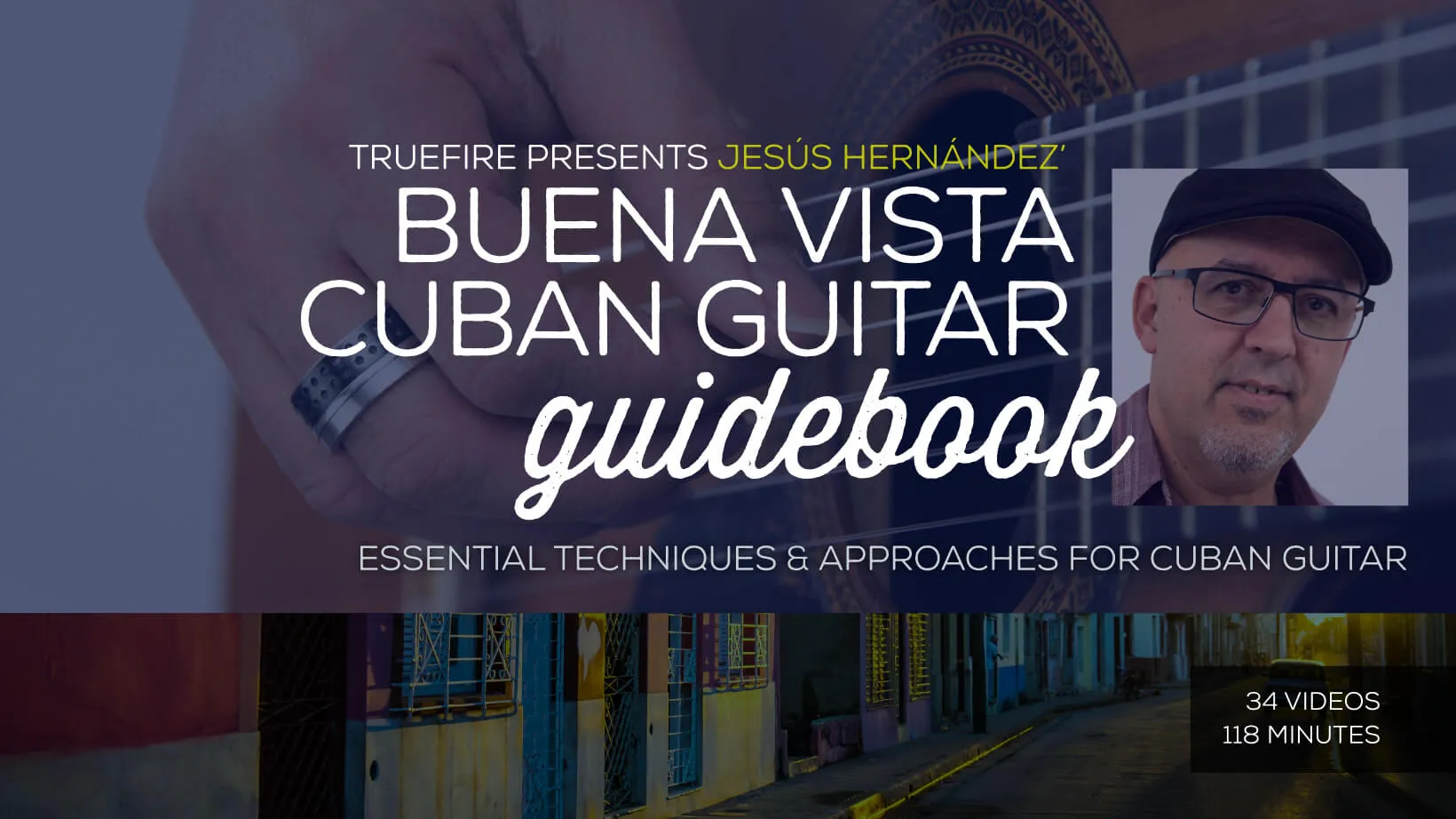
Buena Vista Cuban Guitar Guidebook

Essential Techniques & Approaches for Cuban Guitar

Marty FriedmanTommy EmmanuelSteve VaiEric GalesEric Johnson

Get this course and 1,000+ more with All Access

Try 14 days free. Cancel any time.
Purchase Individual Course for $19.99
Buena Vista Cuban Guitar Guidebook

About this course

Cuban music is considered one of the richest and most influential world music genres. Its highly rhythmical featuring West African and Spanish elements combined with Classical and Jazz textures. Ry Cooder and Cuban guitarist Juan de Marcos González presented Cuban music to the world with the Buena Vista Social Club, which became the umbrella term to describe Cuba's musical golden age between the 1930s and 1950s.

Jesús Hernández' Buena Vista Cuban Guitar Guidebook explores all of the essential concepts and techniques needed to play this romantic style. ”We're going to explore many different Cuban guitar styles made famous by The Buena Vista Social Club. Styles like the the Son, Son Montuno, the Guajira, Guaracha, and Cuban Bolero all have typical guitar parts, based on the Claves. Son music consists of many sub-styles and is a happy sounding style, used for dancing. The Guaracha has a strong and fixed rhythmic pattern. The Guajira is a more subtle Cuban country style.

We'll also play a romantic Cuban bolero and a Danzón, which is an elegant music and dance style. And finally, we'll learn to play a Cha Cha Chá. All of these guitar styles have a Tumbao, which is a rhythmic pattern based on the Claves rhythm. You'll learn how to get a solid grip on the different Tumbaos within each style.”


Jesús will teach you 14 concepts and techniques focused on the essential rhythmical and harmonic concepts of Cuban guitar. Son Claves 2-3, Son Claves 3-2, Son Neutral, Son 2-3, Son 3-2, Guitar Parts, Solo or Ensemble, Voicings for Son, Son Montuno Guajeo 2-3, Son Montuno Guajeo 3-2, Chord Positioning, Bass and Chords, Typical Breaks, Bolero Ornaments, and Picking & Strumming.

Applying all of the key concepts and techniques, Jesús will guide you through a series of original Cuban guitar performance studies. For each study, Jesús will demonstrate the performance and then break it down for you emphasizing the key concepts and techniques in play.

All of the key examples and performance studies are tabbed and notated for your practice, reference and study purposes. You’ll also get Guitar Pro files so that you can play, loop and/or slow down the tab and notation as you work through the lessons.

Grab your guitar and let’s join The Buena Vista Social Club with Jesús Hernández! Manos a la obra!

What you'll learn

  • Apply the guajeo pattern to any chord progression
  • Comp effectively in son montuno style
  • Learn basic guajeo and tumbao patterns
  • Understand how tres and guitar work together in ensemble
  • Understand the Cuban tres instrument and its construction
Release date: 01/10/2018 • 1h 58m runtime
Start Course
Sample lessons
Son Claves 2-3
Son Claves 2-3
Concept 1
Son Neutral
Son Neutral
Concept 3
Peace
Peace
Performance
Peace
Peace
Breakdown

What's included

34 lessons • 22 charts • 19 Jam Tracks

Buena Vista Cuban Guitar Guidebook
Hi, I'm Jesús Hernández, and welcome to the Buena Vista Cuban Guitar Guidebook. In this course, we're going to explore different Cuban guitar styles, much like the ones made famous by The Buena Vista Social Club. Their music had been around for more than a century before Ry Cooder reintroduced it.

Styles like the the son, son montuno, the guajira, guaracha, and Cuban bolero have typical guitar parts, based on the claves. Clave is a rhythmic cell that comes in two directions: 2-3 and 3-2. We'll focus mainly on the son. Son music consists of many sub-styles like the son montuno. This is a happy sounding style, used for dancing. Other substyles are the son and guaracha. The guaracha has a strong and fixed rhythmic pattern. The guajira is a more subtle Cuban country style. We'll also play a romantic Cuban bolero and a danzón. Danzón is an elegant music and dance style. And finally, we'll play a cha cha chá.

All of these guitar styles have a tumbao, which is a rhythmic pattern based on the claves rhythm. You'll learn how to get a solid grip on the different tumbaos within each style. As always, all the performances and breakdowns come with tabs, notation, and backing tracks. Manos a la obra.
Instruments & Claves
Cuban music is quite extensive. It has a lot of different styles within folklore and popular music, like changüí, rumba, danzón, and charangas. It is played on instruments like the tres, guitar, and many percussion instruments like congas, bongos, maracas, güiro, clave/wood block, cencerro (cowbell), and timbales.

In this course, our attention goes to the claves, as they decide which rhythmic pattern will be followed by all instruments. We'll look at different styles, but mainly the son and son montuno, as they are the two most played ones.
Son Claves 2-3
A guajeo - a typical Cuban ostinato melody - consists of arpeggiated chords in syncopated patterns, mostly played specifically by a tres, piano, or violin. In this case, this is the basic guajeo of 2/3 son.
Son Claves 3-2
Now we focus on the basic 2/3 pattern of son. Listen to the accent on the fourth beat, which defines the clave direction.
Son Neutral
If we use a rhythmic pattern based on a single bar pattern and repeat it during a song, we can call this a neutral pattern. This way there is no clash or contradiction with the clave, since it does not define the direction (2/3 or 3/2). I will not bother it rhythmically.
Son 2-3
On the fourth beat of the first bar, you play two eighth notes, and in the second bar you play one quarter note, which accentuates the third note of the "3" part of the clave. Accentuating the fourth beat with a quarter note in a bar and two eighth notes in the following bar makes for the difference that defines the 3/2 or 2/3 clave.
Son 3-2
In this case, we play one quarter note on the fourth beat of the first bar and two eighth notes on the fourth beat of the second bar, defining that this is a 3/2 clave pattern.

+ 27 more lessons

Start Course

Reviews

10 results

Baccetti

Verified buyer

12/01/25

Highly recommended!

klaswestholm

Verified buyer

02/03/25

Exciting, interesting and inspiring

II found this music fascinating. The clave rhythm is not easy but I like challenges. The chords and melodies are so beautiful. I really enjoy this course. The loop feature is a must.

germanbluesguitar

Verified buyer

12/10/21

I just started with the course. Fantastic cuban music. And I also beginn to understand what is meant with 3-2 claves and 2-3 claves. muchas gracias

canabina

Verified buyer

05/15/20

Muy bueno!

El curso está muy bien programado, cubriendo los aspectos básicos de la música cubana, muy bien explicado con ejemplos y piezas musicales divertidas de tocar. Recomendable.

NotQuiteThere

10/17/18

Too high level for non-Latin musicians

The instructor is very good. He is personable, speaks english well, he knows his subject really well and plays beautifully. The problem is that this course is pitched too high for a non-Latin musician in my opinon. In the end I gave up and just enjoyed the sublime guitar playing, but it was frustrating as I really wanted to be able to get more from it. The fingering of the guitar parts is not very difficult as they are based around simple open chords and I could immitate what the instructor was doing easily enough, but my problem was that I really could not understand how this playing connected with the clave, and there were various issues which compounded this: 1. The introduction lessons explaining Clave 2-3 and Clave 3-2, Son etc were much too short and there was no detailed explanation of how the melodies synchronised with the Clave. At points the instructor mentioned that he was synchronising with the Clave and emphasising certain notes but I couldn't see it (beyond the clave and the melody sharing a common 4/4 timing!). 2. There was no real, detailed explanation of the Clave itself - just a brief mention in the Introduction. This was not a problem for me as I am already aware of this, but I think for most non-Latin musicians it would be a show-stopper. 3. Soundslice was simply not up to the job here. The clave was not shown at all in the tab against the melody which makes it much, much harder to work out how the melody and clave are interacting. Also the chords were shown at the start of the bars, but in Son the chord-change happens part way through the previous bar, which makes things even more confusing. 4. The recording of the 2-3 Clave has a miss-hit on the first beat of the '2', every third bar. This isn't the end of the world, but it is irritating when you play and it is a disappointingly sloppy considering the normally-high production values of Truefire. I should add that I have been dancing Cuban Salsa and Rumba for over 10 years, the last five of which have been with a Cuban Instructor from one of the large dance troups in Havana, so I am familiar with the clave itself and how to interact with it rhythmically. However playing montunos on the clave is something very different from dancing. I mention this to make the point that I am probably more familiar with Cuban music than many non-Latin musicians, but that this course was still beyond me. I would very much like to see Truefire make another course at a more basic level, with the same instructor (he is good), in which the clave in Cuban music is explained and there are excercises in synchronising playing with the clave, such as to bring the non-Latin student up to a sufficent level to profit from this course.

Stop searching. Start improving with All Access.

Try 14 days free. Cancel any time.