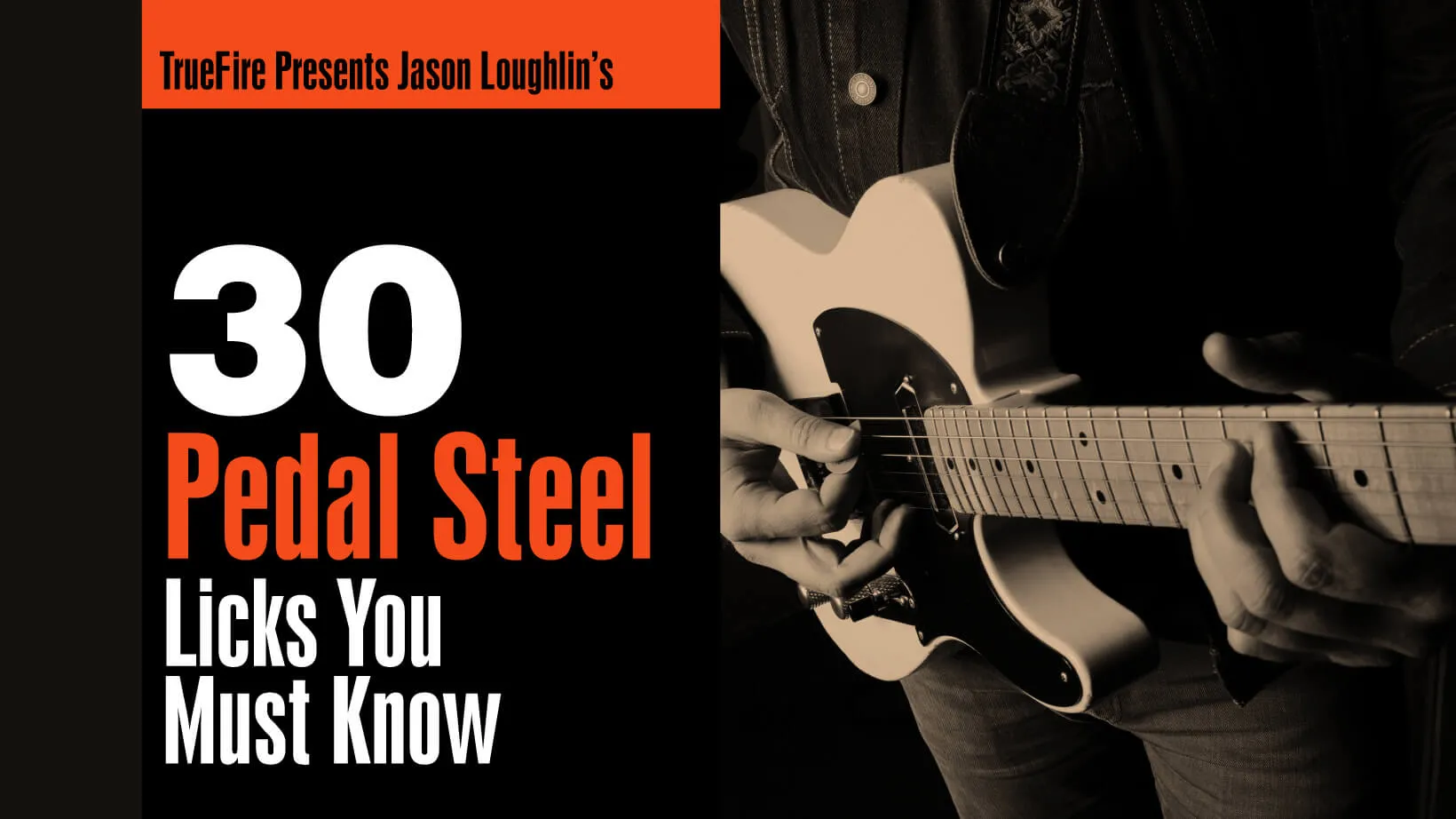
30 Pedal Steel Licks You MUST Know

Learn How to Emulate the Pedal Steel on Guitar

Marty FriedmanTommy EmmanuelSteve VaiEric GalesEric Johnson

Get this course and 1,000+ more with All Access

Try 14 days free. Cancel any time.

Purchase Individual Course for $14.99
30 Pedal Steel Licks You MUST Know

About this course

Pedal steel is one of the most recognizable sounds associated with country music.  Electric guitar players have been trying to copy its sound since the 1950’s. By learning how to imitate the pedal steel we can change our whole perspective on how we see the electric guitar --  the bends that are possible, the expressiveness of the instrument, and it’s unique approach to phrasing.

In Jason Loughlin’s collection of 30 Pedal Steel Licks, you’ll learn ways to bend triads, incorporate bends into our arpeggios, play jazz-inspired altered lines, bend double stops, contrary motion bends, play some classic pedal-steel intros, and a whole lot more.

”Pedal steel guitar evolved out of lap steel guitar in the 50's and starts to really come into focus by the late 50's. Here's what we need to know: There are two common tunings, E9 and C6. These tunings vary depending on how many strings the steel guitar has. For most of this course, we're trying to make bends that correspond with the pedal and knee lever bends.”

Jason will demonstrate the lick over a backing track and then break it down for you emphasizing the key techniques and harmonic approaches in play

Jason will explain and demonstrate all of the key concepts and approaches along the way.  You’ll get standard notation and tabs for all of the performance studies. Plus, Jason includes all of the rhythm tracks for you to work with on your own. In addition, you’ll be able to loop or slow down any of the videos so that you can work with the lessons at your own pace.

Grab your guitar and let’s get play pedal steel with Jason Loughlin!

What you'll learn

  • Execute a Lloyd Green-style chromatic lick to walk into chord changes
  • Combine bending with hammer-ons and pull-offs for complex voicings
  • Apply pedal steel techniques to standard guitar
  • Bend intervals of a sixth diatonically with different bend amounts on each note
  • Understand how to create chord clusters using bends
Release date: 10/18/2018 • 1h 21m runtime
Start Course
Sample lessons
Seesaw
Seesaw
Lick 2
Fishtail
Fishtail
Lick 5
Swinging
Swinging
Lick 9
Building Blocks
Building Blocks
Lick 16

What's included

34 lessons • 30 charts • 29 Jam Tracks

30 Pedal Steel Guitar Licks
Hi, I'm Jason Loughlin, and welcome to 30 Pedal Steel Licks You MUST Know. Pedal steel guitar is one of the most recognizable sounds associated with country music. Electric guitar players have been trying to copy it's sound since the 1950's.

By learning how to imitate the pedal steel guitar we can change our whole perspective on how we see the electric guitar — the bends that are possible, the expressiveness of the instrument, navigating the instruments mechanics and how it applies to the electric guitar and it's unique approach to phrasing.

In this collection of 30 pedal steel licks, we'll check out ways to bend triads, incorporate bends into our arpeggios, play jazz-inspired altered lines, bend double stops, contrary motion bends, we'll learn some classic pedal-steel intros, and a whole lot more. The licks that I've compiled for this course come right from the greats like Ralph Mooney, Lloyd Green, Buddy Emmons, Tommy Collins, Hal Rugg, Jay Dee Maness, Tom Brumley and more.

Everything is tabbed and notated, and you'll have all the jam tracks to work with on your own. You can loop and slow down the videos to work at your own pace.

Grab your guitar and let's get started!
Pedal Steel Guitar
Pedal steel guitar evolved out of lap steel guitar in the 50's and starts to really come into focus by the late 50's. Here's what we need to know: There are two common tunings, E9 and C6. These tunings vary depending on how many strings the steel guitar has. The common E9 for pedal steel tuning is B-D-E-F#-G#-B-E-G#-D#-F# and the common C6 tuning is C-F-A-C-E-G-A-C-E-G. This is good to know so we can see what would be available under our bar.

The foot pedals are known as A-B-C pedals can bend the strings up to different pitches. The A pedal bends the 3rd up to the 4th, the B pedal bends the 5th up to the 6th and the C pedal bends the root and 5th up a whole step.

The knee levers are labeled D-E-F-G and can raise or lower pitches. The D pedal can lower 7ths to b7ths, the E pedal can lower roots to 7ths, the F pedal can raise roots up a half step to the b9th and the G lever can raise the 2nds up to the b3rd.

For most of this course, we're trying to make bends that correspond with the pedal and knee lever bends. I've included a list of popular steel guitarists, and I would also recommend visiting the steel guitar forum at steelguitarforum.com as an additional resource.

Steel Players You Should Know

Ralph Mooney
Tom Brumley
Lloyd Green
Buddy Emmons
Hal Rugg
Curly Chalker
Jay Dee Maness
Paul Franklin
Speedy West
Pete Drake
Sneeky Pete Klienow
John Hughey
Buddy Charleton
Weldon Myrick
Hank Devito
Gear & Tone Considerations
Let's talk about some of the things we can do to help us imitate pedal steel guitar. One thing we can is use light strings to make these bends easier. I'm using 10's, which is on the heavier side. Using 9's or 8's would definitely take some stress off our fretting hand, and because we're fretting notes and not using a bar to slide, we won't have the same sustain that steel players have.

Using a compressor with a long release will also help sustain notes. Reverb is our friend! Steel players use reverb more generously then guitarists do to help create depth to their sound. You don't want it to sound like surf, but not too dry either. I'm not using a volume pedal for any of these licks, so you hear every attack but swelling into chords or crescendo-ing through phase that's decaying is going to sound more steel-y.

You want to have plenty of headroom with your amp. Distortion is not your friend when it comes to steel guitar. You're looking for clarity and quick attack. This is one of the reasons steel players like solid state amps. They can get loud and clean and have a quick response to pick attacks.
Climbing the Fence
"Climbing the Fence" is a lick in G based on a common steel concept. We're arpeggiating through a major chord in sets of three. Though each set of three is descending, the first note of each set starts on a higher chord tone each time. Play staccato, pulsing with the fretting hand so notes don't ring into each other.

After we finish arpeggiating with triplets, the lick wraps up with a couple bends. First is a double stop bend with D and G, the fifth and root of the chord. I keep G on top and bend D up to E. This is called an oblique motion bend. One note stays and the other moves. Next is a double stop of D and G. The last bend is operating in the same way a steel guitarist does one of the most common moves on the instrument. We're using an open D chord shape at the 14th fret and bending the fifth to the sixth and hammering the 3rd to the 4th. This is recreating steel guitarists pressing down the A and B pedals to change I chords to IV chords.
Seesaw
"Seesaw" is a Tom Brumley lick that's used on countless Buck Owens recordings. Steel players love to play IV chords over I chords. The theory name for this is called a secondary sub-dominant. This arpeggiates the Ab and Db major chords. We arpeggiate the Ab chord starting with a double stop and use a bend to get to the third of Db. After playing the root and third of Db, we'll do a release bend to get back to the fifth of Ab. The pattern is played twice.
The Windup
"The Windup" is a Llyod Green lick from a Tommy Collins recording. This lick over D mixes diatonic and chromatic movement. The key here is to try to make the notes ring into each other and get it to sound as legato as possible.

We start with a bend release from the third to the second and then slides back up again. Next, we'll bend the third up to the fourth and play the sharp four on the next string. We'll play this pattern again on the fifth and then diatonically walk up to the root.

The second half of the lick starts with outlining the arpeggio and then jumps up to a double stop of a b3rd and b5th. This double stop will be pre-bent up a half step, so we can do a bend release from the 3rd and 5th down to the b3rd and b5th. Then we move down to the 2nd and 4th, and diatonically down to the root and 3rd. These big intervallic jumps are common for steel players.
The Tailor
"The Tailor" is a Buddy Emmons lick that shows off his tendency to turn dominant chords into altered chords. In this example, we're in A going from a V chord to a I chord. Emmons uses the V chord as a playing field to add altered notes.

It starts with chromatically connecting the six to the root. Then in the next section, it arpeggiates down from the 11. In order: 11, 9, b7 and 5. Now we get into the altered sounds. Emmons bends into the sharp 9 then down to the flat 9. Then we cross strings to the #5. Now we'll use the diminished scale and descend down from the 3rd to connect to the root of the I chord.

+ 27 more lessons

Start Course

Reviews

23 results

EricStrat

Verified buyer

05/25/26

Was challenging at first but worth the time investment.

filmcomposer

Verified buyer

02/27/26

30 Pedal Steel Licks You Must Know

“30 Pedal Steel Licks You Must Know” is a very well done course. Jason Laughlin’s approach is very musical, which makes the material feel practical and inspiring rather than mechanical. He presents the licks in a way that helps you understand not just what to play, but why they work. What stands out most is how he connects everything to the underlying harmony. He refers to the harmony from a very intelligent and traditional foundation, which gives the course real depth and makes it valuable for players who want to build strong musical instincts—not just memorize patterns. Whether you’re new to pedal steel vocabulary or looking to strengthen your phrasing and harmonic understanding, this course is an excellent resource. Jason teaches with clarity, taste, and real musical authority.

countryjammer

Verified buyer

12/04/23

Pedal Steel Licks you'll want to learn

I recently purchased the course "30 Pedal Steel Licks You Must Know", but have only spent a short time with it. I love what I hear and I'm looking forward to spending more time with it. Like all the TrueFire country courses that I have purchased they are all well done.

Osokin

Verified buyer

07/19/23

Next Level String Bending!

Jason Loughlin is a tremendous guitar player and an excellent instructor, and in this course he does a great job of demonstrating how it is possible to play authentic sounding pedal steel guitar licks on a standard electric guitar. Some of the licks are certainly challenging to play - but the reward is that once mastered you not only have some great new vocabulary, you will have also probably taken your string bending capabilities to the next level. Creative players will also discover applications for many of these licks in music other than country. Great stuff!

vcmvcm

Verified buyer

11/28/22

Pedal power

Great stuff that took me on a different route

Stop searching. Start improving with All Access.

Try 14 days free. Cancel any time.