
Acoustic Guitar Explorations


TrueFire
Educator
Genres
About this course
As you progress along this Exploration, we'll also help you learn more about the other learning tools available to you as a TrueFire student.
For example, check out TrueFire’s nav bar and have a look at the drop-down selections. Under “Learning Tools” you’ll find links to our online tuner, online metronome, and jam track library as well as some important chord charts, all of which will come in handy on this learning adventure.
While you’re there, have a look at our blog and Riff Journal. These are both excellent resources for tips, valuable insight, more lessons, and interesting information about our favorite instrument. You might also enjoy saying hey to other TrueFire students in our Student Forum, which can also be found under the “Learning Tools” drop-down.
What you'll learn
- Integrate bass lines with arpeggiated chord accompaniment
- Navigate a 12-bar blues progression with Chicago-style voicings
- Execute polyrhythmic 6/8 against 4 feel in blues context
- Understanding Tim Sparks' teaching approach
- Learn about Pete Hutlinger's contributions to acoustic guitar
What's included
22 lessons • 11 charts • 2 Jam Tracks
Welcome to this Exploration of TrueFire’s top educators and a taste of their acoustic and fingerstyle guitar lessons. The lessons we’ll be suggesting are selected from the educators’ courses, so feel free to explore their other lessons—you have unlimited access to EVERYTHING during your free All Access trial.
As you progress along this Exploration, we'll also help you learn more about the other learning tools available to you as a TrueFire student.
For example, check out TrueFire’s nav bar and have a look at the drop-down selections. Under “Learning Tools” you’ll find links to our online tuner, online metronome, and jam track library as well as some important chord charts, all of which will come in handy on this learning adventure.
While you’re there, have a look at our blog and Riff Journal. These are both excellent resources for tips, valuable insight, more lessons, and interesting information about our favorite instrument. You might also enjoy saying hey to other TrueFire students in our Student Forum, which can also be found under the “Learning Tools” drop-down.
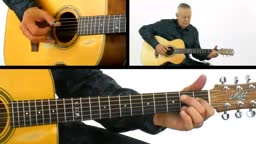
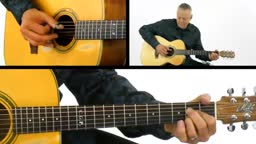
The exercise that I want you to learn now is playing arpeggios with the fingers, but while anticipating the notes while also swinging a little. The bass is still doing the same thing, but the hands are a little different.
I had to remind myself to use all three fingers in this exercise, and you can do it anywhere on the neck. So this is a good exercise for getting the fingers on your right hand used to playing something with a swing and an anticipation to it.
The exercise that I want you to learn now is playing arpeggios with the fingers, but while anticipating the notes while also swinging a little. The bass is still doing the same thing, but the hands are a little different.
I had to remind myself to use all three fingers in this exercise, and you can do it anywhere on the neck. So this is a good exercise for getting the fingers on your right hand used to playing something with a swing and an anticipation to it.
The exercise that I want you to learn now is playing arpeggios with the fingers, but while anticipating the notes while also swinging a little. The bass is still doing the same thing, but the hands are a little different.
I had to remind myself to use all three fingers in this exercise, and you can do it anywhere on the neck. So this is a good exercise for getting the fingers on your right hand used to playing something with a swing and an anticipation to it.
Here’s another scale for you! Sorry, but it’s very important. It’s fun and applicable! Little fragments of this idea crop up in every arrangement I've ever come up with in DADGAD tuning and it exposes the reason why DADGAD became such a prominent tuning.
I’m going to play a D major scale in the most boring way imaginable. Any time I'm teaching, I ask students to say what they hear differently and immediately I get either harp or church bells—both of which are correct. My friend Pierre Bensusan, who is associated with this tuning more than any guitar player alive, coined the term “harpisant” or “harplike” and though in classical guitar I'm not aware of any use of DADGAD tuning, there is a term for the concept of playing across the strings—“campanella” which means “bell like." The idea is to let notes RING!
So let’s look at that scale in detail starting on the open top string. Then, we have 4th fret on the second string and then 4th fret on the third string. Now, the first thing to mess up your head—we're going to go UP a string, from the 3rd to 2nd string to go DOWN a note.
Open strings in any context give the guitar player a chance to change position. We have two open strings in a row, which allows us to get from the starting position to the end position. The point of the weird looking fingering is to create the scale across the strings. We have four notes of a scale across four adjacent strings and on two occasions we go up a string to go down a note. Get used to it—it’s a really handy tool to have at your disposal; to have an open string to get us down the neck.
It’s just a major scale, nothing fancy, but there’s something really satisfying about playing that scale. You can feel the guitar vibrate! Look at the strings you use in playing it the boring way: 2, 2, 2, 2, 3, 4, 4, 4. Now here’s the cool way—it goes: 1, 2, 3, 2, 3, 4, 5, 4. You don't use the same string twice in a row. If you get fancy and extend it you can go 1, 2, 3, 1, 2, 3, 2, 3, 4, 5, 4, 5, 6, 5, 6.
So, the point of this exercise is not to be able to play scales, but to have fragments of that string of notes at your disposal. Those fragments are like words—you're increasing your vocabulary and when arranging melodies bits of that scale will crop up relentlessly, so it’s a good idea to have it at your fingertips in a way that you can play it automatically.
Then if you're feeling really adventurous try applying that idea the key of Bb. The open strings have different roles in this key, but we're going to stick mainly to the key of D. Have that scale under your fingers because it’s going to be really useful!
TrueFire's All Access students have unlimited streaming access to practically everything on TrueFire including all 350+ video courses and 25,000+ interactive video guitar lessons covering all styles, techniques and levels! All Access students also have unlimited access to 11,000+ tab & notation charts, 10,000+ Guitar Pro tabs, and 7,000+ practice jam tracks.
You can work with TrueFire lessons anywhere, anytime and on any device. Many students use their All Access student discount to purchase download versions of specific courses so that they can learn, practice and play offline with them as well.
If you haven’t already, use the drop-down under “Learning Tools” and select “Apps.” Then download a free desktop app for Mac or Windows to check it out — it comes with a free course!
Chord Changes: D - C - G - G—Little groups of five eighth notes with the first of those five serving as the bass note can have a surprisingly comfortable feel, yet with the gentle push that the 5/8 provides. I'm listening to where each of the voices is leading—the bass line, the top voice, and the middle line. On the G chord I chose to play the B in the bass because I’m walking the bass down. I may repeat three or four of the notes in the group of five, and move only one or two of the voices in the pattern, an approach that I've heard in Bach etudes.
+ 15 more lessons
Reviews
No reviews yet
Complete this course and be the first to share your experience.
Stop searching. Start improving with All Access.
Try 14 days free. Cancel any time.
