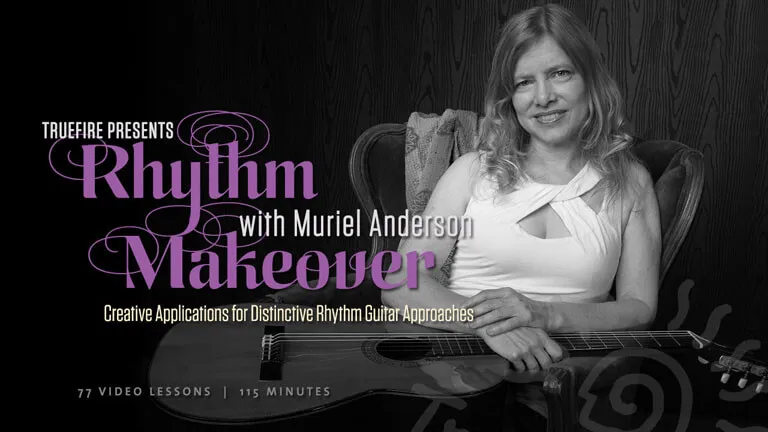
In this Rhythm Makeover edition, Muriel Anderson presents her signature fingerstyle guitar techniques and creative approaches. Muriel is the first woman to have won the National Fingerstyle Guitar Championship, has recorded with country legend Chet Atkins, performed with Les Paul, the Chicago Symphony and the Nashville Chamber Orchestra.
Expand your fingerstyle rhythm guitar prowess with Muriel Anderson’s Rhythm Makeover and be sure to check out Adam Levy’s Rhythm Makeover for electric guitar, and Vicki Genfan’s Rhythm Makeover for acoustic guitar.
Thousands of #1 hit records use the same handful of chord progressions. So, what makes those songs so distinctive from one another? Melody, lyrics and production values are all very important of course, but rhythm is what gets the feet tapping, the bodies moving and the lips smiling.
Whether they perform in bands, duos or solo as a singer-songwriter, guitarists play rhythm 95% of the time supporting the vocalist and/or soloist. A pretty big responsibility, and a pretty big challenge making those common chord progressions sound original and interesting.
TrueFire’s Rhythm Makeover series focuses on the art of crafting compelling, original and interesting rhythm guitar parts by equipping players with the harmonic skills, playing techniques, chord vocabulary and creative approaches for breathing fresh life into any chord progression.
Rhythm Makeover courses are presented by educators with vast experience composing, arranging, recording and performing songs for audiences world-wide. Each edition is presented a single educator, but all of the educators examine the same 15 chord progressions.
The 15 chord progressions were specifically selected because they have each powered hundreds of hit records, across a variety of popular styles. All of the educators also work with the very same bass and drum tracks to emphasize just how much influence the guitar part has on the distinctive qualities of a song. The progressions and tracks cover a variety of keys:
I-V-vi-IV progression in the key of C major I-vi-ii-V progression in the key of G major Descending IV-iii-ii-I progression in the key of E major ii-V-I-IV progression in the key of A major I-Imaj7-I7-IV progression in the key of G major iii-vi-ii-V progression in the key of C major I-vi-iii-IV progression in the key of G major I-IV-V-I in the key of E major Ascending I-ii-iii-IV progression in the key of A major vi-V-VI progression in the key of D i-bVII-bVI-V progression in the key of C minor I-iii-IV-V progression in the key of G major vi-ii-V-I-IV-iv-I chord progression in the key of E major I-II-V-I progression in the key of A major I-bVII-IV progression in the key of D Bringing his or her unique perspective and skill set to the table, the educator presents two distinct creative and technical approaches for each of the 15 chord progressions (30 approaches in all).
As you work through the 30 different approaches, you’ll learn new chord voicings, strumming and fingerstyle patterns, harmonic approaches, creative ideas, right and left-hand techniques and much more, all of which can be applied to any progression that you might encounter, in any key.
What you'll learn
Create multiple fingerstyle arrangements of the same chord progression
Execute Merle Travis-style voicings up the neck
Master complex fingerstyle patterns including double thumb technique
Use natural harmonics melodically and harmonically
Develop chord melody arrangements with moving bass lines
Welcome to Rhythm Makeover for fingerstyle guitar. In this course we'll take 15 progressions that may sound familiar to you because they are used in great songs in all different styles. I’m finding different approaches to each based on what would sound nice for each progression. These are all off-the-cuff ideas and that’s exactly what you would do if you’re figuring out a nice accompaniment or writing a tune using these progressions. I think you’ll find that after working through the rhythms, chord voicings and techniques used in these examples, you’ll get more fluent with the possibilities on fingerstyle guitar and come up with more ideas on your own. Some of the examples are fairly easy, and some are more difficult. Don’t be afraid to skip over some or to start with the ones that intrigue you the most. We will use the traditional Roman numerals to identify the progressions, so that they can be transposed to different keys. In general, capital letters will indicate major chords and small letters will indicate minor chords. The chord based off of the first note of the scale is a I chord, the minor chord based off the 2nd degree of the scale is written as a ii chord, etc. You can do any of these exercises on any type of acoustic guitar, steel string or nylon string, and some techniques transfer over to electric as well.
The I V vi IV progression is used in thousands of songs in all different keys. The key of C lends itself to a very traditional fingerstyle approach. While we're at it, let's throw in some handy licks that can make the progression more interesting. In so doing, we’ll come upon some techniques that we can check to be sure we’re doing them in the most efficient ways.
Chord Changes: C G Am F - If you remember the song “Alice’s Restaurant,” it starts with a simple signature lick. In addition to being a handy lick for other tunes as well, it also is a great technique builder in that it requires good positioning of the left hand in first position, and a nice gentle stretch. A great way to start our fingerstyle rhythm makeover. The standard fingerstyle accompaniment is thumb, middle, thumb, index, with the thumb alternating between bass strings, always on the strong beats. We’ll add a couple slight variations here as well. On the hammer-on, hit the string with the left hand finger with enough force to hear the note, yet be sure the rhythm is not rushed, it is that same rhythm as if you were to pluck the string.
Chord Changes: C G Am F - If you remember the song “Alice’s Restaurant,” it starts with a simple signature lick. In addition to being a handy lick for other tunes as well, it also is a great technique builder in that it requires good positioning of the left hand in first position, and a nice gentle stretch. A great way to start our fingerstyle rhythm makeover. The standard fingerstyle accompaniment is thumb, middle, thumb, index, with the thumb alternating between bass strings, always on the strong beats. We’ll add a couple slight variations here as well. On the hammer-on, hit the string with the left hand finger with enough force to hear the note, yet be sure the rhythm is not rushed, it is that same rhythm as if you were to pluck the string.
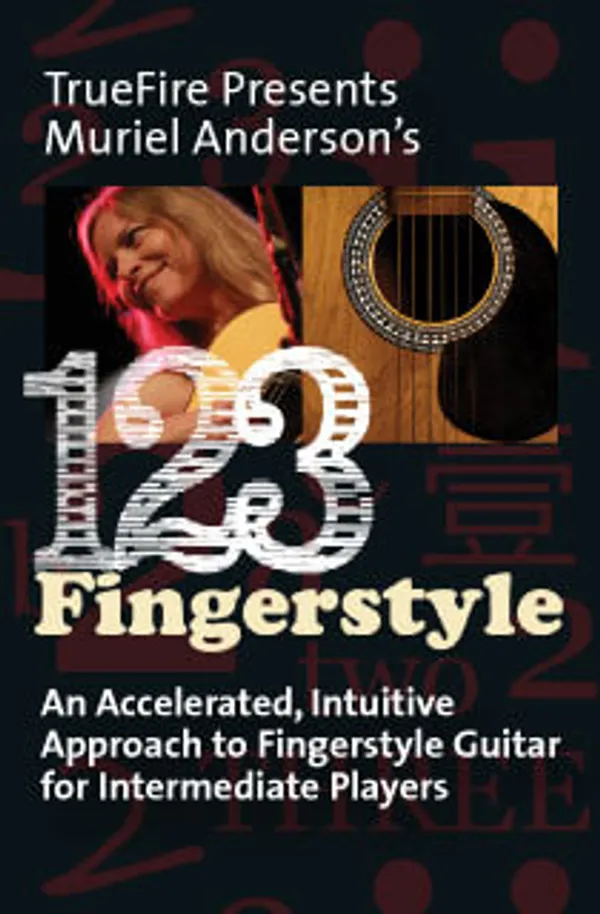
Chord Changes: C G Am F - Whether doing a fingerstyle solo or an accompaniment, we can use the little finger to grab some melody notes. (If you’d like more practice with this, my TrueFire course 123 Fingerstyle works with gradually adding melody notes to fingerstyle patterns.) This is a good time to also play with making some of the notes more staccato, and giving the pull-off a good pull to get a clear sound.
Chord Changes: C G Am F - Whether doing a fingerstyle solo or an accompaniment, we can use the little finger to grab some melody notes. (If you’d like more practice with this, my TrueFire course 123 Fingerstyle works with gradually adding melody notes to fingerstyle patterns.) This is a good time to also play with making some of the notes more staccato, and giving the pull-off a good pull to get a clear sound.
We’ll choose the key of G for this progression, starting with an approach similar to the old time bouncy style of Merle Travis. It’s often nice to sprinkle a few harmonics into your arrangements. Just for fun, in the second approach we’ll do one entirely in natural harmonics and open strings.
This course for me brought out more ability to get people tap their foot when listening. Before, my finger style accompaniment was smoother and more uneventful. I enjoyed applying the different style applications to the same tune.
C
champignon56
Verified buyer
02/26/21
After each lesson, i can't stop to play.
S
solargman
Verified buyer
06/13/20
Learning rhythm playing and being able to keep a rhythm is a important skill all guitar players need to learn. This course is helping me do just that.
T
Tracteur2660
Verified buyer
05/20/20
I found what I was looking for.
I found exactly what I was looking for. Muriel Anderson is an incredible guitarist and a fantastic teacher . The most beautiful thing is I have it at home on line .My next move is world of fingerstyle . Thank you very much.