julseg22
Verified buyer
04/14/26
Very happy



Get this course and 1,000+ more with All Access
Try 7 days free. Cancel any time.
About this course
What you'll learn


61 lessons • 34 charts
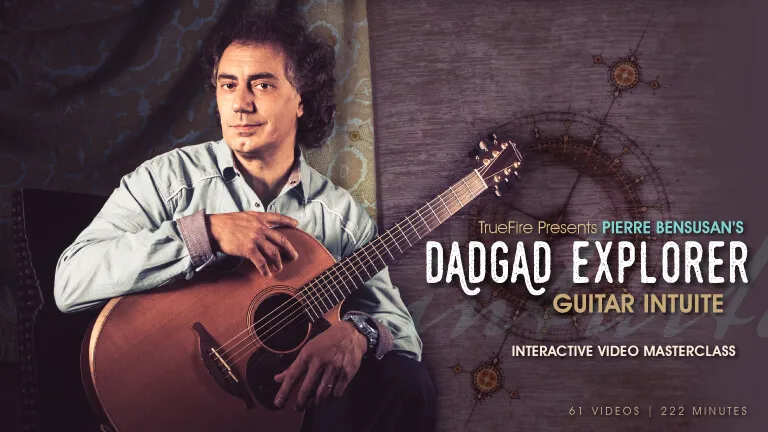
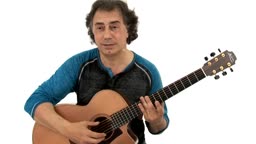
Hello everyone, and welcome to DADGAD Explorer: Guitar Intuite. It's a great pleasure to dive in with you into my musical world, which I hope you'll find inspiring. Before we start, I'd like to remind you that my approach to DADGAD is very different from other guitarists, as I do not see DADGAD as an alternate tuning, but rather my "native" tuning. One of the reasons for this is that I learned to play the guitar in the sonic environment of DADGAD, which I'll keep "exploring" until the end of times.
The name of this course, "Guitar Intuite," is not only a reference to the piece of the same name presented at the end, but to a state of mind, an attitude, or a way to use our intuition at its best. I sure hope you'll be into it, so grab your guitar and let's start exploring!
In this first section of the course, I'll give you an introduction to the sounds of DADGAD and some of the techniques that are key to my style of playing.
I wrote this song in 1977 with Ireland in my heart, as I was on a ferry boat traveling from the harbor of Le Havre in Normandy (France) to Roeselare in the south of Ireland to do my first Irish tour. I've been performing there (south and north) every other year ever since.
"Le Voyage pour l'Irlande," from concept to structure, is a good starting point as it offers the opportunity for the player to see the basic structure and look at the development of the piece (i.e., Segment 7: "Concepts and Approaches: 5").
Melody is very important in the music that I play. Many guitar players focus on harmony first, often at the expense of melody. I always try to make the guitar sing, perhaps this is because singing has also been an important part of my musical experience. I often use the voice as a vehicle for the melody or a different harmony, improvising the vocal "colors." Sometimes the humming will be replaced by real lyrics later on, even though many of the tunes I write are songs without words or voice parts.
In this segment, we'll be working on developing a hierarchy of resonances. Here I'll show you that the fingers of our right hand (when the player is right handed) can be used to create sound but also to mute. In other words, the same finger can be used to pick a string and then to stop the resonance of that same string, letting the next string—plucked by another finger—ring by itself. Practicing this will help you discern what the essential notes are in your playing, better organize both their mixing and length of their resonance, and stop the overlap of undesired tones.
There are several different ways to control the notes’ sustain. Here, each finger has a dual function: pick and stop or pluck and rest. Have your left hand mute all six strings at the seventh fret while your right hand plucks each string, creating a more rhythmic and drier sound that helps articulate what you're doing. For the next hand movement, you'll stop muting the strings with your left hand, having each of them resonate openly until you apply the resting/stopping technique I described.
The little triangle in the tab, next to a letter and arrow, indicates that the referenced finger comes down in rest stroke position on the string (with the triangle) at the same time as the other bass is being played. This way, it stops the resonance of the bass note on which that finger rests. This results in hearing only one bass at a time—no overlap, no undesired interval, more precision, clarity, more music, and less confusion. This technique, relevant no matter the tuning, will make your right hand much more capable and in control. It’s even more crucial in DADGAD, where the tuning has a tendency to regularly drown everything out.
Here we'll be looking at the chords behind the melody of "Le Voyage Pour l'Irlande."
Now let's look at placing the bass line. The location of the bass often gives a clear indication of the tempo. Once you've established a tempo, we can change the placement of the bass notes to make it unpredictable, more exciting, and more musical.
+ 54 more lessons
8 results
julseg22
Verified buyer
04/14/26
Very happy
recordingstudio421
Verified buyer
06/24/25
:)
This course was thorough and very understandable. DADGAD is different and takes time but Pierre explains it well
glynw1
Verified buyer
12/30/24
Demistfied
Has demistfied something I have many years of frustration with.
pjc232
Verified buyer
05/10/23
The Best of the Best in DADGAD
Pierre Bensusan is such an astounding player and teacher; he provides a great intro to his style and DADGAD in general. Highly recommend this for anyone new to the tuning!
fingersloth
12/30/20
DADGAD explorations
Pierre Bensusan is wonderful teacher and human. His music is very melodic and beautiful. The course breaks down the tuning of DADGAD, common chord shapes, some of Pierre's background but it is really a wealth of refined technical guitar skills. He provides a deep philosophical context to playing music. He patiently breaks down the difficult techniques that sound so beautiful
Try 14 days free. Cancel any time.