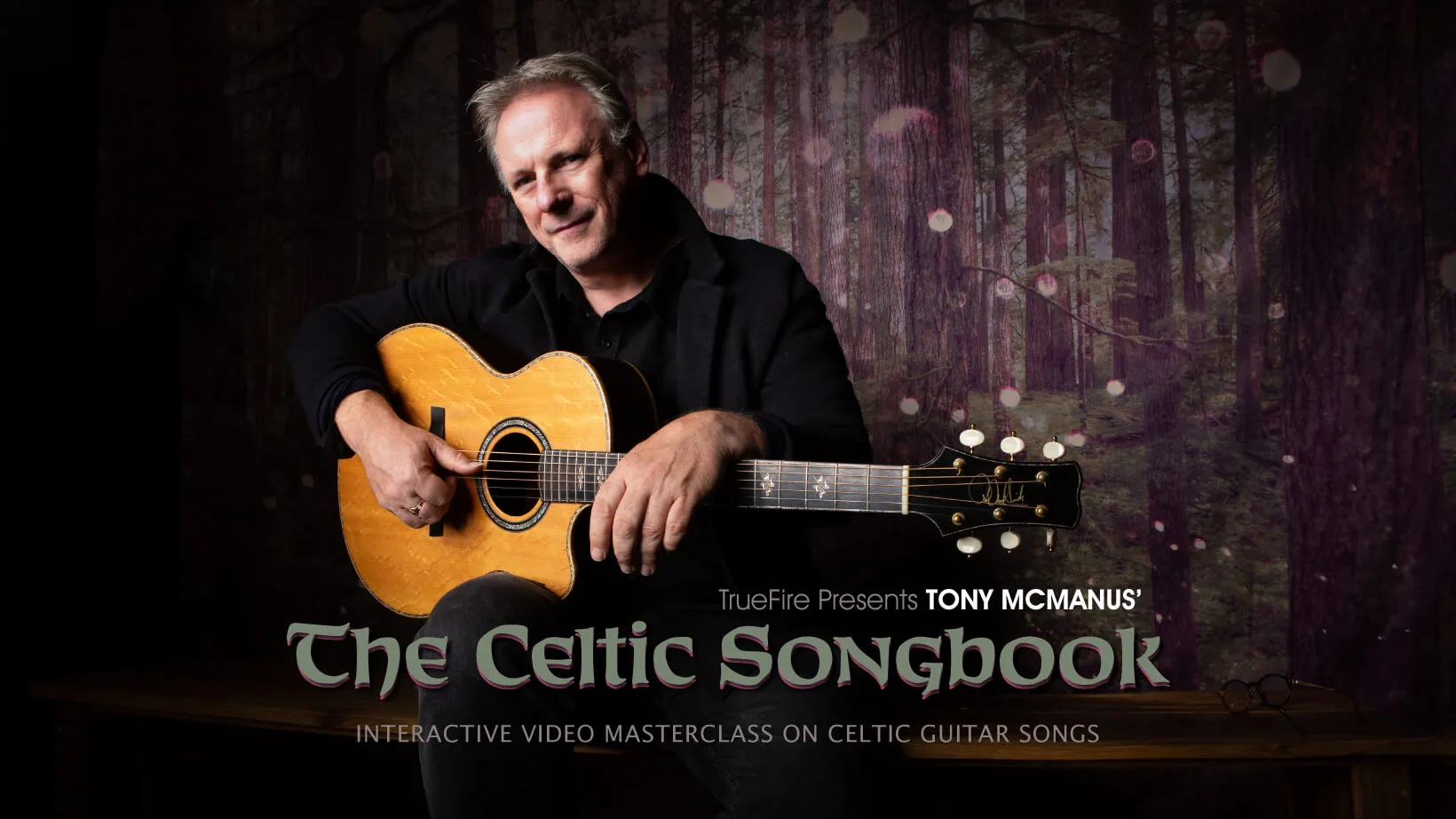
The Celtic Songbook

Interactive Video Masterclass on Celtic Guitar Songs

Marty FriedmanTommy EmmanuelSteve VaiEric GalesEric Johnson

Get this course and 1,000+ more with All Access

Try 14 days free. Cancel any time.

Purchase Individual Course for $19.99
The Celtic Songbook

About this course

Like most styles of folk music, learning Celtic songs and building your repertoire is fundamental to becoming proficient in the style.

In this Celtic Songbook from Tony McManus, you’ll learn 5 accessible Celtic arrangements deliberately selected to help you develop key Celtic techniques, and at the same time -- pass on a varied, authentic repertoire that you can play at the gig, or just for family and friends.

Each song is presented along with a series of lessons and playalongs designed to prepare you for learning the full performance arrangement of the tune. As you work through the set of song lessons, Tony will pass on important insight and tips to help get your Celtic playing up to speed quickly.

Tony will explain and demonstrate all of the key concepts and approaches along the way. You’ll get standard notation and tabs for each of the songs. In addition, you’ll be able to loop or slow down any of the videos so that you can work with the lessons at your own pace.

Grab your guitar and let’s get Celtic with Tony McManus!

What you'll learn

  • Use slides to open strings for emphasis
  • Execute pull-offs in a Celtic music context
  • Maintain 3/4 time feel in uptempo dance music
  • Understand typical Celtic phrase structure (statement and varied ending)
  • Appreciate the emotional depth and authenticity of Celtic music beyond commercial stereotypes
Release date: 01/30/2019 • 2h 59m runtime
Start Course
Sample lessons
Celtic Music History
Primer Part I
Elizabeth Kelly's Delight
SECTION 2: Overview
Slip Jig Timing
Slip Jig Timing
Demonstration
Bassline Movement and Fingering
Demonstration

What's included

50 lessons • 28 charts • 2 Jam Tracks

The Celtic Songbook
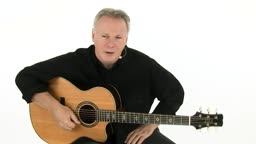
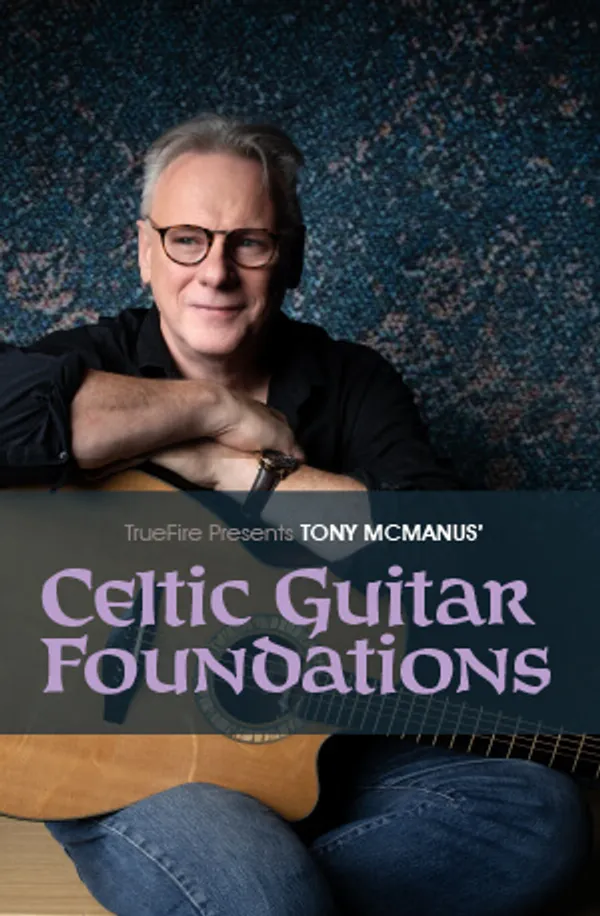
Hi, I'm Tony McManus and welcome to The Celtic Songbook!

Like most styles of folk music, learning songs and building your repertoire is fundamental to becoming proficient in the style.

You'll learn 5 accessible Celtic arrangements in this songbook. I've selected the tunes to help you develop key techniques, and at the same time - pass on a varied repertoire that you can play at the gig, or just for family and friends.

Each tune is preceded with a series of lessons and play alongs designed to prepare you for learning the full arrangement. I'll also pass on some important insight and tips to help get your Celtic playing up to speed quickly.

Everything is tabbed and notated for you. You can loop and slow down the videos to work with the lessons at your own pace.

Grab your guitar and let's get started!
Celtic Music History
Let's look at the term "Celtic music". What does it mean? Well, the Celts were one of the tribes of people in Europe - among Saxons, Normans, Vikings, etc. Over the course of several hundreds of years, they got pushed further and further west, and so today the Celtic regions of Europe are the extreme western points: Ireland, west coast of Scotland, northwest coast of France and Spain, Isle of Man, Cornwall, southwest England, and Wales.

There are commonalities between these regions, and they're reflected in their music and language: Welsh, Scottish and Irish Gaelic, Breton, and dialects of Spain all share Celtic roots. Musically, it's a fascinating landscape - I think it reflects the difficulties of living on the extremities of the continent. It's not exactly easy eking out a living being battered by the Atlantic Ocean, and this is reflected in the emotional depth of the music. It's not really the easy-listening, "new age" genre that it's marketed as. It's the emotional opposite, and I hope through these tunes I can communicate that to you.
Types of Guitars
So, what kind of guitars do we use in Celtic music? The answer is whatever guitar you have in hand. There's kind of a dichotomy here: This music is very, very old, but the role of the guitar is very recent. In fact, too recent for their to be an orthodoxy to what kind you use. The guitar crept in through the "ballad boom" in the 50's and 60's, the explosion of folk music. It replaced the piano as the rhythm instrument, and that is its traditional role.

For the most part, it's steel string guitars - there's no particular shape to the body, or brand that is preferred. It's not like gypsy jazz where there's a very specific type of guitar that's being played. And, in recent years, people like Steve Cooney have played nylon string guitars, and have generated a style of playing that only uses that kind of string.

For tunings, some of the ones I use require tuning way down, so I tend to favor a guitar that will take tuning all the way down to C. I use medium gauge strings on any size instrument that can take the tuning. Don't feel pressured into having any particular sort of instrument in order to play the music.
Musical Concepts
So, we're talking about folk music from the western extremities of Europe. This music involved instruments that are common to every folk tradition: violins, flutes, etc. But also instruments that are unique, including types of bagpipes that change depending on the individual culture. Sometimes the scales of these instruments will determine the structure of the tunes. This limitation, ironically, opens up a whole bunch of harmonic ideas. This is also what seems to give Celtic music it's character.
Celtic Rhythms
Some of the music of the western extremities of Europe has evolved as instrument-specific to their regions: In Scotland, of course we have the Great Highland bagpipes, in Ireland we have the Uilleann pipes, in Brittany we have the biniou (a tiny, high pitched bagpipe), in Spain we have the gaita, etc. And, as we discussed, these all have unique features that determine the structure of the tunes (as we saw in the previous lesson with the Highland pipes and the Mixolydian scale).

Another huge aspect of this instrument is the ornamentation. There are certain techniques that happen on any of the traditional instruments that we can steal on the guitar, some of which are probably familiar to you (hammer-ons, pull-offs, etc.), and others that are not (right hand triplets). I use a combinations of these routinely to make the music sit better within the tradition. We'll look at all these techniques in much more detail within this course.

The way we tune the guitar is also a major aspect of playing this music. Again, the guitar's role is not that old, and we're still exploring things. One way we've done this is altering the tuning - whether it's drop D, DADGAD, open G, Csus2, or another.
Planxty Irwin
This is a tune called "Planxty Irwin". That word, "planxty", is a sort of bizarre artifact of the Irish language. It has an X in it, which I'm told doesn't exist in Irish! And, it doesn't appear ever in English, not even archaic versions of it. So, what does it mean? It means "in honor of", so it's a tribute, and it's often followed by a name (there's a "Planxty Johnson" as well among others).

This song was composed by one of the very important figures of Irish music, Turlough O'Carolan, who was one of the last of the Bardic tradition. A "bard" would be someone who traveled around the country as a composer. He was blind from birth, and travelled around on horse with his wire strung harp strung over his back. He would go from big house to big house composing tunes for special occasions (weddings, births, etc.) for his hosts.

On this one, we're going to look at DADGAD tuning, as well as playing across the strings as if we're playing a wire strung harp. Let's take a look.
DADGAD Tuning & Basic Chords
So we're going to look at a tune called "Planxty Irwin", which is in DADGAD tuning, one of the best known alternate tunings for guitar. It goes back to the mid-60's, to a guy named Davey Graham, who was one of the great acoustic guitar players from the UK. He developed this tuning to play ethnic music - not specifically Celtic music, but Asian, African, etc. He needed a way to play it that sounded closer to that idiom, so he came up with this tuning.

It's more useful to think of this tuning as an alteration of open D rather than of standard tuning, since it's much closer to that tuning. Davey's idea was to take open D tuning and change the major 3rd into a suspended 4th, allowing you to change between major and minor easily. Let's look at some of nuances of DADGAD, as well as where the chords are when playing in this tuning.

+ 43 more lessons

Start Course

Reviews

10 results

Popgun64

Verified buyer

03/01/25

Celtic songbook

Just started, so far so good
mikecee

Verified buyer

01/18/25

The legend Tony McManus teaches Celtic Songs

Was excited to find the legendary Mr Tony McManus teaching Celtic guitar technique on True Fire. As well as being a legend player, he is also an awesome teacher. Do not hesitate to purchase any of his teaching courses, you will not be disappointed. I am just a hobby guitar player and his teaching style is great for all levels, you will learn some awesome tunes whatever your playing ability is.

bivio

Verified buyer

01/02/21

very good and clear

moreshaun

Verified buyer

07/04/20

Inspiring Instruction and Playing

Tony scaffolds everything so that you get both instruction on how to play and the intention behind the playing - the history and sense of things. His demonstrations of the pieces are moving and clear, inspiring aspiration. It is very encouraging to find a course which demonstartes guitar being used in Celtic music for more than rhythmic accompaniment. Thank you, Tony.

justoh

Verified buyer

03/22/20

Wonderful arrangements and an excellent teacher.

Stop searching. Start improving with All Access.

Try 14 days free. Cancel any time.