Greenwave
Verified buyer
09/22/26
Qunitessential teacher
Jeff is the quintessential teacher, his breadth and depth of skill and knowledge is astounding.





Get this course and 1,000+ more with All Access
Try 7 days free. Cancel any time.
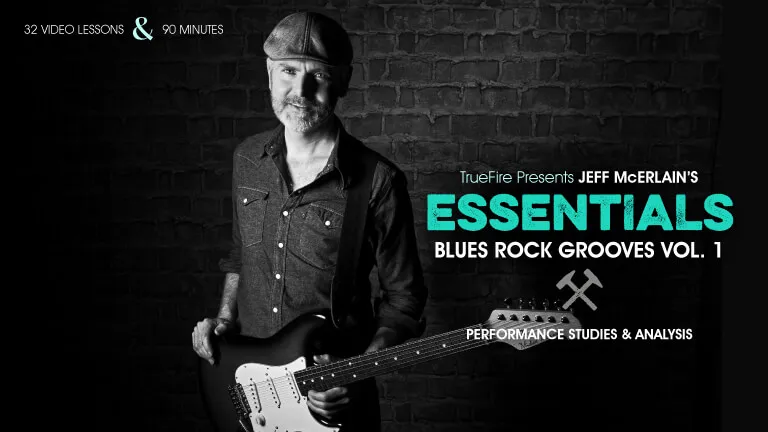
About this course
Below is a list of Jeff McErlain's preferred gear including guitars, amps, pedals, accessories, and more. What you see in Jeff's lessons may or may not be this actual gear, but if you are trying to capture Jeff's sound and tone, the gear listed below is recommended by Jeff and it's a great place to start!
What you'll learn


32 lessons • 10 charts • 10 Jam Tracks
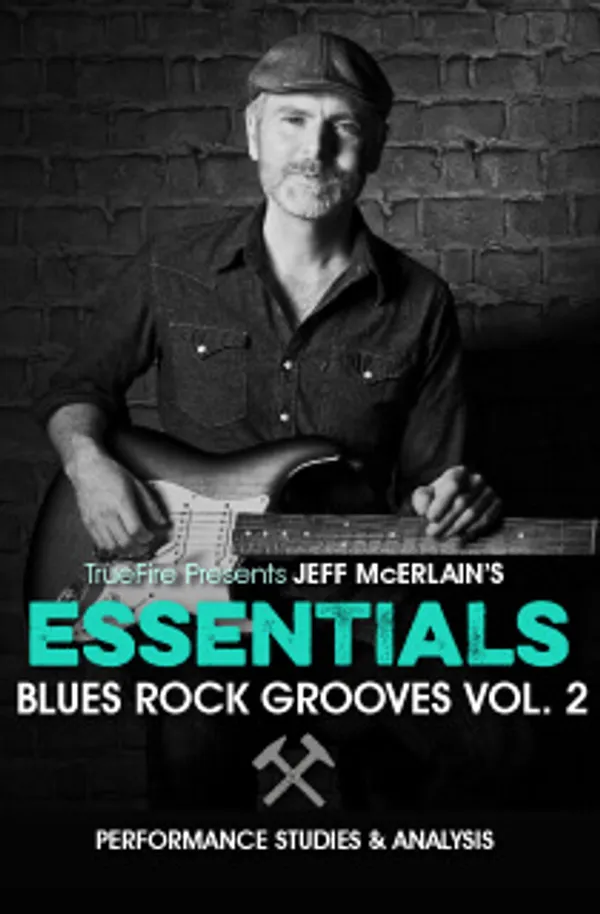
Thanks for picking up Essentials: Blues Rock Grooves Volume I, I'm psyched to share some of what I think are the coolest blues rock grooves out there. It's my intention to show you many common threads between all of these tracks, which is a good thing, so we can repurpose many of the ideas into different types of grooves, feels, and keys.
This course is about learning some great tunes as much as it's about expanding your vocabulary as a player and performer. As musicians, we can never know too many tunes. It can only make us better players, give us more to draw on, and certainly make us more employable! But most of all, let's have fun with these grooves. I drew upon the best to get these, so most of them should be familiar to you. Jimi, Jimmy, Johnny, Robin, and more—and this is just the first volume!
Well, here it is, the riff that influenced generations—Muddy Waters' "Rollin' Stone Blues," also known as "Catfish Blues." Besides the countless covers of this tune and uses of this riff with different lyrics, it remains maybe the single most important riff to inspire the heavy blues genre, and as we work through this course we'll see how ubiquitous it is.
So let's talk about Muddy Waters for a minute; if you're not familiar with his body of work I cannot stress enough to dig into it. My personal favorite period of his work is his years with Chess Records—the songs, the playing, and the singing are all definitive to the electric blues. He was much more of a raw player in contrast to the refined elegance of the late great B.B. King, and that's where the charm lies. Be sure to check out Muddy's 1950 recording of this song, it's one of the greatest blues tunes and riffs of all time. I know the Rolling Stones agree; it's where they got their name.
There are many, many, versions of this classic tune, but Jimi Hendrix's is the one closest to my heart and the one I'm channeling here. The first version of this tune that I heard was the Jimi Hendrix version on his Blues record as a kid, and it along with his song "Machine Gun" changed the way I played and viewed the instrument.
As usual, Jimi took what Muddy did and amped it up quite a bit. I know in this age it's easy to overlook the influence that Jimi had on the guitar and rock and roll, but NOBODY played like that before him. We can certainly see and hear his roots, but he was a true innovator. I could certainly continue to gush over his playing and contributions to the guitar, but if you haven't listened to Jimi play blues in a while, please do so again. It's always a revelation for me and like drinking from a fire hydrant.
The main thing I can say when working on "Fishin' Blues" is to play with intensity. Really commit to the groove, feel, and notes. Take this opportunity, especially on the louder parts, to really dig into the strings to get that blues rock sound out of the guitar. The attack and timbre of note is essential for this tune to sound right. When I go to the softer section, I roll my volume knob back to clean up the guitar's signal, playing softer but still maintaining the same intensity in the playing.
I'm always thinking about the groove and looking to the drummer, so listen to the jam track and pay attention to the drums. Where is the kick and snare in the beat? Ask yourself, "am I locked in or not?" I HIGHLY suggest you record yourself playing the tune back and listen. Does it "make your big toe wanna stand up in your boot" as Little Richard said about Jimi?
I didn't mention what effects I was using in the video, but I have an amp (Marshall 2061x) that's distorting my sound, a fuzz pedal, and a delay as well.
This riff is based on the Free classic "Walk In My Shadow," which Joe B. covered on his Shepherds Bush Empire record. Free is one of the great British blues rock bands that don't get the attention they should. Paul Rogers is truly one of the finest rock singers of all time...I don't think that's in dispute, but I just wanted to say it!
Free guitarist Paul Kossoff died young due to drug abuse, however still wrote the song "All Right Now" and created some of the coolest blues rock riffs in the genre. His lead guitar work influenced many players including Dave Murray and Joe Bonamassa (I can definitely hear a similarity to Kossoff's vibrato and Joe Bonamassa's). Like most bands of the blues rock genre, it's best to listen to the live recordings, so watch some of the great footage of the band on YouTube.
I always love a straight rock groove with the blues, because when we think about the blues it's usually a shuffle feel. In "Shadow Walker," I played off the groove from Free's "Walk In My Shadow" to show you a cool riff just using the pentatonic scale. On this one, I'm going for a classic overdrive guitar sound using a strat into an overdriven tube amp. It's important to not get too crazy with the amount of gain as it can obscure the riff and lose a lot of its attack—some people may disagree, but hey, this in my course! ;-)
As we can see, the riff basically repeats itself throughout the whole tune. The challenge is to continue playing the riff, keeping it locked in, fighting off the will to go off too much. The riff IS THE TUNE and it's awesome as it is, so don't mess with it! In my 30 Authentic Blues Grooves course, I basically say the same thing about the Sonny Boy Williamson tune "Checking Up On My Baby," which is very similar. Keep it going, and keep it grooving. That's the real challenge!
"Shadow Walker" is a G blues with an interesting turn around that descends from the V to the IV chord with an added bIII chord at the end for a little more rock! The trick on this one is to keep the riff strong and driving yet laid-back and in the pocket. I can't stress enough listening to the original tune by Free with the great Paul Kossoff on guitar and Paul Rogers on vocals.
The riff is based upon a minor pentatonic scale although the overall tonality of the song is dominant, meaning that we're really hearing G7 as the I7 chord as opposed to G minor. By not actually sounding the natural third, using the flat third instead and slightly bending each time we come across it (I call this "tweaking the third"), the tonality becomes somewhat ambiguous which is a hallmark of the blues. We'll see this tweaked third in almost every song we play in this course. In fact, we'll see a tweaked third in just about every bluesy song we play. Almost by definition that is what makes it bluesy!
+ 25 more lessons
21 results
Greenwave
Verified buyer
09/22/26
Qunitessential teacher
Jeff is the quintessential teacher, his breadth and depth of skill and knowledge is astounding.
pmorey
Verified buyer
08/10/26
Essential Blues Rock Grooves 1
Packed full of useful deep grooves, this lesson is definitely worth checking out.
Ghetto1969
Verified buyer
12/23/25
Just great!!!
AndreyArtemyev
Verified buyer
11/16/25
A lot of great ideas
Great licks to make you feel much more confident in this style. And of course lot if ideas for your own riffs and solos. I'm totally satisfied.
Kevin7678
Verified buyer
02/11/25
great!
Try 14 days free. Cancel any time.