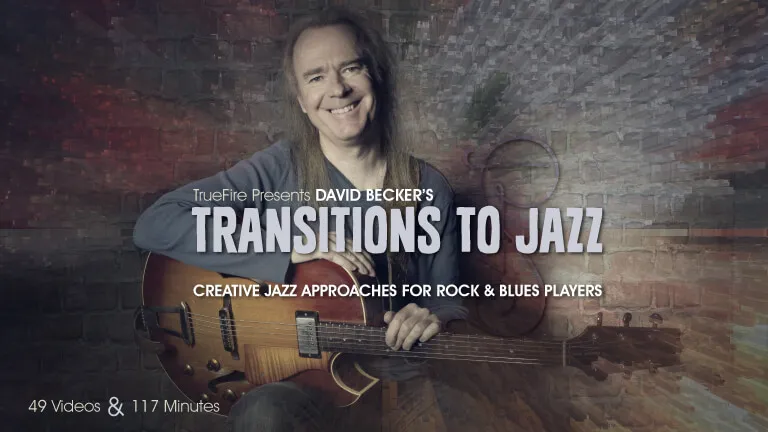
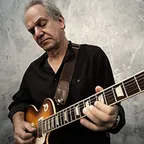
Transitions To Jazz

Creative jazz approaches for rock & blues guitar players

Marty FriedmanTommy EmmanuelSteve VaiEric GalesEric Johnson

Get this course and 1,000+ more with All Access

Try 14 days free. Cancel any time.

Purchase Individual Course for $9.99
Transitions To Jazz

About this course

Jazz guitar is certainly not the easiest style of music to learn how to play, but if you’re already a rock or blues player then you already know more about playing jazz guitar than you might think you do.

Jazz (like rock) is rooted in the blues. Understanding the common threads between the styles is the key to making the transition to jazz much easier and quicker. David Becker’s Transitions To Jazz identifies those common threads and shows you how to tweak what you already know into versatile jazz applications, vocabulary and dialects.

We’re majorly proud to welcome GRAMMY-nominated guitarist, composer and producer David Becker to the TrueFire family. David’s been recording, performing and touring the world over for the past 25 years to critical acclaim. He’s shared the stage with the likes of Miles Davis, Chick Corea, Michael Brecker and a host of other giants on the jazz scene. Fortunately for we students of jazz guitar, David is as passionate about education as he is about his music.

David organized Transitions To Jazz into three sections. In the first section, we’ll examine the tritone, triads and various extensions of the dominant seventh chord. We'll explore ways to comp using two, three and four note voicings, and I'll also introduce you to the standard 2-5-1 turnaround for the blues.”

In the second section, David introduces a concept he calls ‘Jazz Dialects.” In the Jazz Dialects section, we'll work on a variety of jazz applications for the pentatonic information you already possess, while also incorporating chromatics and triads as well as rhythmic variations. I’ll show you various approaches for comping and soloing over the standard 2-5-1 jazz progression. We’ll also work on approaches for changing keys.”

Section 2’s Curriculum includes Pentatonics For G7 and C7, Chromatics, Triads For G7 and C7, Chord Tones, The One Note Solo, 2-5 Progressions, 2-5-1 Progressions: Soloing & Comping, Two-Key Progressions: Soloing & Comping, The Cycle Of 4ths: Tritones & Dominant 7’s, Flat 5 Subs & Altered Dominant.

In the third and final section of the course, you’ll apply everything you learned in the first two sections across three Performance Studies.

I'll demonstrate how to develop a solo based on all the concepts from this course. We'll start out with a Jazz Blues in G, followed by a standard 2-5-1 progression which moves through 6 different keys. Lastly, we'll solo over a Bossanova progression in two keys which address both the Minor 2-5-1 and the Major 2-5-1.

David demonstrates the Performance Studies over rhythm tracks and then breaks them down, stepping you through the key concepts, techniques and creative approaches he used to perform the solo.

All of the key demonstrations, performances and examples are tabbed and notated for your practice, reference and study purposes. You’ll also get Guitar Pro files so that you can play, loop and/or slow down the tab and notation as you work through the lessons. Plus, David generously includes all of the rhythm tracks for you to work with on your own.

Grab your guitar and let’s get jazzed with David Becker!

What you'll learn

  • Master triplet feel against swing tempo
  • Create compelling solos using just one note through rhythmic variation
  • Develop swing feel by playing along with triplet-based drum tracks
  • Develop dynamic control and pick velocity to add expression
  • Build rhythmic motifs for improvisation
Release date: 09/21/2015 • 2h 57m runtime
Start Course
Sample lessons
2 5 1 Turnaround Harmony
Overview
2 5 1 Turnaround Harmony
Performance
Jazz Dialects: Pentatonics For G7
Demonstration
Two-Key Progression: Soloing
Overview

What's included

49 lessons • 24 charts • 6 Jam Tracks

Transitions To Jazz

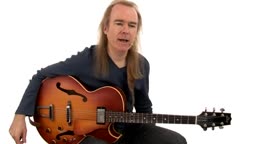
Hi, I'm David Becker and welcome to Transitions To Jazz.

Jazz is often thought of as extremely difficult and hard to transition to from other styles of music, but jazz (like rock) is actually rooted in the blues. Thus, there's a common thread that will help blues and rock players make an easy transition to jazz; the thread that we'll examine in this course.

I've organized this course into three sections. In the first section, we'll explore the tri-tone, triads and various extensions of the dominant seventh chord. We'll explore ways to comp using two, three, and four note voicings, and I'll also introduce you to the standard 2-5-1 turnaround in the blues.

In the second section, we'll take a look at a concept I call "jazz dialects." We'll work on a variety of jazz applications for the pentatonic information you already possess, also incorporating chromatics and triads as well as rhythmic variations. We'll go over various approaches to comping and soloing over the standard 2-5-1 jazz progression, as well as changing keys with a classic bossa nova form.

Then in the final section of the course, we'll explore three performance studies where I'll demonstrate how to develop a solo based on all the concepts from this course. We'll start out with a jazz blues in G, continuing with a standard 2-5-1 progression which moves through 6 different keys. Lastly, we'll solo over a bossa nova progression in two keys which address the minor 2-5-1 AND major 2-5-1.

For each of the performance examples, I'll explain the various approaches and concepts I used. You'll also get standard notation, tab, and rhythm tracks to work with on your own. Remember, music is sound and a language; you have to hear it to understand it. The more audio references you have, the easier it is to understand what sounds work where. So grab your guitar and let's get swingin'!

SECTION 1: Dominant 7 Study

The tri-tone, or forbidden interval, is essential to the blues and dominant 7 chords. It will help you unlock some of the mysteries of the blues progression and the standard II-V-I cadence in jazz, helping explain the use of chromatics as well.

The Forbidden Interval

Here I'm just using the tri-tone (the forbidden interval) for a three chord blues comp, moving them around chromatically (in half steps).

Forbidden Interval: The Blues

In this segment, I'm using the tri-tone as a solo motif. Pay close attention to the different inversions and listen to how two notes can actually outline the chord.

Forbidden Interval: Simple Motifs

Now let's look at some simple solo motifs using the tri-tone interval and one additional note. I've also added in a rhythmic pattern which remains constant throughout the blues form.

Extended Harmony

In this lesson, I'll show you how to use extended harmony (9th, 11th and 13th) over G7 by using different triad shapes.

Extended Harmony

In this performance, I'll demonstrate the use of extended harmony notes over the three chord blues progression.

+ 42 more lessons

Start Course

Reviews

14 results

Uschmed

Verified buyer

04/15/23

Great, invaluable insights and material for a foray into jazz. Recommended.

bobbe

Verified buyer

03/21/23

Very useful

Jeffrey

11/16/22

Great intro to Jazz

David is a great teacher. There's an old saying, "Small steps lead to great distances." This course offered me the footsteps necessary for a musical journey. Less metaphorically: The course is basic but necessary. It's not suitable for someone who has a grasp on cycle of 5ths, 251s, etc., but, even if you are only tepidly interested in jazz, most everything offered here is broadly applicable to traditional blues as well.

Darren J.

12/04/21

If you think jazz is hard, then buy this course!

Got the blues? Does your guitar need a to be jazzed up? Then buy this course! David Becker is an excellent teacher, and shows you how to take what you already know about the blues, and turn it into jazz. This course helped me to bridge the gap between these two genres. It is a liberating course, that will launch you into fretboard freedom!

Stop searching. Start improving with All Access.

Try 14 days free. Cancel any time.