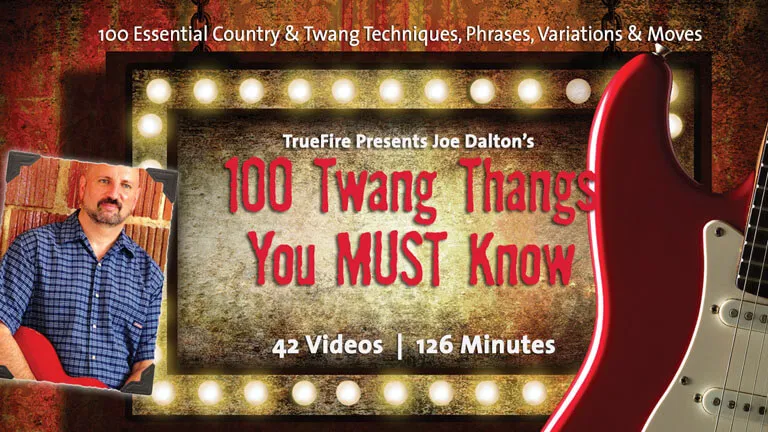
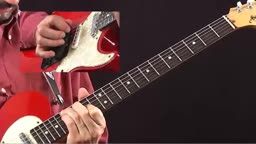
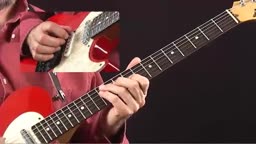
100 Twang Thangs You MUST Know dissects 100 essential country and twang techniques, phrases, variations and moves. This is NOT a "licks" course, although you'll pick up 112 of them during your Twang Thangs learning adventure with Joe Dalton, author of the top-rated Big Twang course.
Joe says "Twang Thangs is not about the licks. The licks and moves in Twang Thangs serve only as a vehicle for developing the 'twang' feel in your heart, soul and fingers. I'll show you how to twist and turn phrases and then apply them to various chords, a wide range of grooves for virtually every style of guitar. Lastly and most importantly, you'll learn how to make them your own."
Some call it country guitar with a dash of rock, blues and jazz. Others call it modern Nashville-style guitar. Derived only in part from "country" and pedal steel guitar, "twang" has evolved into a modern hybrid of blues, country, rock and jazz.
Albert Lee, Arlen Roth, Danny Gatton, Johnny Hiland, Ray Flacke, Leon McAuliffe, Brent Mason, Chet Atkins, Scotty Anderson, Red Volkaert, James Burton, Jimmy Bryant and countless other top cats all have their own signature Twang Thangs.
Dalton has prepared 42 full length video lessons that illustrate the diversity of the style. The lessons are grouped by key techniques; Pedal Steel, Swing, Rock Influenced, Rhythm, Chicken Picking, Banjo Emulation, Double Stops, Travis Picking and Crossover. You'll learn how to master the many different attacks required with the picking hand along with the essential "touches" required from the fretting hand.
For each of the moves and phrases covered in 100 Twang Thangs You MUST Know, you'll learn the physical techniques required to play that phrase, you'll learn the underlying theory for that phrase, you'll learn how to apply the phrase in a musical context, and then how to modify the harmonic and rhythmic structure of that phrase to fit a given style or passage.
Whatever your preferred style may be, 100 Twang Thangs You MUST Know will strengthen your physical skills and spice up your overall sound with an expressive, head-turning vocabulary of lines and moves.
What you'll learn
Execute authentic chicken picking tone through hard picking and string slapping
Execute authentic banjo-style rolls on guitar using hybrid picking or fingerstyle
Create chord melody arrangements using banjo roll technique
Add melodic interest by alternating chord tones and open strings
Adapt bluegrass licks to movable scale forms across the fretboard
Twang Thangs: I think I counted about 113 licks we jam packed into this thang. But it is not about the licks. I would like you to think of these licks as a vehicle for extracting the twang feel from your heart, soul, and fingers. Twist these licks every which way and apply them to different chords, grooves, and styles. Make them your own. Don’t forget about the possible impact you can have on the feel from your picking hand as well. Remember it's all about the feeling you put into it. Anyone can play the licks. Becoming an artist is the challenge I call you to today. Listening is very important. As a matter of fact, there is no substitute for learning by listening. Listen to the twang heroes, then listen to your own playing and compare. Make the adjustments and repeat the process. Become the artist.
In this example, we are simply arpeggiating the chord and resolving the non-chordal tone by bending the note up a whole step. As I read that line back, it didn’t sound simple. An arpeggio is playing the chord one note at a time. The non-chordal tone is the “E” on the ninth fret. The D chord contains the notes D F# A. The “E” doesn’t belong. Bending the “E” up a whole step gives you the “F#”. Support the bend properly with the first and second finger of the left hand. Don’t pick too hard on the right hand. Try different rhythms and different orders of notes.
This time we have two non-chordal tones. The first one is resolved by returning the bent note. The second one is the bend up as in the previous example. This contrary motion is the interest grabber. As you practice this, take your time to make certain that the bent notes are at the correct pitch. The last phrase is a good example of how to dress up a simple lick with a melodic touch.
Here is another example of outlining the chord with the same interval, a sixth. (The distance from the third string 11th fret F# up to the first string 10th fret D is six notes.) This time, we start with the chordal tones and bend the third of the chord (F#) up to the G, which is out of the chord and then resolve this note by returning the bent note back to the original pitch. So, we bent into the chord in the previous example. In this example, we started with the chord and bent out of it. The last lick is just two chords A and D, voiced with the common tone A on top.
This time the chords are voiced with the bend on top. I have taken the root and the fifth and placed them on the bottom. In example 1, the D and the A are the high notes in the first chord. In this example, the D and the A are the low notes of the chord. The result is a very warm sound. Notice the A7th starts with the chordal tone and bends out and the same with the final D chord. The interest in the phrasing is created by using the two different techniques (bending in and bending out).
The scale run at the beginning sets the flow for this example. Note the use of the bends and returns to get this very smooth, flowing effect. What we have done here is added some melodic flow to the imitation steel chord licks. If you play around with this enough, you can find the melodies to some of your favorite songs and start to use these in your solos. Chord/melody playing in any style is just that: chords and melodies. Now you have some ideas for chord/melody soloing while using these imitation pedal steel licks.
First, listen for the variations of the licks you have already been playing. Analyzing a phrase is a great listening exercise and learning experience.
What I’ve done here is added some notes from the scale and changed up the order of the picking. Make up your own variations.
I really enjoyed this course and will continue to check back as with all these True Fire sessions there's always more to work on. One of my favourite Country courses - What a brilliant teacher - Thanks so much