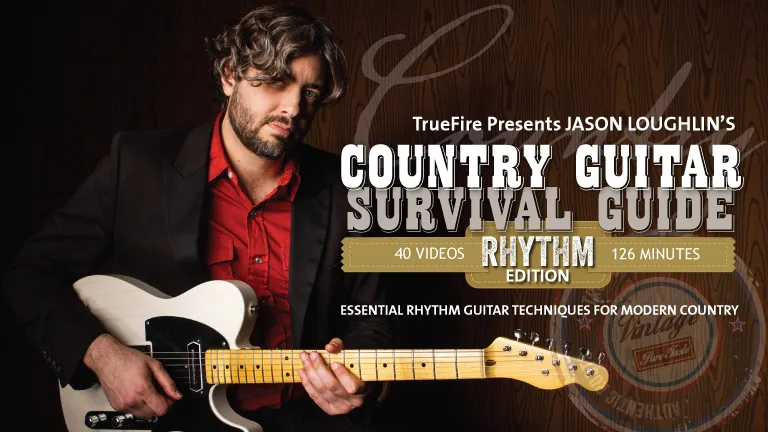
An audience can forgive a mediocre solo if the band is grooving but it's much harder to get an audience on board if the rhythm and groove is uncertain or inconsistent. Yet, guitarists tend to focus only on lead playing ignoring the fact that, for the majority of the time, they’re responsible for establishing the feel, style and harmonic palette of a tune through their rhythm playing.
Band members and audiences’ alike really appreciate great rhythm playing and few players do it as well as Jason Loughlin. Fortunately for we students of guitar, Jason also has an uncanny prowess and passion for teaching as you will experience yourself as you play your way through the Rhythm edition of his Country Guitar Survival Guide.
“Country music is a wide umbrella. This is what makes it so much fun and challenging to play. There are so many sub-genres, feels and other styles to draw from as a rhythm guitarist that you never run out of inspiration. In this Rhythm edition of the Country Guitar Survival Guide, we’re going to look at the essential concepts that you’ll need to become a super solid country rhythm guitarist.”
Jason organized the Survival Guide into two sections. In the first section, Jason presents 12 key concepts and techniques for country rhythm guitar: Basic Country Forms, Common Chord Voicings, Hybrid Picking, Arpeggiation, Boom Chick & Backbeat, Embellishing Chord Shapes, Syncopation, Establishing Rhythmic Patterns, Fills and Hooks, Travis Picking, Acoustic and Tone and Gear.
In the second section, you’ll apply all of the concepts and techniques from the first section across 8 Performance Studies, in a variety of keys and feels: Baker's Dozen, Memphis Sun, Waltz Right In, Outlaw Country, Big Rig Country, Swinging South, Ground Chuck and Country Boogie.
Jason demonstrates all of the Performance Studies over rhythm tracks and then breaks them down measure-by-measure, technique-by-technique. You’ll first learn the parts as performed by playing along with Jason and referencing the tab and notation. When your ready, you’ll work with the rhythm tracks on your own and craft your own country rhythm guitar parts.
All of the key demonstrations, performances and examples are tabbed and notated for your practice, reference and study purposes. You’ll also get Guitar Pro files so that you can loop and/or slow any section down as you work through the lessons. Plus, Jason generously includes all of the rhythm tracks for you to work with on your own.
Grab your guitar and let’s get your country groove up and running…
What you'll learn
Execute the root-six-five bass pattern across chord changes
Apply hybrid picking to country rhythm
Master boom chick rhythm patterns
Understand two-guitar arrangement options in country music
Understand essential country rhythm guitar concepts
Hi, my name is Jason Loughlin and welcome to Country Survival Guide: Rhythm. Too often guitarists focus only on lead playing and forget that the majority of the time you're establishing feel, style and the harmonic palette of a tune through playing rhythm. An audience can sooner forget a mediocre solo if the band is grooving but it's much harder to get an audience on board to a tune if the rhythm is uncertain or inconsisent. Country music is a wide umbrella. This is part of what makes it so much fun. There are so many subgenres, feels and other styles to draw from as a rhythm guitarist that you never run out of inspiration. In this survival guide we are going to look at the essential concepts that you will need to become a super solid country rhythm guitarist. The course is divided into two sections. In section one we will take a close look at the essential rhythm concepts. Together we will work on concepts like the boom chick, hybrid picking, syncopation, using fills and hooks, establishing rhythmic patterns and acoustic strumming. Some of the feels we'll look are are essential to have together as a rhythm guitarist. Feels like country shuffles, country swing, country rock and the half time outlaw country feel. Section two is made up of eight instrumental studies. These studies are there to show you how the concepts work in context. We've included all the backing tracks, notation and tab for all the examples. Let's get pickin'!
In section one we will be discussing rhythm concepts. We'll work through general concepts dealing with technique, theory, song form, tone and musical ideas that transcend styles.
Let's talk about some of the country music forms. We use letters to describe sections of music. For example a verse of a song might be called an A section and chorus might be called the B section. One of the more popular is the A A B A form. This form can be found in jazz and American popular songs. It's typically a thirty two bar form. The B section is also called the middle eight. You may think of it as the bridge. Bluegrass forms may look like A A B B or A B. We also see variations on a 12 bar blues form. Most country tune are very simple harmonically drawing from the I, IV, V in a key. Typically, your first A section will end with a V chord to bring you back to another A section. The second A section will end with a dominant I chord to lead you into the B section. B sections start on a the IV chord mostly and end on V to set up the last A section. Thousands of great songs have been written to this form with little variation. Try analyzing your favorite tunes and see what you find. I think you'll be surprised how many of the follow the same form. There is a common substitution that finds it's way into many country tunes and that's called the secondary dominant. This achieved by treating any chord as a tonic and playing the dominant chord that leads into it. We do this to prolong the tension before resolving to the tonic and it also takes us out of key for a moment which could be a breath of fresh air or the lift a tune needs to keep it propelling forward. If we stack secondary dominants we create something called a cycle. A tune like Cannonball Rag is a good example of this. This works for any chord but the I chord since the dominant of the I chord can already be found in the key. It's most commonly found before the V chord.
I'll show you all the open chord otherwise known as cowboy chords and then we'll learn movable versions. These moveable version of the chords are what make up the CAGED system. We will leaning on this heavily to help visualize chords, chord tones and rhythmic patterns. This is a great shorthand approach to seeing arpeggio notes. We will also learn some jazz chord shapes so we can play country swing, countrpolitan and cowboy tunes. I'll show you maj 6th, dom 7th and min 7th chords. For each chord we'll learn a voicing off of both the 6th and 5th string. This will help our progression to have good voice leading and keep you from having to jump all over the neck.
Hybrid picking is just another way to say pick and fingers. It's one of the must have techniques for country guitar. By being able to use you fingers you can incorporate all the spankiness you want. It's also a great way countrify a rhythm that might not be country to begin with. I'll show you a couple exercises to build strength, rolls and a couple ideas for grabbing double stops out of common shapes.
Here's one of the easiest ways to get movement into your rhythm parts. Great for ballads and waltzs. You're just outlining the notes that make up the chord. It sounds best when you establish a picking pattern. There are an infinite number of ways to do that. We'll look at a couple simple patterns. Try to mindful of voice leading your chords. The smoother your transitions are the more your part will marry with the rest of the rhythm track.
The boom chick. This type of strumming creates the illusion of a bass and guitar. It also helps focus a lot strength to beats two and four. This was a major feel change from Appalachian and polka music who accent is on beats one and three. This strum pattern really driver the backbeat home. There are number of variations to the boom chick. First we'll learn it strumming full chords. By only strumming two strings on the back beat we get a cleaner tighter sound that leaves more space. Chet Atkins adopted this approach for his thumbpick rhythm. By tightening up the rhythm in further we can get more of a Luther Perkins type of rhythm. Now if we add a double stroke on the backbeat we get a boom chick-a. Last we will just play the chick. This is the backbeat. Great to play if there is already another guitarist playing rhythm and fills.
This was just right for me. It has the perfect balance of manageable and challenging material. The delivery was relaxed but in itself was a lesson in how to talk about what you are playing. This is one of the few courses that I have stuck with all the way through. There were a couple of tab anomalies but even these were learning opportunities.
D
duffy315
Verified buyer
06/17/26
Great purchase
Very helpful course. Easy to follow
R
rtgn
Verified buyer
12/27/24
Review of Jason Loughlin's "Country Guitar Survival Guide: Rhythm"
Jason Loughlin's "Country Guitar Survival Guide: Rhythm" is an absolute gem for anyone looking to enhance their country guitar skills! This guide is packed with practical tips and techniques that make mastering rhythm effortless and enjoyable. Loughlin's clear explanations and engaging examples allow both beginners and more experienced players to grasp essential concepts quickly. The book's structured approach helps you build a solid foundation while keeping the learning process fun. Whether you're jamming with friends or performing on stage, this guide will undoubtedly elevate your rhythm playing to new heights. Highly recommended for any aspiring country guitarist!
A
AlFox
Verified buyer
12/05/22
Really nice course. Teaching the basics on a well appreciated level.
J
Jay W.
10/30/22
START WITH THIS ONE - if you are into Jason's series - WORTH IT!
I found this course after trying some of his other courses - and this one is definitely the place to start. Love his teaching. For me his style is the best that I've seen and he goes into (especially in this course) what he's thinking when he's adding a fill or short solo - like for example seeing chord shapes and not thinking in terms of modes. Also so much GOLD in what he says around players to look up and hear and find out more about. This is my second year as a True Fire All Access Member and I've mostly just been re-watching Jason.