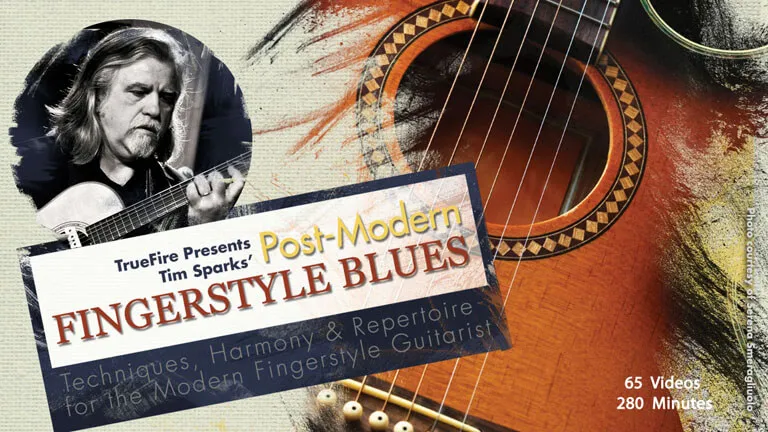
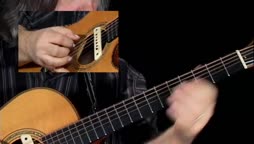
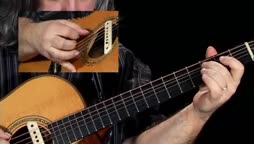
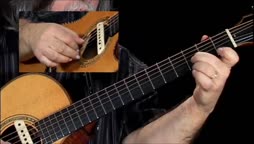
There's just a handful of bona fide mega-genius fingerstyle guitar players walking the planet today. Tim Sparks is one of them. Tim's extraordinary focus, passion, technique, musicality and creativity are all dead giveaways that he is also a time traveling master from the Renaissance sent here to treat our modern ears to his fresh, fascinating and singularly unique art of guitar.
Sparks also brought along a priceless gift for we students of guitar -- a veritable Sistine Chapel of fingerstyle instruction; Post-Modern Fingerstyle Blues, which features enough insight and fretboard wisdom to sustain a lifetime of study.
Sparks cleverly utilizes eight fingerstyle masterpieces as a framework for presenting his curriculum. In the end you will add your own version of these eight tunes to your playlist, but make no mistake about it - this is NOT a repertoire building course. Quite the contrary.
The real educational firepower of Post-Modern Fingerstyle Blues are the key learnings found within the series of breakdowns for each of the eight tunes. It's there that Sparks demonstrates a wide variety of mesmerizing techniques, mind-blowing voicings, innovative fingerings, creative harmony, elegant performance nuances and so much more.
SECTION 1: HOW GREAT THOU ART The roots of gospel and blues run deep through this arrangement of "How Great Thou Art," a now-standard hymn that actually has Swedish roots. It's a great jumping-off point for your plunge into post-modern fingerstyle because it builds on familiar elements like blues lines, improvisation, chord melody -but all in entirely new ways. Sparks covers single-note lines, double-stops, turnarounds, Drop D tuning, melodic voicings, arpeggiating chords with harmonics and a cool pedal tone move on the turnarounds to create interesting motion between the changes and the melody, where the higher melody note remains static as the chords shift underneath.
SECTION 2: BLUES STUDY IN D This study in Drop D tuning (DADGBE, low to high) is blues-based but you'll find yourself a long way from "blues boxes" and the standard I-IV-V progression. The variations here, heard over a 16-bar structure rather than a typical 12-bar blues map, are inspired by barrel-house piano à la Memphis Slim (1915-1988). The bass line's feel is created by playing 6/8 against 4/4; that is, you create the familiar pulse of a 6/8 even though the rhythm is counted in steady 4's. You'll also learn how to use a "slow-hand" fretted thumb to combine the bass line and melody. You'll also pick up a technique for using the thumb in the fretting action to sustain and move the melody around without cutting it short to catch bass notes.
SECTION 3: A FEW BOWLS TURKISH This is an original arrangement of a piece composed by Naftule Brandwein, a klezmer musician who found his way to the U.S. by way of Turkey. Its appeal to both player and listener is in its eclecticism. The arrangement is true to the song's definitively Jewish sound but also draws heavily on the blues, on Middle Eastern harmonies, and on left-of-center jazz harmony. This is what progressive, post-modern music is all about - soulful sounds that draw on global influences but are at home anywhere in the world. Blending Jewish, Gypsy, modern jazz and Freygish scales and chord voicings over a funky, swamp beat using a Brazilian Biaio rhythm, with harp-like cross-picking teaches you how to create some very unusual, gorgeous harmonies.
SECTION 4: LITTLE PRINCESS This series of lessons feature eclectic, post-modern guitar interpretations of the music of Naftule Brandwein, King of the Klezmer Clarinet. Owing as much to klezmer music as to jazz, this arrangement of Brandwein's Little Princess flows effortlessly between styles, and shifts from drone-based harmonies to a style more akin to traditional chord melodies and back again. In an approach that's reminiscent of Flamenco technique, the melody in the second part of the arrangement is played almost entirely against a 8th-fret barre. The Freygish mode, learned in A Few Bowls Terkish, is back in play here in the improv section. The solo follows the chords progression behind the melody, with a few liberties taken to capitalize on the more open changes.
SECTION 5: MISSISSIPPI BLUES Sparks revisit here to one of his signature blues is a testament to how the personality of a particular guitar can have a profound influence on what you play. Whether these lessons on Mississippi Blues provide you with an arrangement to recreate or a mountain of riffs and techniques to adopt and adapt, they'll serve any serious fingerstyle guitarist way beyond their expectations. With bass line, melody and chords all in perpetual motion, this is the type of arrangement that can make a solo acoustic sound like pure magic. You'll learn a boogie bass in 4/4 against upper-string arpeggios in 6/8 and how to reinvent every recurrence of the 12-bar form. The melody riff harmonized in sixths over a boogie bass line, an elaborate turnaround with the "grand descent" and the concluding line using double-stop 6ths, are alone well worth the price of admission.
SECTION 6: ORIENTAL BLUES The Oriental Blues is a brainchild of famed ragtime and blues composer Eubie Blake, and we don't mean to be ironic when we say the tune doesn't fit comfortably under ragtime or blues. If anything it's a stream-of-consciousness version of ragtime from Harlem, circa 1917, with a compelling blend of musical influences mixing jazz, blues, and Middle Eastern harmonies. In terms of technique, harmony, and melody alike, this arrangement is constantly shifting between the familiar and the foreign. The cadenza combining the Middle-Eastern Hijaz (Freygish mode) , the series of 7th chords played with an E pedal tone on the open first string, the 10th intervals, lateral fingering of Hungarian Minor mode and the ascending and descending melody harmonized in 6ths and 10ths will all keep you happily engaged.
SECTION 7: OH DADDY, THAT'S GOOD! We're back to klezmer king Naftule Brandwein here, offering a solo guitar adaptation of a klezmer tune he recorded in the 1920's. It's based on a Romanian Gypsy song and uses Gypsy scales, but also integrates blues licks and Brazilian rhythms, as heard in the bossanova and samba segments in the out chorus. The title is reportedly a reflection of 1920's Prohibition culture; Brandwein was known to be a drinker and may have exalted, "Oh daddy, that's good!" in response to a tasty illegal beverage. But, listen to just a few opening bars and you'll wonder how anyone could attempt such a tune with a single drop of alcohol in their bloodstream. The modes most heavily used in "Oh Daddy" are Hungarian Minor and the Ahava Rabba mode, described and played here The second theme has a 6/8 feel before dropping back to 4/4 using the Biaio pattern. It's followed by a vamp with modal improvisation using the Middle Eastern Saz style. Lots of new and cool to get a grip on here.
SECTION 8: WAYFARING STRANGER The traditional gospel tune "Wayfaring Stranger" is given the post-modern treatment here in Drop D tuning. This arrangement is inspired by a haunting version of the same song recorded by bassist Charlie Haden on his Art of the Song CD. Wayfaring Stranger calls on the traditional elements of fingerstyle playing- alternating bass, jazz voicings, attention to melody - yet it all shapes up to be anything but traditional. Played up-tempo or down, there's a lyrical, longing quality to the melody that is unmistakably rooted in gospel. By mixing in the alternating bass and arpeggiating the changes - that is, by changing the approach to right-hand technique - the feel changes entirely. The Travis-style fingerpicking is explained here, followed by a discussion of modal and chord-melody improvisation.
There's three approaches for working with Post-Modern Fingerstyle Blues; 1) Keep the guitar in the case, roll video, watch, listen, absorb, repeat ad infinitum; 2) Dig in anywhere, cherry-pick your favorite moves, brew the java, shed your heart out; 3) Quit the job, stock ample essentials in the shed, spend next seven years nailing every last note. All will yield desired results.
What you'll learn
Apply syncopation to fingerstyle pieces
Exploring the fantasia section with improvisation
Learning how to blend multiple musical traditions
Understanding connections between jazz, blues, and world music
Developing a personal vocabulary from diverse musical sources
Postmodern Fingerstyle Guitar is an attitude about playing anything that sounds cool, that makes you feel something. Jazz, Country, Blues and Bach, Roots and Rock its all good. We live in an era with a unique perspective because at this moment in the 21st Century we can hear virtually everything from everywhere. The ability to reference the accumulated legacy of the world's music means we can "paint" with a very eclectic musical palette. The pieces in this course were created using a process of omnivorous cannibalization. A quote from Chopin is followed by a Charlie Parker riff. Modern Jazz chords color an Appalachian Gospel melody. An ancient Hasidic chant is wedded to a bayou beat with modal improvisations in the spirit of Ornette Coleman, and on and on.
The inpiration for these etudes includes Lenny Breau, Doc Watson, Andres Segovia, Peter Finger, Tommy Emmanuel, Charlie Byrd, Marc Ribot, Chet Atkins, Raphael Rabello, and Duck Baker to name a few. I hope you enjoy playing these arrangements. Feel free to dissect them and incorporate bits and pieces into your particular bag of tricks. If it sounds good play it. Use it. Make it your own.
Acknowledgements
Big thanks to Brad, Eric, Ali, Tommy, everyone at TrueFire. Recording this course at the TrueFire Studio in St Pete was challenging, inspiring and fun! TrueFire is a great family and company. I'm surprised their heads haven't exploded from all the guitar knowledge they have processed! Much Love and Respect.
This project was funded, in part, by the Lakes Region Arts Council and the Minnesota State Arts Board through the arts and cultural heritage fund as appropriated by the Minnesota State Legislature with money from the Legacy Amendment vote of the people of Minnesota on November 4, 2008.
The roots of gospel and blues run deep through this arrangement of "How Great Thou Art," a now-standard hymn that actually has Swedish roots. The song's origins stretch back to the late 1800's, though it was decades before the song was translated and then embraced by American churches. It's a great jumping-off point for our plunge into post-modern fingerstyle because it builds on elements you're probably familiar with - blues lines, improvisation, chord melody - in entirely new ways.
As you can hear, there are plenty of single-note lines, doublestops, and turnarounds in here that work nicely within the part but also can be easily applied to other contexts. Note that we're in Drop D tuning (DADGBE, low to high) and the song is in the key of G. So, the open low string gives us the fifth of the key, which in the arrangement often functions as a common pedal tone beneath riffs and chords. The arrangement also demonstrates many of the melodic voicings and chord voicings possible when playing in G with a low D holding down on the bottom.
Slowing the A section of the tune down a bit, you can see both what's familiar and what's unexpected about this arrangement. Since we're using Drop D, chord shapes incorporating the lowest string have to be adjusted (play up a step) or the voicing has to be reconsidered entirely. Playing Drop D in the key of G makes for a little more work since you have to re-learn some chord shapes but it also puts some great sounds within reach.
The gospel sound comes to the foreground here in the B section. The original melody to "How Great Thou Art" is not especially busy, which opens up a lot of opportunity to embellish and ornament the melody with gospel and blues colorations. Each of the G blues lines demonstrated here is based on a different chord shape for G, and you can see how familiarity with the shapes leads to blues lines within each chord's "zone" of the neck.
We're back in standard tuning here (EADGBE, low to high) to demonstrate this country blues scale in five keys: G, E, D, C, and A. Each version of the scale correlates with a first-position chord shape, and the shape can be moved up the neck to change the key. By this method, you can find five different chord and scale shapes for a single key (G) by moving around the neck. Seeing the links between scales and chords can help to make giant leaps in your playing - especially when it comes to developing your own arrangements.
Small chords - just three-voices on the lower strings, most of the time - provide a rich bottom and set the changes further apart from the melody. Remember that your lowest note does not have to be the root; it can be any note within the chord you're playing. The chord technique used here, which often places the 3rd or 7th of a chord in the bass, borrows from jazz great Lenny Breau (1941–1984).
Pedal tones on the turnarounds contribute some interesting motion between the changes and the melody, where the higher melody note remains static as the chords shift underneath. We're also dressing things up with the use of harmonics. If you're unfamiliar with the technique of arpeggiating chords with harmonics, start by placing the first finger of your picking hand one octave above each fretted note, and plucking with your thumb behind that first finger.
A good version mix of blues and ragtime songs.
Tim Sparks is a great player and teacher.
F
fingersloth
12/30/20
encyclopedia in a Tune
Tim sparks is genius and extremely skilled and technical player. There is wealth of blues material in these songs. My original interest was in Wayfaring Stranger which I was very pleased with his presentation in Drop D. Blues in D s very approachable, really emulating the style of stride piano player. Mississippi blues is an encyclopedia of blues material presented in one song that can be broken down and cannabalized for ideas. He weaves together a ton of ideas that are well beyond blues
P
pahadoc
11/04/18
Great course but the tabs do not match videos
Absolutely beautiful fingerstyle blues, quite challenging sometimes. The playing patterns in Breakdowns have no corresponding tabs; all videos are accompanied with the same original transcript although in Breakdowns he plays simple versions of the songs.
G
Gonzalo
10/08/18
serious stuff
beautiful tunes and arrangements. Tim Sparks is a virtuoso so don't expect this to be an easy course. But man, such beautiful pieces... You will hear the basic song structure and then work on various arrangements that will be examined in a couple of breakdowns. Lots of material, I think I could study this for months.
M
mattstutts2
10/02/18
Tough
I think this course is fantastic....of of Tim's courses are amazing b/c he is an amazing player. But I found that once you get past the initial tune, it's gets complex really quickly. That's b/c Tim is incorporating different world styles, with different time signatures, different scales, etc. I didn't find it easy and needed to put the lessons to the side until I was ready to come back. If you stick with this, you will be rewarded, however.