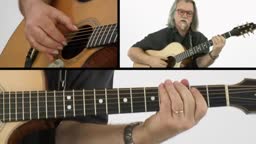
Fingerstyle Boogie Handbook

Creative insight, fingering techniques, and essential vocabulary.

Marty FriedmanTommy EmmanuelSteve VaiEric GalesEric Johnson

Get this course and 1,000+ more with All Access

Try 14 days free. Cancel any time.

Purchase Individual Course for $9.99
Fingerstyle Boogie Handbook

About this course

There are many theories about the origins of the Boogie Woogie. Some claim its origins stem from Beethoven’s 32nd piano sonata written in 1821. Others cite African origins and terms such as ‘Boog’ and ‘Booga’ both of which mean ‘to beat.’ We do know that the first time ‘boogie woogie’ was used in a title of a song was back in 1928 for Pine Top’s Boogie Woogie, which song lyrics offered dance instruction as well. Wherever the boogie-woogie came from, we’re all very thankful because we love to play it, listen to it and dance to it.

While the boogie-woogie originated on piano, guitarists enthusiastically adopted the style, which in turn led to its prominence in rock and blues. In particular, acoustic fingerstyle guitarists have tweaked and refined the boogie-woogie style into a sophisticated art form, still with deep roots to its country blues beginnings but with countless variations and oftentimes very challenging fingerstyle techniques.

There is no other guitar master of the style that has studied boogie-woogie as fastidiously as Tim Sparks. Likewise, no other guitar master that is able to present as complete a curriculum on boogie-woogie as Tim Sparks. Tim’s Fingerstyle Boogie Handbook is your definitive guide to learning everything you really need to know about fingerstyle boogie-woogie.
I just knew I had good reason for not being able to wait for this new course of yours and you've certainly proved it here! Very cool and sophisticated new fun stuff for us to master on the ole acoustic ... this one's even greater than GREAT! Funky and innovative. My fingers are aching after two hours and that's the only reason I've stopped long enough to type up this comment! A++ NO DOUBT!" - Jim C., TrueFire Student
Tim has organized the Fingerstyle Boogie Handbook into three sections. In Section 1, The Boogie Toolbox, Tim equips you with all of the requisite techniques and tools of the boogie guitarist’s trade. You’ll learn melody lines, chord shapes and boogie bass lines that you’ll combine to craft a comprehensive acoustic fingerstyle boogie guitar style.

You’ll learn: an E Blues Master Riff, the I-IV-V Boogie Rhythm Pattern, a Boogie Rhythm Pattern with Thumb, a 2-Note I-IV-V, a Simple Boogie, the Billy Butler Boogie, an 8-Beat Pattern, a 4-Beat Pattern, the Zig Zag Pattern, a 2-Beat Roll, a 2-Beat Grinder, two Hot Rod Boogies, and Arthur's Boogie.

Tim will demonstrate each of the patterns and boogie techniques and then break them down for you so you’ll pick up on every nuance of the move.

In Section 2, Boogie Grooves, Tim presents a series of 16 variations on a 12-bar blues that demonstrate a variety of ways to combine the elements in the Boogie Toolbox over a variety feels ranging from Delta Blues to Chicago Blues to Rockabilly, Gospel and Funk.

These 16 grooves will power your boogie bag for a lifetime: Freight Train Boogie, Highway Boogie, Minor Third Boogie, Boogie On The Tarmac, Lightnin' Boogie, Delta Boogie, Chicago Boogie, The Boogie King, 12-Fret Boogie, Major Three Boogie, Jumpin’ The Boogie, Tommy’s Boogie, New Orleans Boogie, Funky Time Boogie, Buck's Boogie and Gospel Boogie.

Here again, Tim will demonstrate each of the grooves and then break them down for you. There are infinite applications for this collection of grooves for your own compositions, arrangements or jamming pleasure.

The third and final section, Boogie Performances, takes the Boogie Tool Box and the Boogie Grooves material and puts it all to work over two multi chorus boogie performances. The first tune, Ready for Freddie (4 choruses), is a set of Fingerstyle Boogie variations on Freddie King’s Hideaway. The second tune, Drop-D Boogie (5 choruses), illustrates how some of the riffs you learned in the key of E can be played more easily in the key of D, with the 6th string tuned down from E to D.
All of the key demonstrations and examples are tabbed and notated for your practice and study purposes. You’ll also get Guitar Pro files so that you can loop and/or slow any section down as you work through the lessons.

Click now, grab your guitar and jump on this train with Tim Sparks. Next stop — boogie-woogie bliss.

What you'll learn

  • Use ghost notes and string bending for authentic country flavor
  • Play an elegant, streamlined boogie riff using upper string voicings
  • Navigate I-IV-V changes with boogie-woogie bass lines
  • Create subtle implied boogie lines rather than full patterns
  • Coordinate thumb bass line with chord melody on upper strings
Release date: 09/24/2014 • 2h 33m runtime
Start Course
Sample lessons
Rhythm Pattern with Thumb
Performance & Breakdown
SECTION 2: Boogie Grooves
Overview
Jumpin' The Boogie
Jumpin' The Boogie
Performance & Breakdown
Tommy's Boogie
Tommy's Boogie
Performance & Breakdown

What's included

47 lessons • 32 charts

Fingerstyle Boogie Handbook
The Boogie Woogie is a blues form that probably originated in the piney woods of Northeast Texas where itinerant pianists would entertain in the logging camps. One of the earliest boogie recordings is Pinetop's Boogie Woogie, recorded by Pinetop Smith in 1928. The Boogie Woogie piano form has since percolated into blues and country guitar styles and is a foundation of American roots music. This course will show you examples of Fingerstyle Boogie guitar as played in Delta Blues, Chicago Blues, Rockabilly, New Orleans, Gospel, and Funk. We will finish with a couple of complete Boogie Blues renditions which you can play, including one in the style of Freddie King's Hideaway.
SECTION 1: Boogie Toolbox
The Boogie Toolbox will give you melody lines, chord shapes and boogie bass lines that will enable you to put together a comprehensive acoustic, fingerstyle boogie guitar style. These are ideas that you will find are both easy to understand and play.
E Blues Master Riff
The E Blues Master Riff shows you how to play blues licks from the 12th fret down to the lowest note on the guitar and back up again. Learning this master riff will give you a foundation to mix melody licks, small chord riffs and boogie bass lines into a comprehensive style. This segment also introduces and explains two important techniques; pull--offs and double barres.
I-IV-V Rhythm Pattern
This lesson shows you inversions of the I-IV-V chords, the DNA of the blues. These chords are built from the top down and use inversions which gives them a smokey, jazzy sound. These chords consist of only two or three notes. They are easy to play but they have rich chordal quality.
Rhythm Pattern with Thumb
One of the most simple but essential skills in solo, fingerstyle blues playing is to lay down a steady pulse with your thumb while riffing with blues licks and chord shapes on top. This lesson will show you how.
2-Note I-IV-V
Here we get to the essense of the blues chords. Using only two notes, you can get a lot of chordal mojo. These chord shapes have "ergonomic" fingerings. A minimum amount of effort and motion yields a rich sound.
Simple Boogie
This is the introduction to the boogie bass lines that are so fundamental to the boogie sound.

+ 40 more lessons

Start Course

Reviews

9 results

Ray W.

Verified buyer

03/13/26

Groovin boogie!

Useful paterns to record in a looper and improvisin, and 3 beautiful pieces, especially one in drop D


Roger B.

Verified buyer

08/27/21

This is great

This is full of great boogie bass lines plus some great jazzy chords and fill licks. Everything you need to improvise some great boogie music

Bazou

Verified buyer

06/07/20

Fingerstyle Boogie

Tout ce que je m'attendais de ce cours . Tous les exercices sont tres bien expliques.

JBSteel

12/30/18

Great Course for Boogie Guitar

Fingerstyle Boogie Handbook is a great course for adding a more piano-like sound to your boogie guitar. Tim Sparks starts you off with the basics and builds into some pretty sophisticated patterns. The course also serves as a great catalog of boogie patterns that you could use in single line playing. If you want to get some fingerstyle boogie in your playing this is the course. I’m hoping Tim can do a course like this for Ragtime/Ragtime Blues guitar where he builds you up from the basics and gives you ideas so you can develop your own Rags

abu94064

Verified buyer

11/30/18

Fingerstyle boogie handbook

Good

Stop searching. Start improving with All Access.

Try 14 days free. Cancel any time.