

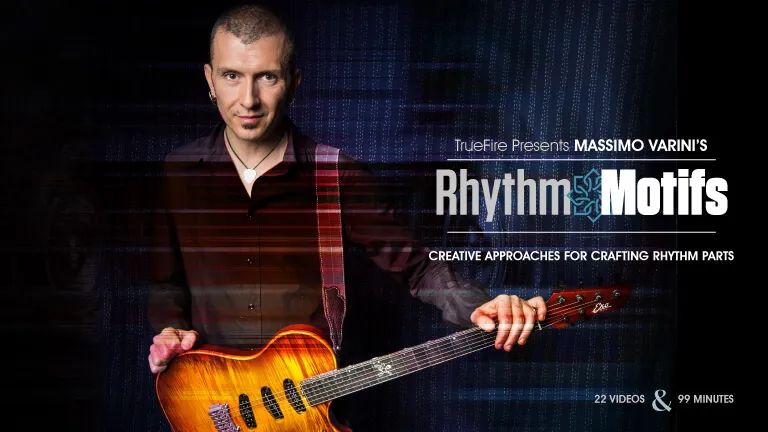

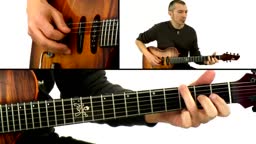
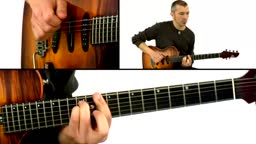
Rhythm Motifs

Creative Approaches for Crafting Rhythm Parts

Marty FriedmanTommy EmmanuelSteve VaiEric GalesEric Johnson

Get this course and 1,000+ more with All Access

Try 14 days free. Cancel any time.

Purchase Individual Course for $14.99
Rhythm Motifs

About this course

Listen to any master musician comp or improvise a solo and you’ll hear a series of musical themes being introduced, developed and then resolved. The process is called motivic development and themes are referred to as motifs.

Rhythmic motifs are very much a staple of Massimo Varini’s creative palette, “A motif is an initial idea, a spark, something that is first created spontaneously or taken from a melodic fragment or melodic rhythm, and then repeated, developed, varied rhythmically or melodically or both. The motif may even be so subtle it becomes almost unrecognizable but still serves as a point of reference for those musicians who are improvising or creating a rhythm part.”

Motifs are technically defined as “a short succession of notes producing a single impression; a brief melodic or rhythmic formula out of which longer passages are developed.” Motifs help you connect with your audience, interact with your band, and creatively frame the stories you tell them through your solos and improvisations.

Any guitar player with strong motivic development skills doesn't need blazing technique or deep theoretical knowledge to engage listeners and pull them to the edge of their seats.

Naturally, Massimo isn't consciously thinking about motifs while he’s comping or improvising;. it’s a creative prowess that's been long embedded in his musicality. Fortunately, to help the rest of us develop those skills, Massimo dissected his own approach and presents his key rhythm guitar motivic development techniques here in Rhythm Motifs.

“Many of my students ask me how I craft my rhythm parts, and how they should approach crafting their own. They may know all of the chord shapes, and even many rhythmic patterns but they run into trouble when trying to put that knowledge to work in a creative, musical way. My answer is always — start with a simple motif, and then build out from there.”

Massimo presents Rhythm Motifs across 10 sets of Overviews and Demonstrations. “We’re going to work over 10 distinct backing tracks in a variety of styles, keys and tempos. For each track, I’ll show you a few creative approaches for developing rhythmic motifs and building interesting grooves, and then I’ll apply those ideas and approaches in a performance study.”

All of the performances are tabbed and notated. You’ll also get Guitar Pro files so that you can loop and/or slow any section down as you work through the lessons. Plus, you'll get all of the rhythm tracks to work with on your own.

Grab your guitar and let’s get your motivic groove on with Massimo Varini!

What you'll learn

  • Create fluid and dynamic rhythm parts from simple chord progressions
  • Create funky rhythm patterns with close voicings
  • Connect chord voices using minimal movement
  • Vary rhythm motifs using different positions and inversions
  • Build rhythm motifs around 6th intervals
Release date: 08/03/2015 • 1h 39m runtime
Start Course
Sample lessons
Keep It Simple
Keep It Simple
Concepts & Approaches
Keep It Simple
Keep It Simple
Performance
Rockin' Ballad
Rockin' Ballad
Performance
Riff Intrusion
Riff Intrusion
Concepts & Approaches

What's included

22 lessons • 10 charts • 10 Jam Tracks

Rhythm Motifs: Massimo Varini
What do we mean by the term "motif" in music? We refer to a "theme", an initial idea, a spark, something that is first created spontaneously or taken from a melodic fragment or melodic rhythm, then is repeated, developed, varying rhythmically or melodically or both. The Motif may even get to be almost unrecognizable but serves as a point of reference for those who are improvising or creating a rhythm part. In this course we are going to focus on building upon rhythmic motifs across a wide range of styles. Let's dig in!
Keep It Simple
Motifs are very important in music, allowing you to start from a simple idea and then process it until you get the full track. Remember "less is more!" Often playing "little" leads to great results. We'll start with an arpeggio of three notes and discover together how to use this motif in our arrangement. The motif is considered the spark from which our musical discourse can be born. We'll talk about the notes of the triads, extensions, and rhythmic variations.
Keep It Simple
In this video I will show you how to put together some of the concepts and examples you've just seen. In this video, as in all other performances and examples, you'll have the transcript of the stave and tablature to use as a base for practice.
As Close As Possible
A motif can also become a "planned" arrangement, keeping the voicings as steady as possible. So let's look at how to connect them effectively while creating the basis for our song.
As Close As Possible
In this video I will show you how to put together some of the concepts and examples you've just seen. In this video, as in all other performances and examples, you'll have the transcript of the stave and tablature to use as a base for practice.
Rockin' Ballad
Now let's look at how to build rhythm/bass riffs from the Am chord and then move throughout the turnaround; we'll find a Motif in the Add9 chord with tensions that must be resolved, then with the same concept we'll approach the rhythm in the second part.
Rockin' Ballad
In this video I will show you how to put together some of the concepts and examples you've just seen. In this video, as in all other performances and examples, you'll have the transcript of the stave and tablature to use as a base for practice.

+ 15 more lessons

Start Course

Reviews

9 results

Addahia

Verified buyer

01/12/25

Rythm and Solo motifs

Both the Solo and Rythm edition of this motifs are outstanding. Massimo shares very simple core ideas that you can the develop to your own musical interest. But the ideas in it self are so cool that they really hook you up into the groove of the backing tracks. So if you are in a crative rut, this will help you for sure. Or, if you need some coordinates to organize your own ideas, here you have a compass.
ChickChitarra

Verified buyer

11/07/22

Makes learning quicker, easier and fun to play.

Everything I need to know about learning rhythm motifs in one "folder" that is, the TrueFire App. Being able to loop difficult passages and slow the video speed make "getting it" quicker and easier. Add having the tabbed music in a window below the instructor enables me to see the notes while hearing them. There is no better learning environment including having a personal guitar teacher. Speaking of instructors, Massimo Varini explains each lesson and shows incrementally how to play it. Then I play along with him. Great course. You can be sure many more in the future.

Rankles

Verified buyer

11/15/21

How to truly create music

Massimo's courses on Truefire are fantastic. Here he continues to give lessons that don't bog you down with theoretical ideas or techniques, but instead shows you how to think musically and most importantly how to create music. Get this if you're feeling stuck in a rut with your writing and want to know how to approach creating music rather than just learning the theory behind it.

bouncerec

Verified buyer

02/17/21

Awesome

Great musician and great teacher!

2canoe

Verified buyer

04/27/20

Expand your Rhythm

Massimo starts with a basic chord progression and adds a theme..already your playing has more interest and then he expands those ideas leading out from the original motif....makes the rhythm far more dynamic and more fun to play

Stop searching. Start improving with All Access.

Try 14 days free. Cancel any time.