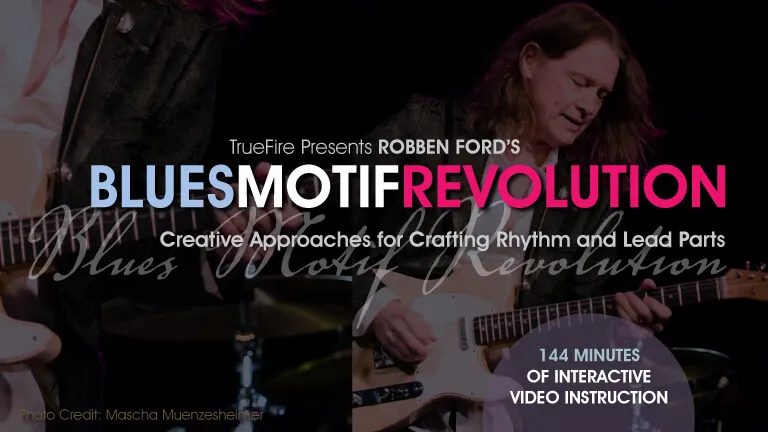
Listen to any master musician improvise a solo and you’ll hear a series of musical themes being introduced, developed and then resolved. The process is called motivic development and the themes are referred to as motifs.
Motifs are very much a staple of Robben Ford’s creative palette, “Motifs are not only important, they are indispensable in making any kind of music. You can use them for your rhythm playing, use them to develop a solo, a phrase that's played in a different octave, a note that's repeated, some kind of pattern that's established with the use of a note. Motifs are really at the heart of improvisation.”
Motifs are technically defined as “a short succession of notes producing a single impression; a brief melodic or rhythmic formula out of which longer passages are developed.” Motifs help you connect with your audience, interact with your band, and creatively frame the stories you tell them through your solos and improvisations.
A blues guitar player with strong motivic development skills doesn't need blazing technique or deep theoretical knowledge to engage listeners and pull them to the edge of their seats.
Naturally, Robben isn't consciously thinking about motifs while he’s improvising;. it’s a creative prowess that's been long embedded in his musicality. Fortunately, to help the rest of us develop those skills, Robben dissected his own approach and presents his key blues motivic development techniques here in Blues Motif Revolution.
Robben presents Blues Motif Revolution across 16 sets of Overviews and Demonstrations; 8 of them focused on Rhythmic Motifs and the other 8 focused on Soloing Motifs.
Robben demonstrates over a collection of 8 blues tracks, in a variety of keys, tempos and feels: Up-Tempo Blues Shuffle, 12-Bar Funky Blues, 8-Bar Shuffle in A, a C Minor Blues, One Chord Vamp in F, Straight Ahead Shuffle in E, Rumba Blues in D, and a Vamp in E.
Robben demonstrates both a rhythmic motif and a soloing motif for each of the 8 tracks. In the first video lesson of the set, Robben overviews the track, presents motivic ideas and then demonstrates a particular motivic approach. In the second video of the set, Robben applies the approach to construct a full performance.
All of the performances are tabbed and notated. You’ll also get Guitar Pro files so that you can loop and/or slow any section down as you work through the lessons. Plus, you'll get all of the rhythm tracks to work with on your own.
Grab your guitar and let’s get motivic with Robben Ford!
What you'll learn
Create effective rhythm guitar parts that support soloists without overplaying
Use simple triad voicings to create space and clarity in ensemble playing
Apply interval patterns (especially fourths) as thematic material
Learn to develop rhythm parts using motifs
Develop simple musical ideas (motifs) and expand them throughout a song
Hi, I'm Robben Ford and welcome to Blues Motif Revolution. Motifs are indispensable for making any kind of music—you can use them in your rhythm playing, in a solo or a phrase, a pattern of notes, or even a single note. Motifs lie at the heart of improvisation, getting you out of playing something that you already know and helping you play something new.
I've organized the course into two sections. In the first section, we'll go through eight tracks and work on some rhythm motifs. In the second section, we'll take the same eight tracks including the rhythm parts and start working on crafting solos using motifs as well.
All of the key studies are tabbed and notated, plus you get all of the rhythm tracks to work with on your own as well. So let's get to it!
This track is a basic up-tempo blues shuffle. We'll go through some of the things that I listen for when developing a motif, and then we'll work through some ideas for our rhythm part.
Now, we'll apply some of the ideas we explored in the overview lesson over a full performance with the track.
In this lesson we'll work with a 12-bar blues track that has a funky feel and a lot of room to move around. I'll start with a classic blues motif and bring in a little funky rhythm. It's important to keep the rhythm guitar in conversation with the other instruments, building the motif with them, developing it more and playing higher on the neck. By "talking" to the other instruments you can establish some ground for the soloist so they'll know what's coming next.
Now let's use some of the motivic elements we looked at in the previous lesson to improvise over the track.
This track is an 8-bar blues with a shuffle feel in the key of A—a classic blues sound. When playing the blues, it's important to think of dynamics, playing loud or soft depending on what's needed and thinking about the ebb and flow of the track. Don't just stay in one place, think of the track as a journey from one place to another!
We'll use the riff that we developed in the overview, focusing on building it up and not staying in one place.
This is a wonderful play along course to learn blues grooves and how to develop them in interesting cohesive ways. I like to watch it a few times before I even pickup my guitar. Once the presented motifs soak in enough, I play along with Robben but create my own lines based on his. This way I feel confident my parts are original bu
E
EarleG
05/27/21
Blues Motif Revolution - Nice!
This has been a fun and informative video. Being acquainted and using many of these techniques for decades it was cool to see how Robben applies them plus giving variations on other ways to use. He also presents some new combinations of voicing and space I hadn't tried before so that is a real bonus. Main thing is the thought process involved here. It can inspire to look at the relationships of chord voicings. This brings back memories a bit of a Joe Pass book I studied in the early '70s and Blues Motif Revolution does it very well from a blues/jazz blues perspective.
O
Osokin
Verified buyer
05/12/21
Join the Blues Motif Revolution!
The ability to create melodic and rhythmic motifs is a tremendous asset and naturally makes our playing more musical and accessible to listeners. Yet many guitarists struggle in this area, and fail to make coherent musical statements. So who better to help you than Robben Ford, whose playing is always built upon the creation of beautiful, melodic motifs. Through exercises and examples of both rhythmic and soloing motifs, we can develop a more musical style of playing that will appeal to listeners and fellow musicians alike.
R
Rythameen
Verified buyer
07/12/20
Great Course
A ton of great information here from a true master. I really enjoy Robben’s teaching style...even if he seems to go off on a tangent sometimes as if he himself is rediscovering something, but that’s also what makes this course so good.
J
jvidaurre
05/04/20
Excellent Guide
This is an amazing course that really makes you think of new ways to approach song writing and construction. I know music theory really well but I am always trying to remind myself of not limiting my own creations by imposing structures. This motif ideas allow me to go back to the musicality of a theme in a song rather that what is “supposed” to come next or what note is right or wrong. It is also a good way to structure daily exercises, so they do not become to boxy after a while. The same technical exercise can be reconfigured in many ways and if we approach them as motif rather than just a succession of notes it really becomes much more fun a motivational.