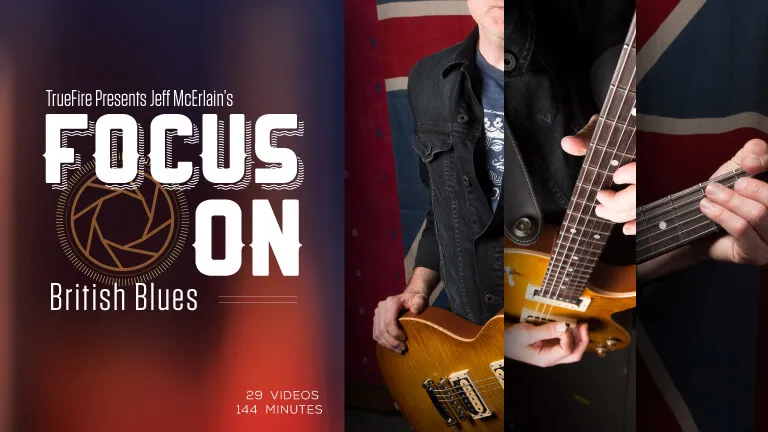
Focus On: British Blues

Essential insight and practices for British blues guitar

Marty FriedmanTommy EmmanuelSteve VaiEric GalesEric Johnson

Get this course and 1,000+ more with All Access

Try 14 days free. Cancel any time.

Purchase Individual Course for $14.99
Focus On: British Blues

About this course

While British Blues had its hey day back in the 60’s and 70’s, it contributed an indispensable vocabulary and a timeless influence for virtually all contemporary blues and blues-rock guitar players. Eric Johnson, Joe Bonamassa, Gary Moore and even John Mayer are just a few of the modern players that pay homage to, and at times directly quote, British Blues guitar giants like Eric Clapton, Peter Green, Jeff Beck and Jimmy Page.

If you dig playing contemporary blues, then you must likewise embrace it’s characteristics and stylings. Jeff McErlain's Focus On: British Blues is an insightful examination of the key elements and techniques that define the British Blues genre.
"This is a great course and has improved my blues/rock playing. The lessons are well thought out and build on each other in a logical manner. There is lots of great information in this course, but I'll pull out 3 of my highlights. First there is a good section on getting great tones from just your guitar and amp. This course is also a great place to start learning how to mix minor and major pentatonics in your solos. There is some really good stuff on articulations to help you get a really bluesy sound. Jeff also nails the difference between Page, Clapton and Green's playing, so you can add more variety to your approach. There is so much good stuff in this course you'll keep coming back to it. Super!"
- Terry F., TrueFire Student
Jeff organized the course into four sections. In the first section, Jeff gives you a little background about British Blues, its history and the key guitarists that ignited the movement. Jeff also rundowns how to dial in that British Blues tone tone and suggest the gear that best captures that distinctive British Blues sound.

In the second section, Jeff shows you Essential Soloing Concepts covering the key characteristics and progressions of the style: The I7 Chord, The IV7 to I7 Change, The Turnaround, Bend That String, Key Phrases in British Blues Soloing. He’ll also demonstrate important techniques such as bends, vibrato, scales and phrasing approaches that are signature to the British Blues genre.

In the third section, Jeff focuses on Essential Rhythm Concepts: Riff Based Shuffle Blues, Riff Based Straight Blues, Typical Chord Voicings and Putting It Together. You’ll learn how to play a riff-style shuffle blues, a straight-on rock style blues a la Led Zeppelin, and a number of useful chord voicings you’ll need to know to have a solid grip on British Blues rhythm guitar.

In the fourth and final section, you’ll put all of the techniques and concepts, from the first three sections, to work across four Performance Studies. You'll check out a Peter Green-influenced slow blues, A mid-tempo Clapton-esque shuffle, a mid-tempo straight rocker ala Jimmy Page, and an uptempo shuffle nodding to Fleetwood Mac.

Performance Study #1: I Need It Bad (Sweet Slow Blues) - "This tune is similar to one of Fleetwood Mac's hits from that era called "I Need Your Love So Bad" on which Peter plays brilliantly. The song and soloing really shows his love of BB King as well as his own style. I love the chord changes, so please learn those as well because there is some really cool sounds going on that you can take advantage of as a player."

Performance Study #2: The Londoner (Mid-Tempo British Style Shuffle) - "In the solo I'm going to mix major and minor pentatonic scales, along with some cool bends, vibrato, and aggressive phrasing. I'm channeling Eric Clapton on this one as best I can!"

Performance Study #3: Hindenburg (Full-On Rocker with a Straight Groove) - "All self respecting blues/rock guitar players must pay tribute to Jimmy Page and his legacy. His influence as a player, songwriter, producer, rock God, cannot be overlooked."

Performance Study #4: Messin' Around (Uptempo Shuffle in C) - "[This one] is based on Fleetwood Mac's "Stop Messin' Around" from the Mr. Wonderful record released in 1968. It's an awesome midtempo rockin' blues that makes a great addition to any set of blues. I highly suggest checking out the original of course as Peter Green's playing is so darned good on it.”

Jeff demonstrates all of the Performance Studies over rhythm tracks and then breaks them down measure-by-measure, technique-by-technique. All of the key examples and performance studies are tabbed and notated for your practice, reference and study purposes.

You’ll also get Guitar Pro files so that you can loop and/or slow any section down as you work through the lessons. Plus, you'll get all of the rhythm tracks to work with on your own.

Grab your guitar, dial in that British Blues tone, and dig in!

Jeff McErlain's Preferred Gear

Below is a list of Jeff McErlain's preferred gear including guitars, amps, pedals, accessories, and more. What you see in Jeff's lessons may or may not be this actual gear, but if you are trying to capture Jeff's sound and tone, the gear listed below is recommended by Jeff and it's a great place to start!

Guitars

Amps

Pedals

Accessories & More

What you'll learn

  • Play characteristic British blues rhythm patterns and chord voicings
  • Play a complete British blues solo in the style of Peter Green over a C shuffle
  • Study and emulate classic blues-rock guitar styles
  • Understand the history and key players of British blues guitar
  • Learn to dial in authentic British blues tone on guitar and amp
Release date: 06/24/2015 • 2h 17m runtime
Start Course
Sample lessons
Tones & Gear
Tones & Gear
Overview
The Turnaround
The Turnaround
Soloing Concept 3
Riff Based Straight Blues
Rhythm Concept 2
Hindenburg
Hindenburg
Overview

What's included

29 lessons • 13 charts • 13 Jam Tracks

Focus On: British Blues
Hi I'm Jeff McErlain and welcome to Focus In On British Blues. Many of today's top guitar players owe a great debt of gratitude to some of the classic British blues giants like Eric Clapton, Jimmy page, Peter Green, Mick Taylor, and more. In this course were going to focus in on the essential techniques and elements that define British blues guitar. Not only will we look at guitar techniques, I'll also talk about what makes the classic British blues guitar sound. This guitar sound is basically a Les Paul and a Marshall amplifier, the blueprint of the modern guitar sound that many of us still consider the Holy Grail of tone. I have broken up this course into four sections. The first section will give you an overview of the history of British blues and the main players, also looking at the gear and how to dial in your amp and guitar for just the right sound. In the second section we'll look at essential soloing techniques like bends, vibrato, licks, and phrases that are characteristic to the genre. In the third section I'll show you the essential rhythm guitar moves, grooves, and chord voicings of British blues. And finally, in the fourth section we'll put them all together into four performance studies where we'll combine all the techniques we discussed in the earlier sections. So let's fire up that guitar and get to it!
SECTION 1: Background
In this section we're going to talk about the background of the British Blues, the history and the key players that started this fantastic movement that really was a blueprint for rock 'n roll. I'll also talk about the tone and the gear that these guys would use and ways that we can try to approximate it as best as we possibly can! So let's take a look!
History and Players
In the 60's the blues had lost it's popularity in America largely, but in post-war England it was experiencing a revival with teenagers. As a result it spawned bands like the Beatles, The Rolling Stones, The Yardbirds, Manfred Mann, The Animals, and John Mayall's Bluesbreakers. I want to take this opportunity to talk about the godfather of British blues, John Mayall. Mayall was born in England in 1933 and was the main force in the blues scene in London at the time. The list of musicians that went through the Bluesbreakers is a who's who of rock and roll. Eric Clapton, Peter Green, Mick Taylor, Jack Bruce, John McVie, Mick Fleetwood, Harvey Mandel, Freddy Robinson, Jimmy McCulloch, Kal David, Walter Trout, Coco Montoya, Randy Resnick, Sonny Landreth, Buddy Whittington, Eric Steckel, Robben Ford, David Grissom, Aynsley Dunbar, Paul Butterfield, and more. As a fan of his work I highly suggest John Mayall's Bluesbreakers featuring Eric Clapton, a fantastic album, or A Hard Road featuring Peter Green.
Tones & Gear
The blueprint of the British blues guitar sound (and the rock n' roll guitar sound) was created single-handedly by Eric Clapton, documented on the first John Mayall's Bluesbreakers record featuring him. This record is also known as the "Beano" record in reference to the comic book Eric Clapton is reading on the cover, which gave its name to this famous and huge guitar sound (called the Beano tone). Basically what it was is a Marshall JTM 45 2x12 combo cranked and a Gibson Les Paul. That's it! (well a 1965 Marshall and a 1959 Les Paul...) A key thing to keep in mind is that there were no channel switching amps at the time, all the tones you hear on these great recordings are from the guitar and amp. The main element is the player's hands. Work on sounding good by emulating your heroes!
SECTION 2: Essential Soloing Concepts
In this section I'll discuss essential soloing concepts. I'll go over what to play on the I7, IV7, and V7 chords in a blues as well as bends, vibrato, scales, and phrasing that are indicative to the British blues genre.
The I7 Chord
As a guitar player the first scale we usually learn is the minor pentatonic scale. Of course this is an awesome scale that we could spend a lifetime using and perfecting, but we can spice up that scale immediately by adding in the natural third. This is an essential sound in British blues.  If we look at an A7 chord—the I7 chord in an A blues—we see the notes are AC#EG. An Am pentatonic scale is spelled ACDEG, and an inherent "problem" appears that we can see clearly when we write out the scale. The chord has a C# in it and the scale contains a C natural. Those two notes can create quite some tension. This tension can be a good thing if we know how to use it properly, or a bad thing if we don't. The first thing we can do is add that C# into the a minor pentatonic scale.  Jam along with the included track using this new scale, paying close attention to the resolutions I show you in the examples.  The great thing here is if you were not already familiar with the sound, it is fairly easy to get under your fingers because it is so common.  I say common with my tongue in my cheek because it took me years to figure this out! :-)
The IV7 to I7 Change
One of my favorite scales, and one that is quite common in the British blues style (especially in Peter Green's playing), is the minor pentatonic natural 6th scale. That's not a very fun name for sure, but it's a great sound. This scale is a little "sweeter" sounding than the standard minor pentatonic scale. Here we are replacing the b7 in the minor pentatonic with the natural 6th. The formula is R 2 b3 4 5 6, and in the A that would give us the notes A,C,D,E,F#. This scale works exceptionally well on all three chords in the blues, giving a nice lighter sound on the I7 chord, and matching the IV7 chord perfectly. I suggest playing the scale over the I7 chord vamp provided in the previous concept. Then, play the same scale over the track provided here to hear it in action over the IV7 chord. The IV7 chord here is D7 (DF#AC), and as we can see the Am pentatonic natural 6 scale contains a full D7 arpeggio. By just changing one note of the Am pent scale we have outlined the IV7 without even having to know an arpeggio. Of course we should know that too...

+ 22 more lessons

Start Course

Reviews

24 results

OmahaCreep

Verified buyer

01/08/26

British Blues !!!

Jeff’s Focus on British Blues course is just what I was looking for. He has such an enthusiasm for this style of blues and his knowledge and experience shine. the course is broken down into clear and concise segments that really explain what makes this style of blues tick. if you’re a fan of the Clapton “Beano” sound this is a no brainer !

Catfish J.

Verified buyer

12/31/25

Jeff McErlains is not only a phenomenal guitarist but a consummate teacher. This course brings out great licks and tips on some of the great British Bluesmen.

arpeggio5

Verified buyer

03/27/25

Jeff is very clear on t his style of music during this rea explained well. PS you have all good teachers & all good styles of music thank you true fire .

paul61miller

Verified buyer

03/19/25

Good Style

Easy to follow, good style and approach and very relaxed.

Cessl

Verified buyer

01/08/25

highly recommended

Best online course to learn british blues.

Stop searching. Start improving with All Access.

Try 14 days free. Cancel any time.