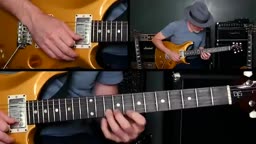
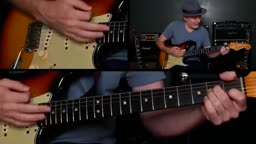
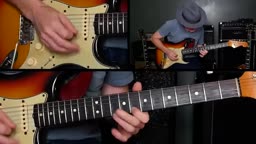
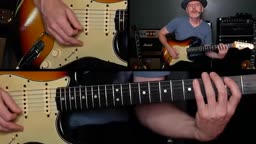
On Location: Pentatonic Deep Dive

Advanced Pentatonic Applications for Improvisation

Marty FriedmanTommy EmmanuelSteve VaiEric GalesEric Johnson

Get this course and 1,000+ more with All Access

Try 14 days free. Cancel any time.

Purchase Individual Course for $19.99
On Location: Pentatonic Deep Dive

About this course

The first scale that most guitarists learn is the pentatonic scale, which is very commonly associated with the blues and rightfully so. Yet, as we explore other styles and develop our soloing and improvisational skills, we discover how far-reaching and powerful those five notes can be in virtually any style.

Shot on location at Jeff McErlain’s Brooklyn studio, this Pentatonic Deep Dive course explores a much wider and “deeper” range of creative pentatonic applications. As you play your way through Jeff’s hands-on Deep Dive curriculum, you’ll learn how players like Hendrix, David Gilmour, Eric Johnson, Jimmy Page, and Joe Bonamassa infuse the pentatonic scale into their distinctive soloing approaches.

"We’ll start by exploring the scale one string at a time to help open up the fingerboard. Then, we’ll break it down into 4 note groupings to create connecting pathways across the neck, investigate the intervals and shapes within it, we’ll explore string skipping approaches, and even a few fast mixed grouping licks for getting extended pentatonic applications for both rhythm and soloing within rock, jazz, funk, and fusion contexts. I’m really excited to share these approaches with you here in this Pentatonic Deep Dive!"

In Performance Study 1, Jeff examines the Am pentatonic scale on one string at a time and in four-note groupings. Performance Study 2 focuses on connections between lines and what Jeff calls “the helix pattern” over a familiar progression similar to Stairway to Heaven.

In Performance Study 3, you'll change keys and look at the major pentatonic scale for a more funky chordal/double stop approach. Performance Study 4 uses one of Jeff’s favorite devices, chords built off of the pentatonic scale utilizing moody sounding open-string, spread-voicing applications.

Performance Study 5 takes you to the key of D Dorian, for a more extended, mixed pentatonic approach that you can use to get more melodic sounding solos. In the 6th and final Performance Study, you’ll work on some of those cool Eric Johnson/Joe Bonamassa style rapid pentatonic licks with mixed groupings - a ton of fun to play.

Jeff will explain and demonstrate all of the key concepts and approaches along the way. You’ll get standard notation and tabs for all of the performance studies. Plus, you’ll be able to use TrueFire’s learning tools to sync the tab and notation to the video lesson. You can also loop or slow down the videos so that you can work with the lessons at your own pace. All of the backing tracks are included to work with on your own as well.

Grab your guitar and let’s take a deep pentatonic dive with Jeff McErlain!

Jeff McErlain's Preferred Gear

Below is a list of Jeff McErlain's preferred gear including guitars, amps, pedals, accessories, and more. What you see in Jeff's lessons may or may not be this actual gear, but if you are trying to capture Jeff's sound and tone, the gear listed below is recommended by Jeff and it's a great place to start!

Guitars

Amps

Pedals

Accessories & More

What you'll learn

  • Play sparse, rhythmic funk guitar over one-chord vamps
  • Use G major pentatonic scale in a chordal context rather than for soloing
  • Play rhythmically on beats 2 and 4 to lock with the snare drum
  • Explore pentatonic scales one string at a time to open up the fingerboard
  • Develop right-hand rhythm technique for syncopated patterns
Release date: 10/13/2020 • 1h 46m runtime
Start Course
Sample lessons
One String, Four Note Groups
Performance
Connecting Lines & The Helix Pattern
Demonstration
Connecting Lines & The Helix Pattern
Performance
Funky Chordal Pentatonics
Demonstration

What's included

21 lessons • 7 charts • 6 Jam Tracks

On Location | Pentatonic Deep Dive
Hi, I'm Jeff McErlain. Welcome to On Location: Pentatonic Deep Dive.

I've want to make this course for a while but it really came together through a series of live lessons I I did on my YouTube channel. In those lessons I started to put together how I see the pentatonic scale and how I teach it. As guitar players, we often associate the pentatonic scale with playing blues. Now that is true, and that is the main scale used in that genre, the scale itself isn't inherently bluesy. It's just a collection of 5 notes.

In this course, I'll show you how to open up the fingerboard using the pentatonic scale, how to create cool sounding chords using just the pentatonic scale, use double stops, mixing pentatonic scales for get modal sounds, and, Eric Johnson inspired note groupings. So, let's get started!
Pentatonic Scale Review
A pentatonic scale is just a major or minor scale without the half steps. I'll mainly be discussing the pentatonic scale here in minor terms, so let's look at an A minor scale. A minor is spelled ABCDEFG, A minor pentatonic is spelled ACDEG. If you look you can see that we have removed the B and the F. By removing them, we no longer have any half steps left in the scale. This is one of the reasons the pentatonic scale is so easy to use, by removing the half steps and having less notes, there are less chances of hitting a "wrong" note. I highly suggest starting with Am pentatonic and learn the 5 minor pentatonic fingerings. While doing this start in on learning the scale up and down one string at at time, THIS is the real key to opening up the scale.
One String, Four Note Groups
So, let's dig into that minor pentatonic scale one string at at time. Once again A minor pentatonic is spelled ACDEG. Start on the high string and play the notes ascending and descending. So we'd start on the 5th of the scale, E and go through the scale from there. Say them as you play them! Say the notes of the scale out loud as you play them, this really helps to memorize them. Ascending is fairly easy, it's the descending that makes me really need to know the notes. Just try saying alphabet backwards right? Start with this and play it over the track!
One String, Four Note Groups
I don't necessarily think you need to learn this solo note for note. It's more about the concept of moving around the fingerboard using one string at a time and 4 note groupings. If you like what I played, then by all means please learn it! I like to think of these kind of things has a bit of a meditation, just hearing the notes of the scale in relation to the background track. Say the notes and listen to what they sound like, it is a great way to get the sound the scale into your head. As you can see there is nothing inherently bluesy about the scale itself.
One String, Four Note Groups
The four note groupings are exceptionally important and extremely useful for getting around the fingerboard. We see guys like Jimmy Page to Eric Johnson to Pat Metheny use this fingering idea mainly because it works so well on the instrument. As you can see in the video, the patterns repeat themselves making that much easier to memorize and frankly, place fast. By working through these ideas it really helped to demystify how these players are moving around the fingerboard so freely.
Connecting Lines & The Helix Pattern
I mentioned Jimmy Page earlier, usually my earliest guitar heroes, and still is to this day. I remember watching the Song Remains The Same concert in seeing him move pretty freely around the fingerboard. What that told to me was that he really knew his scales and how to connect them freely. In this section I'm going to show you some classic Jimmy Page style connecting ideas basically over this chord progression to Stairway To Heaven.
Connecting Lines & The Helix Pattern
An excellent way to practice your pentatonic scales is using what I call the helix method. This just reminds me what a DNA helix looks like, to go up one position, slide up to the next position and go down that one, slide position go up that one. This helped me to see how the scale fingerings interlock and overlap. Where one ends the next one begins.

+ 14 more lessons

Start Course

Reviews

61 results

PeteyMS

Verified buyer

12/10/25

The Deep Dive into Pentatonic

I always enjoy learning something from Jeff McErlain. I enjoy his approach and the way he explains what is happening. Grest little course. Looking forward to more from him.

jborhez

Verified buyer

11/18/25

Shines a light on the pentatonic scale!

Love Jeff and his lessons! This course opened my eyes to new ways to navigate the pentatonic up and down the neck. Excellent!

Hent03

Verified buyer

07/11/25

Some great ideas here for looking at the pentatonic scale in different ways and learning to expand outside of your comfort zones. The backing tracks are also a lot of fun and help you put the lessons into practice straight away.

ezmaypop

Verified buyer

06/16/25

Play aware,. this is what this course teaching.

Ghetto1969

Verified buyer

05/03/25

Perfect

Stop searching. Start improving with All Access.

Try 14 days free. Cancel any time.