Guitar Lab: Blues Soloing

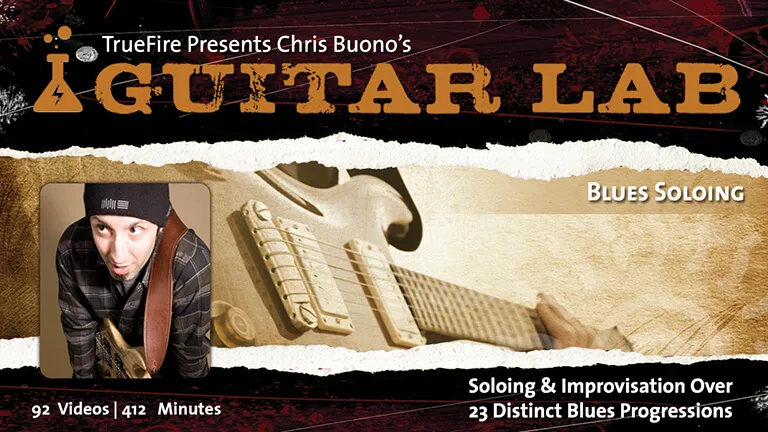
Soloing and improvisation over 23 distinct blues progressions

Marty FriedmanTommy EmmanuelSteve VaiEric GalesEric Johnson

Get this course and 1,000+ more with All Access

Try 14 days free. Cancel any time.

Purchase Individual Course for $9.99
Guitar Lab: Blues Soloing

About this course

OK bluesmen of the Fire, you've had enough time to get a grip on the 23 blues progressions and 69 rhythm lessons that Chris Buono presented in Guitar Lab: Blues Progressions and so now it's time to start blowing solos over those 69 choruses. And we're going to have to respectfully ask you to strip away those tired old pentatonic lines of yours and prepare to put some fresh flesh on those bones 'cause Buono's pulled out all of the stops on this one.

"No doubt about it - we guitarists LOVE to solo! And what do we love to solo over? The blues, baby! When you're in the zone, there's nothing better than diggin' into a root-position minor pentatonic scale and blowin' lick after lick over a 12-bar I-IV-V at the local jam. But those I-IV-Vs and stock licks tend to grow stale real fast."

Guitar Lab: Blues Progressions, which is still ranked as one of the top TrueFire courses, gives players a fresh range of progressions to call out at the jam or gig. However, the first question a student asks after completing that course is; "Now, how do I solo over these forms?"

"My previous Guitar Lab expanded your repertoire of progressions, voicings and rhythmic moves and so now we'll build up your soloing chops in a hurry as well. So, grab your axe and get a fresh 9-volt in that Tube Screamer - we have work to do!"

In Guitar Lab: Blues Soloing, our very own Professor of the Deep, Chris Buono, shows you how to solo over all 69 choruses of the 23 blues progressions covered in his previous Guitar Lab analyzing every chord and target tone along the way. Chris explains and demonstrates melodic voice leading, motivic development, stationary and movable permutations, repetition, call & response, space and the all important principle of targeting tones.

"The 69 solos that you'll work through were constructed to illustrate the key concepts in the course rather than fancy technique. You'll find them all not only very accessible but also melodic enough to serve as head melodies over the progressions. Consequently, the harmonic and phrasing concepts at work are very easy to identify and pick up on."

"If you haven't already installed the aforementioned 9-volt, get to it because you're gonna need some extra juice for this one!" We'd recommend you pick up a half dozen of those bad boys because you won't want to put down your instrument for quite some time.

What you'll learn

  • Apply A minor pentatonic scale in a musical solo context
  • Apply setup licks to transition between chord changes
  • Execute a minor key solo with proper syncopation and feel
  • Navigate a 10-bar solo form using repetitive melodic phrases
  • Phrase melodic lines that target chord tones on strong beats
Release date: 11/18/2010 • 6h 52m runtime
Start Course
Sample lessons
Larry's Trick
Larry's Trick
Introduction
Larry's Trick Solo 1
Key: G - 12 Bar
Larry's Trick Solo 2
Key: G - 12 Bar
Larry's Trick Solo 3
Key: G - 12 Bar

What's included

94 lessons • 69 charts • 69 Jam Tracks

Blues Soloing
There's no doubt about it: We guitarists LOVE to solo. And, what do we love most to solo over? The blues, baby! There's just something about diggin' into a root position minor pentatonic scale and blowin' lick after lick over a 12-bar blues at a hot jam - when you're in the zone it's pure bliss. But, did you ever stop to wonder what makes it all work? Or why a certain something you played worked so well over the chords you're soloing over? Perhaps more importantly, why didn't a certain something work? And, how do you play over those changes in Blues Progressions, anyhow? This course aims to answer those queries and many more so grab your axe and get a fresh 9-volt in that Tube Screamer-we have work to do!

Welcome to Guitar Lab: Blues Soloing - a thorough look into the how, what and why behind soloing over fresh sounding blues progressions of all kinds. Blues Soloing is a direct continuation of Guitar Lab: Blues Progressions where we take the 23 progressions introduced in that course and learn how to improvise over them. Like Blues Progressions this course is focused on a few key points that will make your blues soloing that much more effective. From intensely analyzing the relationship between your melodic device of choice and the chords you're soloing over (chord tones!) to the melodic voice leading that needs to be present within your licks to make it all come together; Blues Soloing will set you on the right road to becoming a formidable blues soloist making your jam session soloing excursions the talk of the town.

Blues Soloing features a gaggle of solos for you to dig into. For every set of three variations played per progression in Blues Progressions there's a solo designed specifically for it - that's 69 solos! The solos laid out for you in this course are meant to be memorable. So much so, they could very well be used as head melodies over the progressions giving you some serious firepower when hitting the next jam. The overall goal here in Blues Soloing is to show you how to make yours just the same.

Throughout the vat of solos you'll delve into important improvisational approaches such as:

-melodic voice leading
-motivic development
-stationary and movable permutations
-repetition
-call & response
-space

Making sure you can get your full geek on you'll find every last note played in the video segments in the accompanying Power Tab and PDF charts ready to be dissected in the shed. After viewing the lesson and printing your chart of choice be ready to rock with one of the included 69 backing tracks and get that mojo groovin'!

As for technique I hope you have some thick calluses 'cause you're going to be bending a LOT. In addition to the throng of whole step bends there will be an equal amount of an often overlooked bend - the half step bend. But, don't count out extended bends such as 1-1/2 and double whole step bends either. You'll also be coming across plenty of grace note hammer-ons, legato moves of all kinds and more!

If you haven't already installed the aforementioned 9-volt, get to it because you're gonna need some extra juice for this one. The 69 solos contained within this course are meant to be played with some grit in your sound. As always, if you're a POD person, the tones files are included and I have to say: They are quite delicious. I went overboard on tweaking this time around so enjoy.

OK, ENOUGH TALK-LET'S DO IT TO IT!

*** A big thank you goes to Steve Jenkins for laying down the stellar bass lines in every last jam track. Also big thanks to Chris Donlon of Beta Monkey for the completely cool drum loop libraries. Because of these two guys your jam tracks rock! And, hey, an overdue thank you to Brad Larsen for giving the world Power Tab. Kudos to you, Brad, wherever you are!

Sussy Strut
The three solos contained within Sussy Strut will introduce several vital reoccurring concepts that will be present throughout Blues Soloing such as melodic voice leading, playing with space and the importance of half-step bends. Above all, there will be a focus on playing chord tones with an emphasis on playing MAJOR 3rds over dom7 chords as opposed to the biting (but not always cool) b3rd/#9th. Don't get me wrong, that approach sounds killin' and has served many blues soloists very well. It just seems that many players have missed the boat on major 3rds and that's a huge component when trying to get your lines to sound more happenin'. You'll see...
Sussy Strut Solo 1
Sussy Strut gets straight to the point in regards to nailing chord tones and playing the aforementioned major 3rds with this first chorus. As you play through the solo and the two that follow look for how the root position Bb minor pentatonic vision is morphed into a more Mixolydian sound by playing the additive major 3rd (D) over the Bb7 chord (I7). That approach, as well as the basic theme, will stay in focus in the second and third solos, but within more embellished ideas. Speaking of themes, notice how the lines follow the comp rhythm, especially in bars 9-10. This makes for a more cohesive solo and gives the listener, as well as the band, something to grab onto. By doing this everyone in the room can begin to feel a part of what it is your playing and get more into it. In regards to the band they may further emphasize what you playing, making the entire delivery that much more are exciting!
Sussy Strut Solo 2
In the second and third solos you'll find some not-so-common first finger bending situations. In the second chorus they'll pop up in bars 4 and 8 - watch out for the tricky transition in bar 8. As for the third solo you'll see them in bars 8 and 9. When it comes to first finger bends it's generally a good idea to pull down for the 3rd string instances and push up for the 2nd string ditties.
Sussy Strut Solo 3
In this third solo while still outlining chord tones, the theme changes up a bit to match the overall vibe of the comping. There's a bit of a departure from that theme in bars 5-6, but as with many solos here in Blues Soloing, you'll come back to the main theme at the end. Though the major 3rd will have much of the spotlight in this course, as seen in the first two solos, notice how the third solo stays away from the 3rds due to the 9sus4 chords.
Larry's Trick
Larry's Trick is going to follow a similar format for its three solos: The first two will be closely related to each other with the second solo containing variations of the first solo, while the third solo will depart from the former and set its own path to match the signature comping groove. Every set of three solos could be played within a multi-chorus solo. With that in mind, check out the thematic changes littered across the sets. Here in Larry's Trick you have a feel change within bars 1 and 2 from the first to second chorus where the swing 1/8 vs. triplet 1/8 feel is reversed. Also, check out how the phrasing in bars 3 and 5 of the first chorus are slightly enhanced to triplet 1/8s in the second chorus. This idea comes to full fruition all in one bar in the second chorus where you see this approach played out in bar 9 over the D7.
Larry's Trick Solo 1
In this first solo, as well as the following second solo, there's ample emphasis on the major 3rd of the G7 chords (B), but the trick is it's played in every possible way that avoids playing it conventionally! There's half step approach bends from below (bar 1, first chorus), half step approach hammer-ons (pickup to bars 1, 3, 7 and 11 in second chorus) or half step approach slides (pickup to bars 3, 5 and 11 in first chorus) scattered throughout. This, as with many other moments throughout the course, are a testament to one simple fact: It's all about how you PHRASE the notes!

+ 87 more lessons

Start Course

Reviews

14 results

Sockenfrank

Verified buyer

09/09/22

All you need

A must for Blues Soloing. With the rhythm/chords course, he also provided basic care.

jaimeguillenmd

Verified buyer

08/27/22

Great course!! Full of soloing over the changes and a outside the pentatonics tips. Fantastic!!

hansjohn

Verified buyer

11/05/21

the solos on the tracks are approach in a good way.

gagglyguitars

Verified buyer

10/29/21

New Ideas for Blues Soloing

Lots of interesting, new ideas for Blues Soloing...

drf66

Verified buyer

10/27/21

Good book

Stop searching. Start improving with All Access.

Try 14 days free. Cancel any time.