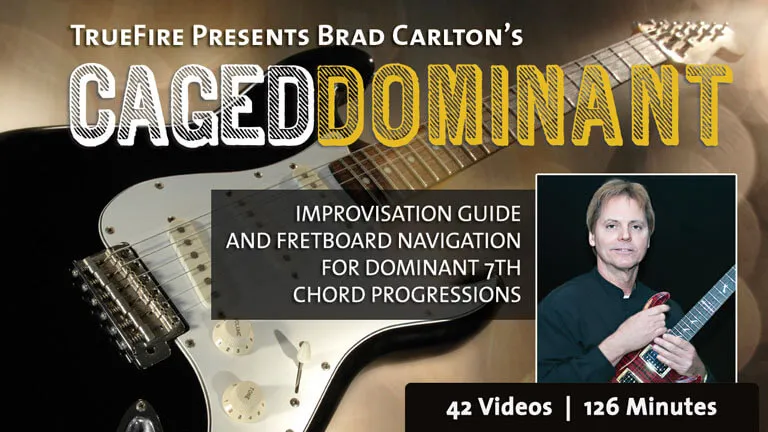
CAGED Dominant

Improvisation guide and fretboard navigation for dominant 7th chord progressions

Marty FriedmanTommy EmmanuelSteve VaiEric GalesEric Johnson

Get this course and 1,000+ more with All Access

Try 14 days free. Cancel any time.

Purchase Individual Course for $9.99
CAGED Dominant

About this course

Brad Carlton's CAGED Dominant is the sequel to his acclaimed "breakthrough" CAGED Cracked course. In CAGED Cracked, students developed a comprehensive of the CAGED system - five moveable major chord forms (C, A, G, E and D) that can be played in any position, up and down the neck. They also learned EDCAG - the five moveable minor forms that can likewise be played in any position, up and down the fretboard. This new CAGED Dominant series focuses solely on the moveable dominant chord forms, which are especially useful for blues, rock and jazz.

CAGED Cracked and CAGED Dominant gives players a much broader perspective of the fretboard and provide a significantly wider selection of chord choices and positions for any given tune.

Carlton unlocks the improvisational firepower of these essential fretboard systems for not only rhythm work but fills, solos and melodies as well.

Carlton will step through each of the 5 Dominant 7th forms up and down the neck; C7 Form, A7 Form, G7 Form, E7 Form and the D7 Form. You'll learn how to easily and quickly identify roots and other strong tones and all of the associated arpeggios, intervals, pentatonic scales and other scale forms for each of the forms - all of them also moveable to any key. You'll also learn handy inversions of the chord forms to connect the dots between the forms and add texture to the harmony.

Now the fun begins as you put your big bag of moveable chords, arpeggios and scale forms to work to comp and improvise solos over any changes, in virtually any fretboard position. Carlton includes a lengthy series of vamps and practice rhythm tracks to illustrate the improvisational firepower of the system.

You'll learn how to pull out fills at will and instantly connect strong tones across even the most complicated changes to form seamless melodic lines and compositions.

You'll also explore 7 Add b3 Arpeggios, chromatic connections of chord tones, applying the Blues scale, 13 arpeggios, Mixolydian overlays, Major Pent Add b3 and how to "soften" the Blues scale.

The ultimate "rut-buster" for intermediate and advanced players alike, CAGED Cracked and CAGED Dominant will quickly transform every aspect of your playing and understanding of the fretboard.

What you'll learn

  • Use octave technique to play arpeggios
  • Connect arpeggios smoothly across positions
  • Visualize and play dominant 7th arpeggios in five areas of the neck
  • Blend multiple positions into a unified fretboard map
  • Develop and move melodic motifs through chord changes
Release date: 07/05/2008 • 2h 06m runtime
Start Course
Sample lessons
G7 Form
G7 Form
Chord & Arpeggio
G7 Form
G7 Form
Arpeggio Patterns
E7 Form
E7 Form
Chord & Arpeggio
C7 - Eb7 Vamp
C7 - Eb7 Vamp
Part 1

What's included

40 lessons • 10 charts • 4 Jam Tracks

C7 Form
Brad Carlton shares his considerable talent and vast knowledge of theory in his latest TrueFire course, CAGED Dominant, the third in the CAGED Cracked and EDCAG Primer series. In this course, Brad continues to base improvisational ideas and fingerboard visualization on five different chord forms, giving you the structure to solo over changes that fall outside of typical I-IV-V progressions such as those found in funk, jazz and certain blues styles.

You will explore these forms and their associated dominant 7th arpeggios as well as the use of motifs to bring a fresh approach to your solos and to avoid painting yourself into a corner when improvising over less common chord progressions.

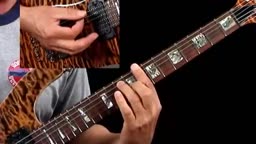
In this video we begin with the C7. Brad stresses the importance of learning the names of the dominant 7 chord tones – the tonic, 3rd, 5th and b7th. Since we are dealing with C7 in this example, the root will be located on the fifth and second strings.

As stressed throughout this course, visualize the arpeggios, which in this example is E, G, Bb, and C – the 3, 5, b7 and 1 respectively. Seeing both chord tones and their respective arpeggios as notes and chord tones will help you utilize the entire fretboard during improvisations.

C7 Form
Arpeggios are integral to single note ideas, but here Brad demonstrates their importance when building harmonies and chords. After a demonstration, he stresses running through all of the possible combination of tones to develop a multitude of dominant 7th voicings as well as an aid to help visualize the fingerboard beyond simple finger patterns.

Next, Brad discusses singing the scale tones and note names while running through single-note phrases built from arpeggios. Expanding on this technique, he offers up ideas for developing both rhythmic and melodic motifs to use in improvisations.

A7 Form
Here Brad moves to the A7 form, demonstrating the chord tones and techniques for breaking the fingerboard into less daunting segments while learning the arpeggios. Again, explore the chord fragments created using the associated arpeggio while continuing to identify the chord tones and note names.
A7 Form
By using the arpeggio patterns from the previous chord form, Brad constructs new patterns through skipping tones. He then improvises while skipping two tones, demonstrating a musical way to sidestep the familiar, up-and-down arpeggio pattern. He also discusses the importance of keeping the phrases and rhythmic patterns musical, stressing the avoidance of simply playing through the arpeggios.
G7 Form
The G7 form provides an opportunity to stretch out your fretting hand. Since the form is somewhat unwieldy and can lead to intonation issues, Brad suggests breaking the form into smaller fragments.

Next, look at the chord, look at the arpeggio, then use those tones to build phrases and chord fragments. Again, Brad’s mantra here is to know your tones, both by name and numerically.

G7 Form
After a quick review of the previous chord forms, Brad discusses ways to link them together. Then he demonstrates the use of melodic patterns combined with lower note/higher note motifs. He finishes things off with a look at mixed ascending/descending motifs.
E7 Form
Brad reviews this familiar shape and demonstrates two positions for playing the arpeggios while showing us a new, sustained arpeggio technique suitable for both lead and rhythm textures. Next, he uses some jazzy sounding devices built on common arpeggio patterns. He also begins incorporating known scales with the dominant 7th arpeggios.

+ 33 more lessons

Start Course

Reviews

7 results

MarkGavin

Verified buyer

03/01/21

Excellent no nonsense method of showing these concepts

magditfr

Verified buyer

05/19/20

More meat to the bones

A great companion to Andy's CAGED Cracked video lesson. Great motivation tool to learn and find the notes over the fret board and do more exploring!

Archie123

Verified buyer

05/17/20

Caged Dominant

grahamparsons

Verified buyer

11/26/19

This is the best course I have purchased from Truefire so far. It has really advanced my thinking about soloing on the guitar and has stopped me thinking only pentatonic minor when I attempt a solo. I recommend this course for anyone trying to play more interesting guitar parts and solos.

guinnessed

Verified buyer

09/26/18

great course brad is a terrific teacher

Stop searching. Start improving with All Access.

Try 14 days free. Cancel any time.