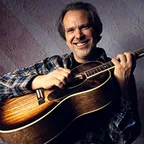
OK, admit it... you secretly covet fingerstyle skills but won't go public with it because you've given it a go in the past and you're pretty darn sure that you just don't have the essential ambidexterity and finger/thumb coordination to pull it off. And since you can't juggle either it all sort of makes sense. So, no big deal -- there's lots of music you can play with a pick but still, deep down inside, you know that the guitar is a polyphonic instrument and jeez, if you could only...
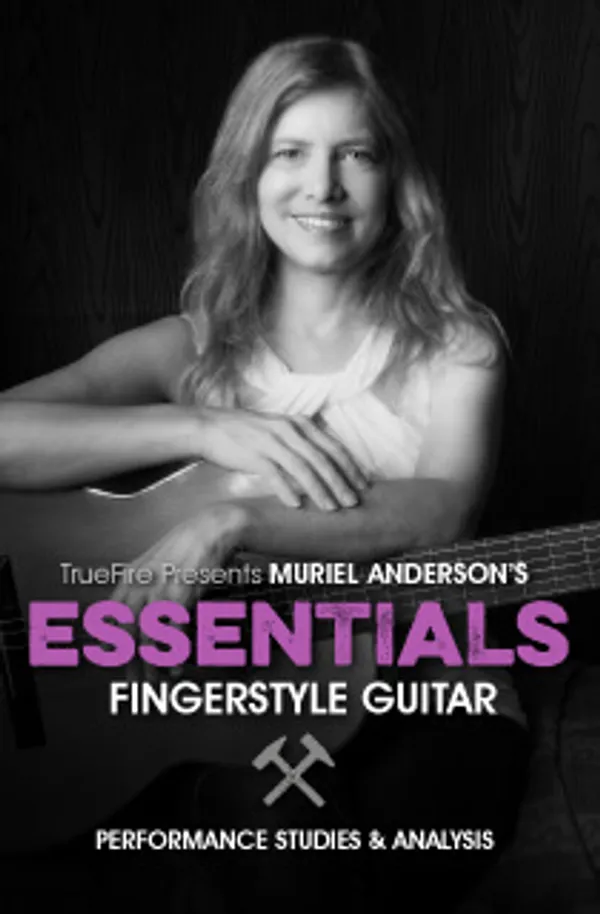
STOP! Anyone can learn to play fingerstyle. Yes, even you. It's simply a matter of repetition, muscle memory, and solid instruction. If you promise to take on the repetition, your muscles will handle the memorization, and Muriel Anderson will provide the solid direction with 1-2-3 Fingerstyle Guitar. Square deal?
1-2-3 Fingerstyle Guitar is designed for intermediate to advanced flat-pick players who are ready to throw down that pick for a while to finally get a handle on fingerstyle. That's the secret ingredient of this study program -- it's a beginning fingerstyle course NOT a beginners course. You won't be bogged down working through a ton of remedial instruction.
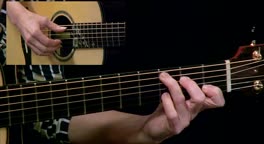
You'll find the left-hand side of things very familiar and accessible. You'll dive right into developing that finger/thumb independence on the right-hand, and Muriel's got the educational goods to get you up, running and fingerpicking faster than you can imagine. Guaranteed.
In the first section, Muriel focuses on getting your thumb to think for itself by introducing you to thumb circles, the Merle Travis arm, muffling and a few simple alternating bass moves. You'll then start adding the ring, middle and index fingers to the mix, take on your first fingerstyle tune and ... voila!
Muriel then steps you through three accompaniment patterns that you can apply to virtually any tune. You'll learn how to work the pinky over a G, C and E chord and that will prep you for your second fingerstyle tune, Brad's Rag.
Next up; blue notes, more open chord forms, barre chords, dominant chords, 7th chords, arpeggios, forward rolls, reverse rolls, lullaby, travis and country patterns. These skills round out your fingerpicking chops and open the door to your new fingerstyle world. But wait... there's more.
Bass runs, chromatic walk-ups and walk-downs, turnarounds, hammer-ons, pull-offs, plus Muriel adds bits and pieces of Deep River Blues, Ali Cat, Alice's Restaurant, String Along Rag, Nine Pound Hammer, Windy and Warm, Waterfall in G, and Potato Gun Rag to your fingerstyle repertoire.
We can't help you with the juggling, but you won't have time for that anyway -- those weekend solo fingerstyle gigs will be keeping you pretty busy!
Traditional fingerstyle guitar is a great avenue to develop independence between the thumb and fingers while keeping a constant groove. We will emphasize the alternating bass using the arm and even the entire body to push the thumb. This translates into groove which translates into emotion.
Each of the 19 sets of lessons has three parts to learn. We’ll work on adding the fingers in different ways, accompanying songs, typical chord forms, blue notes, arpeggios, patterns, bass runs, walk ups and walk downs, turnarounds, endings, hammer-ons, pull-offs, and cool licks.
I’ve composed some easy tunes for you that are similar to standard fingerpicking tunes that you might be learning later. With much already under your fingers, it should give you a jump start when you set out to learn fingerstyle music, or to write your own.
Chet Atkins used to say that he spent a couple of years just moving the thumb back and forth before adding the melody.
Playing accompaniment and really listening to the groove and getting your body to move with the music is a good first step to playing fingerstyle guitar.
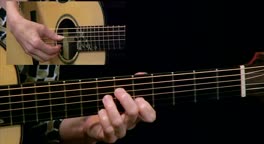
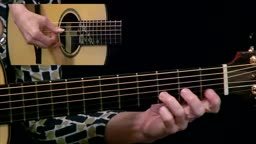
We'll work a lot with the movement of the thumb, and moving the arm and body as well. There are also different ways to detach or muffle the bass notes for a crisp and distinctive sound.
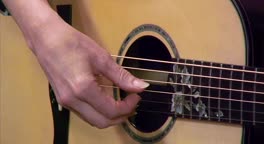
Pay attention to where your right hand falls over the sound hole. The right hand position might be a little bit different for each person.
Find where your hand can hang in a relaxed way, so that your three fingers can hang relaxed over the first three strings, and your thumb has freedom of movement.
Here are a couple of ways to have a crisp, detached sound in the bass.
The first way, muffling the bass, is typical of the playing style of Chet Atkins and Merle Travis. The technique was first developed to prevent the bass notes from feeding back on an electric guitar, and the sound became stylistic.
The second way is a technique I learned from Leo Kottke. This is unique, in that it allows the hand to be over the soundhole, where you can get a greater variety of tone from the melody notes, and still keep the bass notes from ringing too long.
Using more of the arm, and leaning the body into the bass notes, makes an incredible difference in the groove of the music.
Whether I'm working with classes of beginners or with advanced students, in every case, I've found the music suddenly takes on more solidity and meaning.
You'll get used to the distance between the strings as you rotate your thumb back and forth between two strings.
Use these exercises to listen to and adjust the amount of muffle or detachment of the bass notes, really nail the groove, and play loud! Just the volume itself combined with very precise tempo and crisp sounding bass will give energy to your playing. Playing with recordings or playing with other people is more fun than only playing with a metronome.
Try some of each.
On some tunes, a simple rotating bass, together with a melody or fingerpicking pattern, is the best kind of sound for that tune.
Try adding a melody note or two as you're playing this rotating bass.
I love this course. It does just what it says on the tin. Muriel is a great teacher, she explains things really well.
M
MarcelvB
Verified buyer
02/22/26
clear and structured course
D
Davidhabermel
Verified buyer
10/07/25
1 w
Excellent presentation and useful and ready to use techniques.
M
Mahkmud
Verified buyer
07/10/24
123 Finger Style
I love it, getting my fingers coordinated for finger style because I learned to and mostly play the guitar using a pick. I play a variety of styles, Bossa Nova, Folk, Delta Blues, Jazz and other.
D
Dave58
Verified buyer
04/28/23
Great!
Fun and instructive starter course to learn this guitar style. These techniques are taught by a master teacher. All of Muriel's courses are a pleasure to enrich you with her guitar knowledge. the Lesson examples are a delight to the ear. But whether it will succeed in 123 will depend on the exercise? Great.