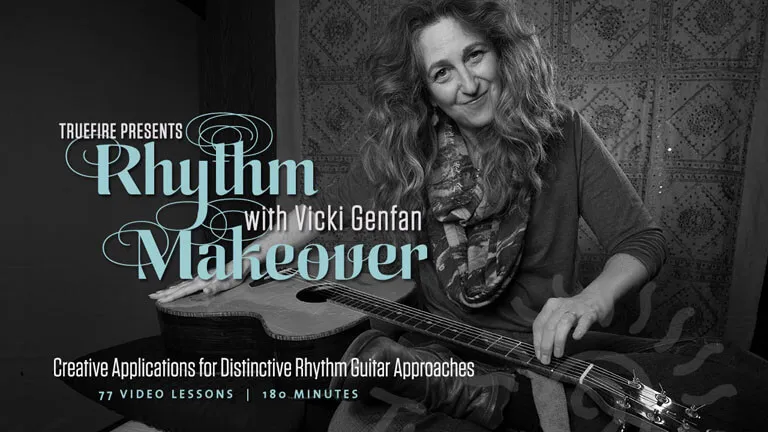
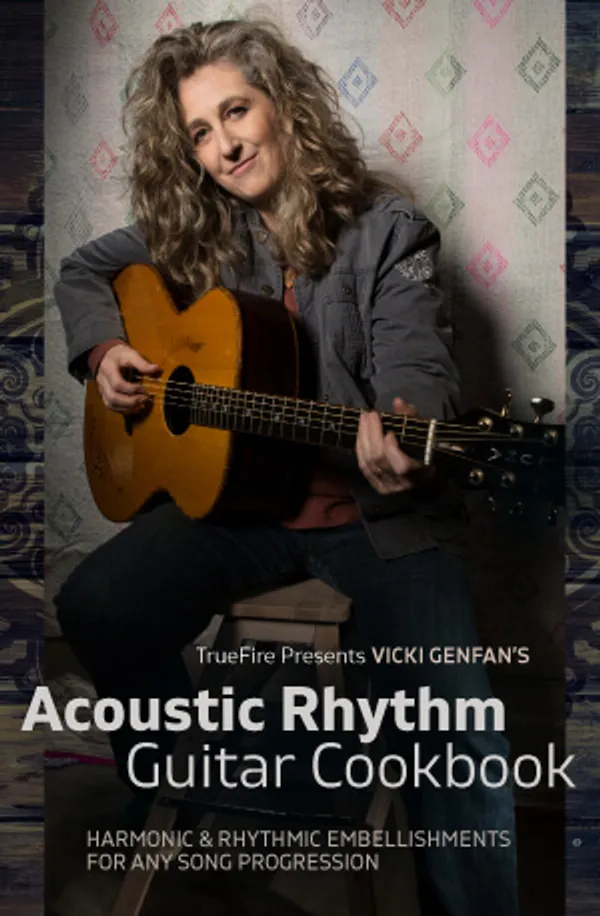
In this Rhythm Makeover edition, Vicki Genfan presents her signature acoustic rhythm guitar techniques and creative approaches. Crowned champion of Guitar Player magazine's Guitar Superstar competition, Vicki plays all the big international stages from Montreal's Jazz Festival to Germany's Open Strings Guitar Festival to Italy's Soave Guitar Festival.
Expand your acoustic rhythm guitar prowess with Vicki Genfan’s Rhythm Makeover and be sure to check out Adam Levy’s Rhythm Makeover for electric guitar, and Muriel Anderson’s Rhythm Makeover for fingerstyle guitar.
Thousands of #1 hit records use the same handful of chord progressions. So, what makes those songs so distinctive from one another? Melody, lyrics and production values are all very important of course, but rhythm is what gets the feet tapping, the bodies moving and the lips smiling.
Whether they perform in bands, duos or solo as a singer-songwriter, guitarists play rhythm 95% of the time supporting the vocalist and/or soloist. A pretty big responsibility, and a pretty big challenge making those common chord progressions sound original and interesting.
TrueFire’s Rhythm Makeover series focuses on the art of crafting compelling, original and interesting rhythm guitar parts by equipping players with the harmonic skills, playing techniques, chord vocabulary and creative approaches for breathing fresh life into any chord progression.
Rhythm Makeover courses are presented by educators with vast experience composing, arranging, recording and performing songs for audiences world-wide. Each edition is presented a single educator, but all of the educators examine the same 15 chord progressions.
The 15 chord progressions were specifically selected because they have each powered hundreds of hit records, across a variety of popular styles. All of the educators also work with the very same bass and drum tracks to emphasize just how much influence the guitar part has on the distinctive qualities of a song. The progressions and tracks cover a variety of keys:
I-V-vi-IV progression in the key of C major I-vi-ii-V progression in the key of G major Descending IV-iii-ii-I progression in the key of E major ii-V-I-IV progression in the key of A major I-Imaj7-I7-IV progression in the key of G major iii-vi-ii-V progression in the key of C major I-vi-iii-IV progression in the key of G major I-IV-V-I in the key of E major Ascending I-ii-iii-IV progression in the key of A major vi-V-VI progression in the key of D i-bVII-bVI-V progression in the key of C minor I-iii-IV-V progression in the key of G major vi-ii-V-I-IV-iv-I chord progression in the key of E major I-II-V-I progression in the key of A major I-bVII-IV progression in the key of D Bringing his or her unique perspective and skill set to the table, the educator presents two distinct creative and technical approaches for each of the 15 chord progressions (30 approaches in all).
As you work through the 30 different approaches, you’ll learn new chord voicings, strumming and fingerstyle patterns, harmonic approaches, creative ideas, right and left-hand techniques and much more, all of which can be applied to any progression that you might encounter, in any key.
What you'll learn
Play fingerpicking patterns with thumb-thumb-fingers technique
Execute hybrid picking (pick + fingers) for arpeggios
Play funky 80s-style rhythm approach without capo
Play in 5/4 time signature with confidence
Use palm muting to create rhythmic texture and tightness
Find new ways to play that same old groove! One of the coolest aspects of creating this course has been preparing 2 completely different rhythm ideas for each progression. As you learn them and play them yourself, you might enjoy recording one of them and playing the second one along with it. In a lot of cases, they work beautifully this way!
But the other reason for doing this - creating 2 different grooves - is to remind you that there are so many ways to lay down that groove, and the more open your musical mind is, and the more flexible your chops are, the more unique and awesome you’re going to be as the rhythm guitarist, whether that’s in your band, as a singer/songwriter or accompanying a vocalist. The first thing you might do with this course is learn and play along with the grooves I’ve created for you. However, my wish is that you’ll take the grooves that really move you and apply them to progressions and songs you’re already playing that may need a face lift, or to songs you want to learn or write!
For this progression, we'll be working in the key of C and playing a I-V-vi-IV progression. That's C-G-Am-F. This could be the most commonly used progression in all of pop music! Songs like 'I'm Yours' , 'Wherever you Will Go', 'She Will be Loved' and U2's 'With or Without You' are just some of the major hits using this progession. Our first approach uses chords in the first position and incorporates a spacious, chunky rhythmic pattern that uses right hand palm muting, color tones and a melodic motif that follows each chord, creating a simple counter-melody. Version 2 uses chords in the higher frets (5-10) and voicings that have much closer intervals. With these voicings we create more dissonance or tension. We're also using a strumming pattern that's much busier, employing a 16th note rhythm.
By varying the amount of right hand palm muting you use, you’ll change the sound and the feel of this riff. Also try focusing your pick on different strings - I put a lot of emphasis on the bass notes but you may want to feature more of the higher strings.
Can you find any alternate color tones for this progression? How are you playing the F chord? Are you able to bring your thumb over for the low F on the 6th string? Don’t tense up too much for that! Keep an eye on your shoulders.
Be sure to let that hi E string ring! It gives us some really nice color tones with these voicings.
You may have to take some extra time with this to make sure you can get the strum really flowing while staying clear of the 6th and 5th strings!
This is a I-vi-ii-V progression in the key of G. So we have G-Em-Am-D. This progession is sometimes referred to as the 50's progression, since so many songs from that time use it. For instance, Jack Lawrence and Charles Trenet's 'Beyond the Sea', Sam Cooke's 'Loveable', and we also see it in more current pop songs like Elton John’s ‘Crocodile Rock’, Green Day’s ‘Jesus of Suburbia’ or Led Zeppelin’s ‘D’yer Mak’er'.
In our first example we’re using first position chords and playing our bass notes in time with the kick drum. We add a few color tones to provide a nice movement within the progression.
Our 2nd approach uses voicings up in the 8-12th frets giving us some very high notes on the 2nd string that move in a simple melody. We use the open 1st string as a drone for this version. The rhythm is completely in opposition to the movement of the bass and kick drum, giving us a real nice syncopated feel.
Vicki provides a great framework for writing and arranging. The voicings presented are fresh and unique. The course will make your playing more interesting to your audience.
V
Vuiller
Verified buyer
12/23/21
Basic Toolbox
A very useful toolbox with fundamental elements to vary approaches towards more pleasure!
T
tomac
Verified buyer
07/16/21
I really needed this. Great job
P
patrick m.
Verified buyer
04/10/21
rhythm makeover
This is a terrific course. I've learned a great deal about acoustic strumming that I didn't know. She is great !
M
mccambda
Verified buyer
12/27/20
Rhythm Makeover
This is an interesting lesson.
Lots of new concepts.
Vicki explains things so well.
Thanks