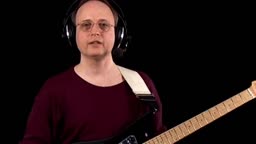
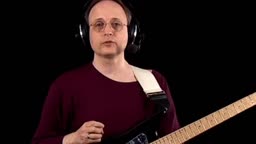
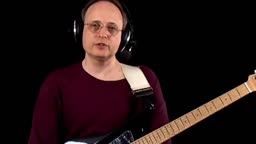
Learning how to play jazz guitar is no cakewalk but then that's what attracts most of us to the style to begin with. Jazz guitar is indeed challenging, however it's also extremely rewarding because the form allows you the ultimate freedom of expression as a musician. But before you can exercise that freedom, you have to put your time in listening to jazz, watching video jazz guitar lessons, and learning the requisite theory, chords, rhythms and vocabulary.
As is the case with all of the arts, you can read all of the books on the subject but the only way to truly learn the form is to study with a master. And the sooner you find your mentor, the better.
Beginning Jazz Guitar is not just a solid starter jazz guitar course, it's also your apprenticeship with a jazz master who is supremely qualified to be your guide throughout the many study phases you will undertake on your journey towards becoming proficient in all aspects of jazz guitar.
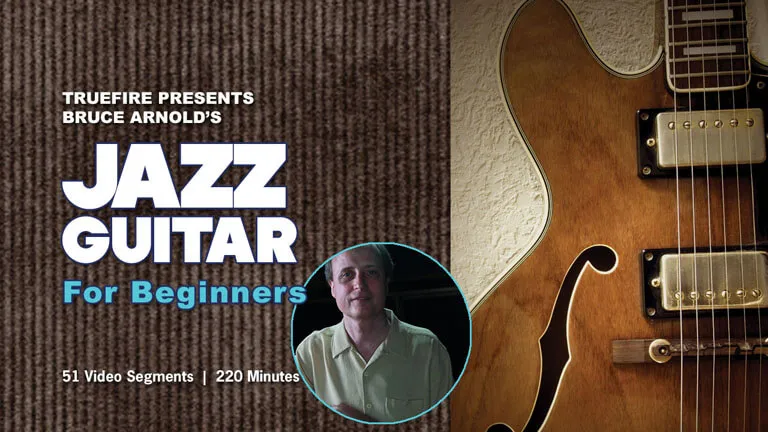
Bruce Arnold may likely be the most talented, most prolific and most accomplished composer, player and jazz educator on the planet. Bruce runs the guitar programs at Princeton University and New York University, hosts the Summer Jazz Workshops in NYC, and is widely respected by peers and students alike as a "powerhouse in the world of jazz education."
Arnold has published over one hundred books and courses on subjects including improvisation, ear training, sight reading and rhythmic studies. With over twenty five CD and DVD recordings to his credit, Arnold tours internationally and has played with a diverse range of musicians including Stuart Hamm, Peter Erskine, Joe Pass, Joe Lovano, Lenny Pickett, Randy Brecker, Stanley Clarke, the Boston Symphony Orchestra and the Absolute Ensemble under the baton of Kristjan Järvi.
Arnold is enthusiastic about using software to accelerate the learning process. "Most beginner students realize that jazz is a complicated musical style and that they will need to develop a lot of tools to play it well. A famous jazz musician once said 'jazz can be taught in just three lessons; 1st lesson: practice for 10 years; 2nd lesson: practice and perform for 10 years; 3rd lesson: practice, perform and develop your art for 10 years.' Hopefully we can drastically shorten that 30-year cycle by leveraging some of the educational tools we have available to us today such as interactive video and online learning assets :)."
Beginning Jazz Guitar takes ready advantage of today's educational technologies. "Before we had tools like the Internet, DVDs, CD-ROMs and software, it took much longer to learn because it was harder to access relevant information. I've included all of the information in this course that I consider to be important components in your early development as a jazz musician."
All of the great players agree that the best first step is learning the basics no matter how arduous that task might be. "The exercises I recommend will range from inspiring to challenging. The inspiring ones will keep you coming back to the guitar each day; the challenging ones will build and strengthen your chops. You're learning a new language and this takes time and dedication. Stick with it and you'll reap rewards that you'll enjoy for rest of your life."
Arnold makes the learning process fun and engaging. "You'll "play" your way through the Beginning Jazz Guitar lessons by applying the scales, arpeggios and techniques that I teach you, over dozens of practice rhythm tracks that I've prepared for you. This way you put your newly gained knowledge to immediate use by learning how to improvise right from the start."
"Bruce Arnold may likely be the most talented, most prolific and most accomplished composer, player and jazz educator on the planet."
What you'll learn
Execute sweep picking and pull-off combinations with arpeggios
Combine arpeggios with scales for varied improvisation
Use minor 7th arpeggios in improvisation over static minor vamps
Apply proper hand positioning and relaxation techniques to avoid tension
Target minor 7th arpeggios specifically over the ii chord in a 2-5-1 progression
Welcome to Beginning Jazz Guitar! Learning how to play jazz guitar is no cakewalk but then that's what attracts most of us to the style to begin with. Jazz guitar is indeed challenging, however it's also extremely rewarding because the form allows you the ultimate freedom of expression as a musician. But before you can exercise that freedom, you have to put your time in listening to jazz and learning the requisite theory, chords, rhythms and vocabulary.
Most beginner students realize that jazz is a complicated musical style and that they will need to develop a lot of tools to play it well. A famous jazz musician once said 'jazz can be taught in just three lessons; 1st lesson: practice for 10 years; 2nd lesson: practice and perform for 10 years; 3rd lesson: practice, perform and develop your art for 10 years. "Hopefully we can drastically shorten that 30-year cycle by leveraging some of the educational tools we have available to us today such as interactive video and online learning assets :).
Beginning Jazz Guitar takes ready advantage of today's educational technologies. "Before we had tools like the Internet, DVDs, CD-ROMs and software, it took much longer to learn because it was harder to access relevant information. I've included all of the information in this course that I consider to be important components in your early development as a jazz musician."
Jazz has a deep history and some of the greatest musicians have helped create its legacy. It is beyond this course to give you a complete history so I recommend that you get a book on the history of jazz to get a better understanding.As I've mentioned in the videos its important to start understanding not only the specifics of which notes are used in a song, chord or scale but also the organization of the music which includes considerations of form, solos, rhythm and style.
Usually learning all this comes from years of experience playing and listening to jazz. I've included a list of guitarists to listen to which will help you start to understand the music.
I also recommend you familiarize yourself with other great jazz instrumentalists to understand all aspects of the idiom.
Music Theory is usually the weak point for most musicians and is doubly true of guitarists due to the majority of "self taught" players.
I would highly recommend you work through the book "Music Theory Workbook for Guitar" Volumes One and Two. These are the only books I know of that directly relate learning music theory to the guitar fretboard.
Mastering the information found in these books will help you not only learn the notes on the guitar but also to understand how chords, scales and arpeggios are played on the guitar and also to understand fundamental concepts like "diatonic chords of a scale" and "tensions" which are essential components in playing jazz.
You should tune your guitar every single time you pick it up. Guitars (particularly cheaper ones) tend to go out of tune quickly.
Make sure your guitar is in tune when you begin to play it, and check the tuning frequently while you're practicing, as the act of playing the guitar can cause it to go out of tune.
At first, it may take you five minutes or more to get your guitar in tune, but the more familiar you are with tuning, the more quickly you'll be able to do it. Many guitarists can get their instrument roughly in tune in about 30 seconds.
In this video, I'll show you how to get that jazz sound our of your guitar and amplifier.
It's really quite easy and you don't need a lot of effects and fancy gizmos to get a great jazz sound out of pratically any guitar or amplifier.
Open chord voicings are the chords that many people call folk chords or first position chords becuase they are played on the first few frets of the guitar.
Most players learn these chords first whatever their preferred style of music happens to be. I will step you through the basic ones and I've also provided a chart of these open chords so that you can learn others.
While its important to know open chords as a beginning guitar player, you will soon discover that jazz players rarely use these types of chords.
It's just what I needed to continue with my journey. Easy to follow and a challenge to excel
K
Kamilde
Verified buyer
01/11/25
Recommend
Very good course for beginner guitarists. I like the relaxed pace and the sound.
O
OTernian
Verified buyer
11/30/22
Good course so far
At the time of this review I’m only about 25% through the course but I like it and making progress. He’s a good teacher, very evenly paced, and seems to be heading in a logical direction. I had to slow down for a couple weeks or so because I needed to get my hand accustomed to barre chords and it also seemed like progressing without knowing the notes on the fretboard was going to be a problem so also made a good start on memorizing those.
G
gwcannon
Verified buyer
12/08/21
This course is a good refresher for the more experienced and a great course for the beginner.
C
chaji
Verified buyer
06/20/21
Basically a blues player. The Jazz course has expanded my perspective.