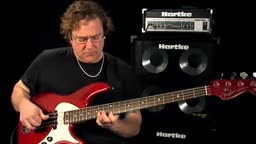
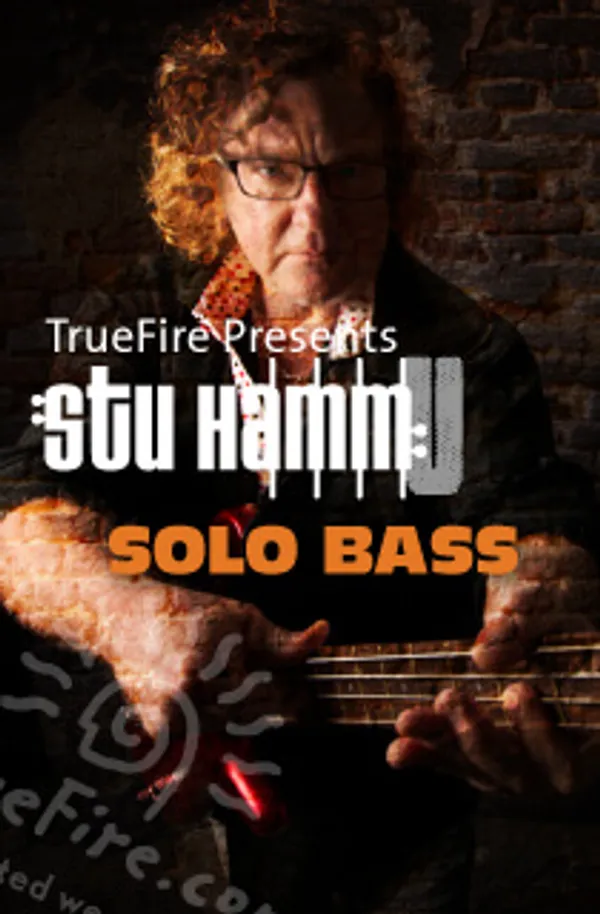
Stu Hamm's Fretboard Fitness digs deep into bass guitar fretboard navigation, finger agility and the theoretical knowledge necessary to play all styles of music. If you consider yourself an intermediate bass guitar player, Stu Hamm's Fretboard Fitness is the bass boot camp you need to take your skills to the next level.
"These are the bass guitar lessons I wish I had when I was coming up. I've distilled the curriculum in Fretboard Fitness to the essential nuts and bolts of playing bass guitar; navigating the fretboard, building hand strength, and understanding the essential principles of music theory and harmony. All of the video bass guitar lessons, exercises and workouts that I've included in Fretboard Fitness are designed to form a strong bond between your hands, ears and mind."
The best quality of this course is how you work with it; you'll play your way through Fretboard Fitness. No tedious, boring routines or theoretical math here. Stu designed each workout to provide equal measures of applied theory, fretboard navigation and hand strength. This 3-in-1 approach gives you more of a musical perspective and makes working out more fun. The lessons and workouts include:
STRETCHING: Stretching exercises designed to loosen you up and keep you loose so that you can avoid harming yourself when you play.
TRITONES & WHOLE TONES: A series of tri-tone and whole-tone stretches to loosen up your left hand and rhythmic quarter to eighth noted patterns to work out your right hand.
DOUBLE STOPS & BARRING: Major pentatonic patterns, barring/double stops and the technique of holding down ( or “fretting”) 2 or 3 (or 4) strings with one finger.
MODES & SCALES: Stu de-mystifies modes and explains where they come from, what they mean, and what to do with them. Hamm runs down the tonal characteristics for each of the modes demonstrating both single and double octave fingerings for Ionian, Dorian, Phrygian, Lydian, Mixolydian, Aeolian & Locrian modes.
DIATONIC MODE EXCERCISE: Here comes the bread and butter; this exercise puts all of the modes together to demonstrate how they operate within the key of G and on your fretboard. This is the foundation of Hamm's own warm-up routine and the basis for the patterns that will follow in the course.
PARALLEL MODES: Stu twists your brain a bit by taking you through a routine where you'll play all of the modes starting on the same note as opposed to going up the scale diatonically.
PATTERNS 1 & 2: Learn another couple of Stu's favorite warm-up techniques; patterns of 3-note phrases going up the modes diatonically.
ARPEGGIOS & 7TH CHORDS: Theory, arpeggios and application of 7th chords is discussed and demonstrated. Stu throws another brain/finger twister at you with a workout of 7th chord arpeggios going down the neck.
DYADS: Work with dyads to learn how to play major and minor 10ths to train your fingers and ears to tell the difference between major and minor. Stu presents another great exercise working the G and C major scales, playing the appropriate major or minor 10th.
7TH CHORDS: Learn where 7th chords come from to form 4 note chords by going through the modes starting on all of the different tonics, and finding which major or minor 7th notes are created by each scale.
DIATONIC 7TH CHORDS: Another great exercise that takes you up a G and C scale, playing the mode-appropriate root, major or minor 3rd and major or minor 10th (the octave of the 3rd) to play 3 note chords and further familiarize yourself with the fingering patterns and tonality of the chords created by the modes.
3-NOTE CHORDS: Here you learn the different fingers for 3 note chords (triads). You'll learn a few different sounding ways to play major 7th, minor 7th, dominant 7th and flat5 triads.
DIATONIC 3-NOTE CHORDS: This exercise once again takes up the C major scale, playing chords using the root, 3rd and 7th tones from each of the modes that are created by starting on the different notes of the scale.
4-NOTE VOICINGS: Stu introduces you to some 4 note voicings and shows you an exercise that will show you how to play chords using the root, 5th, 7th and 10th. Challenging stuff but well worth it.
9TH CHORDS: Another way to add spice and flavor to your chordal playing is to add different notes other than the root, 3rd, 5th or 7th to add more tension. Here Stu demonstrates adding a 9th (an octave 2nd) to major and minor chords.
OPEN NOTE MAJOR & MINOR ARPS: This exercise will introduce you to using open strings and provide you with patterns outlining G major and C major as well as G minor and C minor arpeggios.
OPEN NOTE MAJ & DOM 7THS: Stu adds 7ths to the arpeggios using the open string leaps. This time, after the leap you will not just be outlining a major arpeggio, but adding the major and minor 7th twice in the upper register.
MAJ 7 & DOM 7 ARPS: This particular exercise is the main part of Stu's warm-up routine. It helps strengthen and stretch your hands out...and sounds cool as well.
OPEN NOTE MINOR 7TH ARPS: You'll utilize the same techniques that you've been working on and apply them to G minor and C minor arpeggios.
COMBINING MINOR 7TH ARPS: Another exercise for you to work on that utilizes the open note jump idea to string together C minor 7th and G minor 7th arpeggios.
All in all, Fretboard Fitness will get your bass guitar theory, technique and fretboard savvy up to speed in a relative hurry. Stu has organized an extremely efficient and well-balanced course of study that will save you hundreds of hours of wasted practice, but you need to bring the desire and discipline to the table to make it happen. Start today.
What you'll learn
Navigate ascending and descending diatonic chord progressions
Navigate mode patterns up and down the neck in a single key
Perform exercises at multiple tempos (slow practice to doubled speed)
Connect modal theory to practical chord voicings
Outline chord arpeggios (root, third, fifth, octave) for each mode
Welcome fearless bassists to the 2nd in a series of instructional courses that I will be doing for the good folks at TrueFire... "Fretboard Fitness". This course will hopefully challenge you and help you see the neck of bass differently. By teaching our hand some basic positions and playing exercises using them over and over you should be able to form a strong bond between your hands, ears and mind. Master all of the exercises contained in this course and you will be an improved bass player and musician!
It's really important for you to develop good warm-up habits, and the sooner you start setting a routine, the better! This section shows you some stretching exercises that will loosen you up and hopefully keep you loose so that you can avoid harming yourself when you play. If you feel any pain when playing, stop, take time to relax and stretch before continuing.
Now that you have stretched out your arms and upper body, let's start warming up and stretching out those fingers. Here are some exercises that I use at the very beginning of my warm up routine. This series of tri-tone and whole-tone stretches will loosen up your left hand, and the rhythmic pattern of quarter to eighth notes will help your right hand. If the stretches are too big for you to play as a chord, just do the best that you can and if you feel any pain, stop and relax for a bit!
I think that you will find these exercises very useful. Here you will learn some major pentatonic patterns that will help to strengthen your hand and introduce you to the concept of barring/double stops, the technique of holding down ( or "fretting") 2 or 3 (or 4) strings with one finger. If you have never played this way and have difficulty at first don't get discouraged, just practice at your own pace and be assured that eventually it will become second nature.
There seems to be much mystery, mystique and confusion concerning the modes. Often spoken of as the secret Holy Grail of jazz chord scales and improvisation, in this section I attempt to de-mystify the modes and explain in a basic harmony lesson where they come from and what the heck people mean when they talk about them.
Here we go. Let me show you the Ionian, or tonic or major scale which will be the foundation point for our modes and scales. You will learn to play it in four different keys in this exercise, and see that with the same fingering pattern, you will easily be able to play this scale in any key, all you have to do is find the correct starting note!
Have fun with this 2 octave version of the Ionian scale. It will help you move smoothly up and down the neck and connect what your fingers do with what your ears hear! The progressive change forms single quarter notes to double quarters to eighths will improve your timing with your plucking fingers.
Very enjoyable and very informative! Really helpful for speed!
O
Osokin
Verified buyer
03/14/23
The Path To Bass Fretboard Mastery!
This is a great course for bass players who really want to master the fretboard! Stu Hamm is an excellent player and educator, and these lessons will really get your fingers working. Stu's approach to teaching you how to play modes and arpeggios all over the neck is very accessible, and he certainly knows how to groove! Great stuff!
C
Chinmay A.
05/21/21
Stu Hamm is an incredible player and an even better teacher.
This course is thoroughly made. All modules cater to beginner and intermediate level players, doesn't matter if you're a session musician or a bedroom musician. My bass playing significantly improved after following this course. 5/5 recommended.
P
PaulJT
Verified buyer
08/10/20
Good grooves from tunes you can relate too
Far from being a bassist, I am a bit biased ever since I seen Stu Hamm play bass w/ Joe Satriani in a small venue on the the Surfing w/ the Alien tour and then purchased his debut Radio Free Albemuth at the time. But, with that biasness set aside, Stu does a great job run through lay down the groundwork on basic scales. This video is more like a fretboard and scale visionalization course rather than a fingerboard exercise or shredding or slap-happy funk techniques, so it's definitely geared to those who are starting out on bass like me or needs some refinement. I do like this course as well as his Essential Rock Grooves.