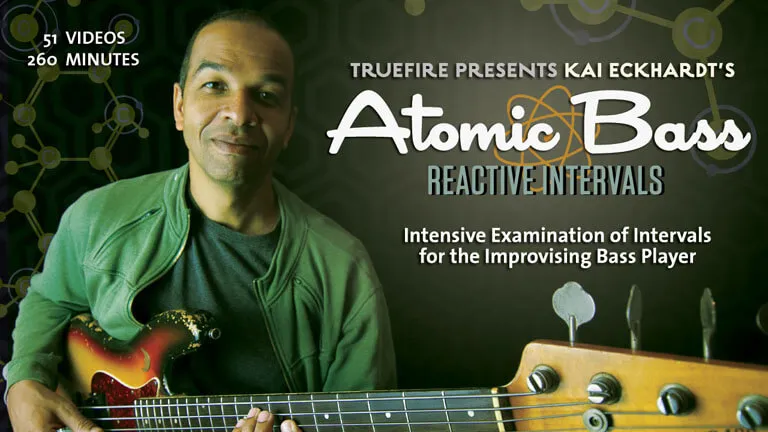
Atomic Bass: Reactive Intervals

Intensive examination of intervals for the improvising bass player

Marty FriedmanTommy EmmanuelSteve VaiEric GalesEric Johnson

Get this course and 1,000+ more with All Access

Try 14 days free. Cancel any time.

Purchase Individual Course for $9.99
Atomic Bass: Reactive Intervals

About this course

Elemental Potassium (Atomic Number 19) is an extraordinarily reactive metal element. Mix it water to produce highly flammable Hydrogen, which in turn ignites from the heat generated by the reaction itself (do NOT try this at home). Intervals are extraordinarily reactive musical elements. Mix with the strings of your bass guitar and enlightening guidance from Kai Eckhardt to ignite atomic groove and intense emotional reactions from your listening audience (DO try this at home).

"Intervals shape the character of every melody, lick and scale under the sun. Intervals are to music what the alphabet is to language and what colors are to a painting. Learn how to harness the power of intervals and you can make your music sound beautiful, ugly, smooth, rough -- virtually any texture or mood is possible."

Reactive Intervals is not another one of those tedious theoretical courses, filled with boring exercises and musical math -- far from it. Reactive Intervals is a learning experience unlike anything you've encountered in your past educational initiatives. Kai takes you on a journey filled with creative stimulation, musical exploration and enough groove crafting insight to last you a lifetime.

Over the past thirty years, Kai Eckhardt's signature musicality was instrumental in defining the role of the modern bassist if not the sonic qualities of modern music itself. Best known for his contribution to the John Mclaughlin Trio in the 80's, Billy Cobham's Quartet in the 90's and Garaj Mahal most recently, Kai has also recorded and performed with Stanley Clarke, Wayne Shorter, Bela Fleck, Victor Wooten, Alphonse Mouzon, Larry Coryell, Al Di Meola, Steve Smith, John Scofield, Bill Frisell, George Benson, Mike Stern and so many other musical giants, across so many genres of modern music.

Fortunately for we bass players joining Kai on the Reactive Intervals journey, he is also a passionate music educator who has taught clinics and master classes world-wide for the Berklee School of Music, the Bass Collective, the Musician’s Institute, the Anton Bruckner Conservatory in Austria, the Amsterdam Conservatory and Victor Wooten’s Bass and Nature camp.

Kai presents the Reactive Intervals curriculum across 12 multi-lesson Interval Studies: Minor Second, Major Second, Minor Third, Major Third, Perfect Fourth, Diminished Fifth, Perfect Fifth, Minor Sixth, Major Sixth, Minor Seventh, Major Seventh, and Octaves.

For each of the 12 Interval Studies, Kai first defines the interval technically and also demonstrates its shape and fingering on the fretboard both horizontally and vertically. Kai provides key insight for the interval and points out the "reactive" role that the interval plays when crafting a musical texture or mood.

You'll then learn two "reactive interval" patterns for each interval (24 in total) to practice up and down the entire fretboard to imprint the sound of the interval in your head. The patterns also accelerate the muscle memory process for that interval's fingerings all over the fretboard.

After learning Kai's reactive patterns and becoming familiar with each interval's characteristic tonal quality, Kai rolls a rhythm track and demonstrates how to creatively apply the interval to develop melodies and bass lines with maximum groove. Keep your bass real close because no sooner do you learn the pattern applications, than you join Kai in a play-along where you put it all to work immediately with Kai guiding you every step of the way.

Kai's interactive and cognitive teaching approach accelerates your ability to process new information and apply it immediately in a musical context. Kai also provides tabs and notation for all of the studies and also includes all of the rhythm tracks for you to practice with on your own. Bonus material including improvisational performances and a learning system for ear training further sweeten the overall learning experience.

Get reactive! Your groove will thank you for it.

What you'll learn

  • Navigate the fretboard using interval inversions
  • Apply interval inversions to create playable exercises across the fretboard
  • Combine legato and staccato articulations in bass lines
  • Apply minor sixth patterns to create melodic lines
  • Develop finger independence through systematic interval exercises
Release date: 03/15/2013 • 4h 38m runtime
Start Course
Sample lessons
Intervals in Popular Music
Overview
Minor Third
Minor Third
Interval Study 3
Minor Third
Minor Third
Variation
Minor Third
Minor Third
Application

What's included

53 lessons • 39 charts • 26 Jam Tracks

Atomic Bass: Reactive Intervals
Intervals shape the character of every melody, lick and scale under the sun. Intervals are to music what the alphabet is to language or what colors are to a painting. Once in charge, you can make them sound like anything: Beautiful or ugly, smooth or rough. In music that's always okay as long as it's done with intention. But before that can happen, you are advised to explore the emotional qualities of those basic shapes to make them your own. After you finish this course you will have a much easier time creating lines and learning new music in general. By combining all variations with all intervals, we cover all possible ways to get from one place to another on the fret board of your instrument. A word of caution upfront: This is a vast and comprehensive course and if you get it you will find yourself in an intimate relationship with music like never before. No two people will sound alike after working through this material. It starts simple (assuming you know nothing about music) and goes out there past the college level. So please relax, be patient and have an open mind. That will guarantee the best result. The first few segments are dedicated to giving you a solid theoretical background before you start working out. Welcome to intervals, the molecules of music!
Intervals in Popular Music
Here are three examples from the popular world of music. All of them get their sound from a combination of specific intervals. The major scale, for instance, is made up of major seconds and minor seconds which is the technical name for whole steps and half steps aka semi-tones. In the case of modern bass lines the same principle applies: Billy Jean by Michael Jackson contains three intervals: a perfect fourth, a minor third and a major second. 'For The Love of Money' begins with an octave followed by a major second and a minor second. During this course we will dedicate multiple exercises to each interval until you become intimately familiar with their sound and positions.
Meet the Intervals
In the music of our western traditions we distinguish between 12 basic intervals. The simple definition of an interval is the space between two pitches. Even though possibilities appear as infinite, there really are only 12 repeating intervals in various positions on any well tempered instrument. (Fretless instruments and instruments tuned to Arabic scales offer another set of possibilities belonging to a different field of study). We are now going to learn the names of the basic intervals, to play them on the bass guitar and to recognize them by ear. Take a look at my drawing called "Meet the Intervals" and see how all of them are present within the space of one octave from C to the next C higher up. If you start on any other note and span across an octave (C# to C#, D to D) their names remain the same as they are always relative to the tonal center you happen to choose.
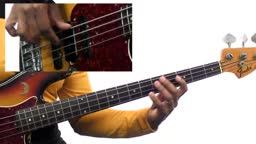
We shall begin by placing our index finger onto the E string between the 7th and the 8th fret to play the root C. Then we place the ring finger on the D string between the 9th and 10th fret to play the octave C. Now we strike both notes at the same time by using the thumb of the right hand on the E string and the index finger on the D string. This is the sound of the interval called the octave. The word refers to the number 8, which is the 8th note of the major scale counting up from the root. Now drop the higher note down by successive half steps, one fret at a time while you say the name of the occurring interval. This is how you sweep through all of the intervals systematically and get to know them for the first time.
Minor Second
The first interval exercise is made up of the smallest steps you can take on the bass guitar or any fretted instrument. This interval is called the minor second, also referred to as a half step. The shortest term for this interval is b2 or m2. You will hear it featured in the theme song for the movie "Jaws". The term second refers to the second step of the major scale and minor second makes it a half step lower. We will now learn to play continuous minor seconds until we reach the octave. This gives you the pure sound of this interval. You will always find twelve notes before the series repeats itself. These twelve half-steps make up the chromatic scale. The chromatic scale in western music is the mother of all scales. Now you are ready to play.
Minor Second
The second interval drill builds on the structure of the first and introduces a variation. We still remain true to the stepwise motion but launch into a small choreography for the fingers. There is a little groove built into this drill with some spaces on the descending run making it fun to play with a drum pattern or a metronome. We will play this one in 4 key centers as well from A to C.
Minor Second
The 12 note, one octave interval exercise is like loaf of bread. Once baked, you can cut it into smaller slices. Those slices all carry the character of that interval. Let's do some of that. Here is an example of a bass line created with a lot of minor seconds in the mix. The same way you can slice a groove into smaller loops to make a cool sounding beat, you can take the chromatic scale and turn fragments of it into leading tones that give your bass line a distinctly chromatic character.
Minor Second
Okay, now that you've had a chance to get to know the sound of this interval, let's do some jamming together to help you get the movement under your fingertips. We'll use the following trading system to do this: I'll play the exercise four times, then you play four times, then I'll play twice and you play twice, then I'll play once and you play once. We'll finish up with playing the exercise together four times. Ready? Let's go!

+ 46 more lessons

Start Course

Reviews

11 results

tadeo.am

Verified buyer

06/29/26

Atomic Bass

Hi , I love Kai courses, he is so easy to follow , I have improved my understanding and meaning of each interval. I totally recommend this course


janglingjack

Verified buyer

06/10/26

Something truly special!

I am originally a guitar player, but recently I have been spending a lot of time learning about intervals. At the same time, I have always had a craving to play bass. Since I had a bass lying around, I decided to shake up my practice routine and use the instrument as a way to solidify my understanding of intervals, improve my bass technique, and focus more on aural training. Miraculously, this course does exactly that. First of all, Kai Eckhardt is a phenomenal musician. I have listened to his work with Garaj Mahal, so having him teach this course already feels very special. Secondly, he is a fantastic teacher. His method and approach to structuring the course are novel, interactive, and engaging, and the way he transfers knowledge feels natural, relaxed, and highly effective. I honestly think this may be the best musical instructional video I have ever used, and that says something, because I have been playing guitar for more than 20 years and have worked with a lot of instructional material. Buy this course with the utmost confidence. Any bass player who is serious about their instrument will benefit enormously from it.

allensalinas

Verified buyer

01/16/21

Great course. Totally recommended!!!

MikeAlan

Verified buyer

12/28/20

Atomic Intervals Sure To Get a Listener's Reaction

I am thoroughly enjoying this Kai Eckhardt course! Intervals. It may sound bass-ic or like beginner material; however, there is much here in terms of ability and application. I dabble with several instruments and enjoy improvisation as well as writing. It is sure to help all as this is a fantastic course from one of the premier jazz fusion bassists. Sure, bass lines drive each message home and the demonstrations include popular songs to help understand intervals in application. While the course is helping me improve as a bassist, this truly is a course to be mined by all. I've had an understanding of the subject, but can see the benefit beyond bassists to composers and instrumentalists including vocalists seeking to elicit certain emotional responses thru note choices in melody, and on.

Javierdelarco

05/22/20

Atomic Bass: Reactive Intervals

Worth every penny!!! Amazing material, well explained and useful.

Stop searching. Start improving with All Access.

Try 14 days free. Cancel any time.