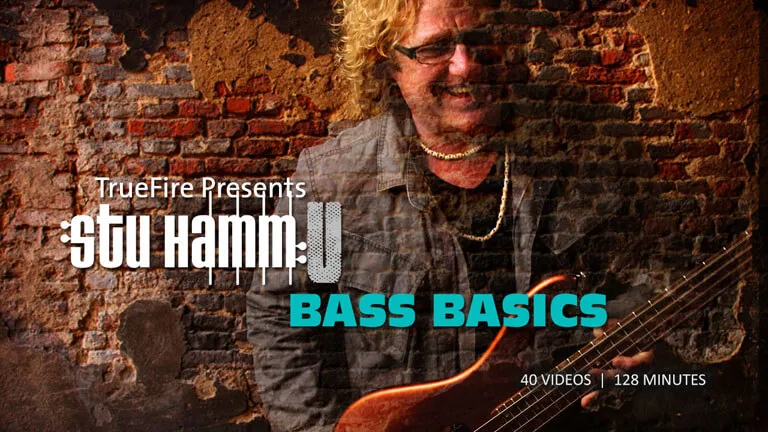
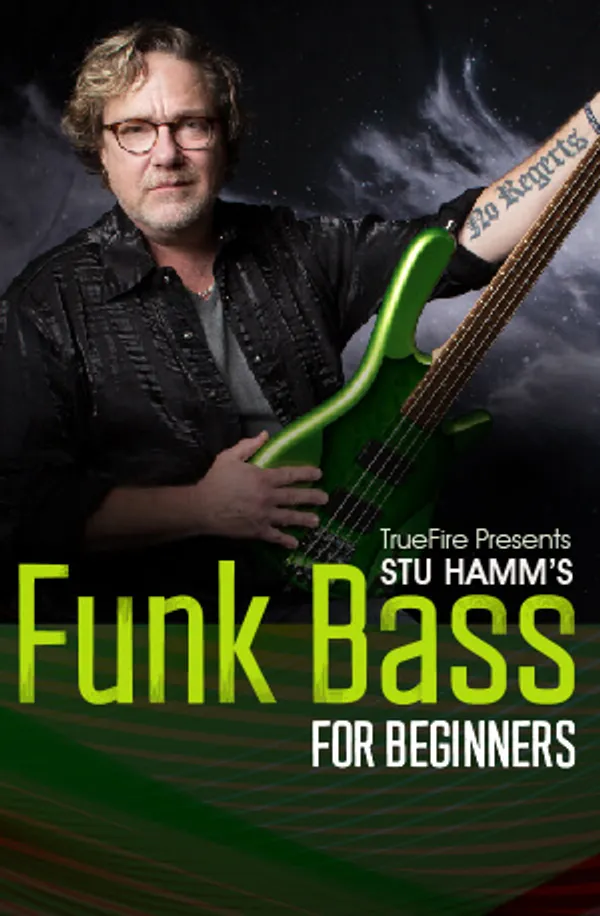
Stu Hamm U: Bass Basics

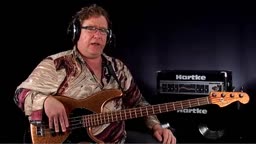
Learn how to play bass guitar from the ground up with Stu Hamm

Marty FriedmanTommy EmmanuelSteve VaiEric GalesEric Johnson

Get this course and 1,000+ more with All Access

Try 14 days free. Cancel any time.

Purchase Individual Course for $14.99
Stu Hamm U: Bass Basics

About this course

Bass players lay down the foundation in practically every style of music by bridging the gap between the strict rhythm of percussion instruments and the melodic domain of lead instruments and vocals. Today's bassists must not only lock-in with the drummer to serve up the all-important "groove" but are now also called on to step up front and treat the audience to a searing and melodic solo from time to time.

Bass players are in high demand and can easily find gigs, making the instrument attractive for aspiring musicians. But once you decide to play bass, you still face the question of where to begin and that's what Bass Basics is all about.

Bass Basics starts at the very beginning, teaching you journeyman-level bass chores such as the proper way to change and tune strings. You will learn the instrument's individual parts as well as what to look for when shopping for a new bass - Stu even gives you a guided tour of his latest Fender signature Urge Bass II! He shares tips on tone settings for both the bass and amplifier and how to use these controls to get the sound you want.

In this volume of video bass guitar lessons Stu demonstrates the essential left and right hand techniques developed to build strength and endurance. He teaches you the language of music to help make quick work communicating ideas at jams and auditions. Bass Basics equips you with a solid foundation of techniques, theory, rhythm patterns and bass lines, all of which can applied in any style of music. Stu even shows you how to read tab and follow a chart as well as teach you the essential theory required to take your playing in any direction you choose.

Never before has a bassist of this caliber shared such vast knowledge in such a comprehensible and accessible way. If you're serious about learning the bass and want to enjoy the journey, let Bass Basics be your guide. You won't go astray!

What you'll learn

  • Navigate a 1-4-5 progression using number charts
  • Play dotted quarter-eighth note rhythm patterns
  • Use major pentatonic and dominant seventh tones in shuffle context
  • Understand the difference between straight eighth and shuffle grooves
  • Understand the bass player's role in unifying melody and rhythm
Release date: 12/17/2008 • 2h 52m runtime
Start Course
Sample lessons
Open Strings
Open Strings
Chromatic & Accidentals
3rd & 10th Intervals
Jammin' with Arrpeggios

What's included

41 lessons • 32 charts

Bass Basics: Introduction
Bass players lay down the foundation in practically every style of music by bridging the gap between the strict rhythm of percussion instruments and the melodic domain of lead instruments and vocals. Today’s bassists must not only lock-in with the drummer to serve up the all-important “groove” but are now also called on to step up front and treat the audience to a searing and melodic solo from time to time. Good bass players are in high demand and can easily find gigs, making the instrument an attractive proposition for aspiring musicians. But once you decide to play bass, you still face the question of where to begin and that’s what Bass Basics is all about.

Laying down the foundation for freshman bassists, Bass Basics follows an innovative and very effective “contextual” approach to accelerate the learning process. You’ll play your way through the course, learning all of the fundamentals of the instrument from tuning up to nailing that first audition. Bass Basics walks you through each of the lessons in an easy, hands-on fashion without requiring you to struggle through tedious examples and exercises. Better yet, the material is presented from the point of view of a very accomplished musician, who worked his way up from novice to top pro and is willing to share information that he’s gathered from decades of top-level stage and studio experience.

This musician is none other than Stu Hamm, bass player extraordinaire who first came to prominence after playing on Steve Vai’s Flex-Able disc. Going on to become the bassist of choice to lay down the low-end for virtuoso guitarists like Frank Gambale and Joe Satriani, Stu has continued to hone his already considerable chops, both on stage and in the studio. Fortunately, Stu’s teaching skills match his musicianship, giving you a rare opportunity to learn from one of the very best bassists on the planet.

Bass Basics starts at the very beginning, teaching you journeyman-level bass chores such as the proper way to change and tune strings. You will learn the instrument’s individual parts as well as what to look for when shopping for a new bass – Stu even gives you a guided tour of his latest Fender® signature Urge Bass II! He shares tips on tone settings for both the bass and amplifier and how to use these controls to get the sound you want.

Stu demonstrates the essential left and right hand techniques developed to build strength and endurance. He teaches you the language of music to help make quick work communicating ideas at jams and auditions. Bass Basics equips you with a solid foundation of techniques, theory, rhythm patterns and bass lines, all of which can applied in any style of music. Stu even shows you how to read tab and follow a chart as well as teach you the essential theory required to take your playing in any direction you choose.

Never before has a bassist of this caliber shared such vast knowledge in such a comprehensible and accessible way. If you’re serious about learning the bass and want to enjoy the journey, let Bass Basics be your guide. You won't go astray!

Parts of the Bass
The first video in this course is a basic overview of the parts of the bass guitar and their functions. It’s very important to get to know your bass inside and out, much as a marine is able to take apart and put his rifle back together in the dark! I’ll guide you through the functions of the various parts of the head stock (the tuning pegs and the nut) and the neck (frets and the difference between a fretted and fretless bass). Then we’ll talk about the body and pick-ups and controls. Get to know your Bass! Be good to it, and it will be good to you!
Stu's Signature Bass
In this section I discuss the genesis and functions of my signature Fender Bass, the Fender Urge II. I explain how my experimentations with different Basses led me back to Fender, and how I tried to incorporate some of the modern innovations and features that I liked with the classic look and sound of a Fender Bass. Included is an in-depth look at how the active electronics work, as well as a demonstration of the many different tones you are able to get out of this Bass!
Changing Strings
Here we are going to talk about strings; the difference between roundwound and flatwound strings, and how to change them yourself on your Bass. You’d be surprised at how many students I come across who don’t really grasp this concept! We’ll talk about when you’ll know it's time for a new set (generally when you can afford a set!) and the right way to take them off and replace them with a nice fresh set. I'll also demonstrate the need to stretch your strings out after you put them on and the correct way to do so, as well as the correct way to wind them around the top of your neck. For me, a fresh set of strings is like a brand new pair of Sneakers!
Amplifiers
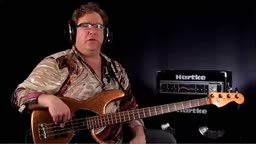
You’re only as good as you sound, and a good amp is essential to getting the tone that you want. In this section we’ll talk about amps - combos and component rigs, which are made up of separate speaker cabinets and heads. Cabinets come in all different sizes and the main thing you’ll want to do is figure out if you like the sound of 10”, 12”, 15” speakers, or a combination of speakers and cabinets. Then we’ll talk about heads, which amplify the sound and send it to the speaker cabinets. I’ll let you hear the difference between a solid-state and a tube amp, and walk you through the controls and EQ, which will vary greatly depending on what amp you use.
Using A Digital Tuner
Be on time, be in tune and have a good time, a session player creed, so let’s find out the correct way to use a tuner. There are as many different kinds of tuners as there are companies who make musical instrument products, but they all operate on the same basic principal. Check your tuning often when you are playing, as a good bend or jerk of the neck can put one or more of your strings out of tune, and then the whole Bass will sound off. Here is a little secret that I have discovered - if you and your guitar player both tune to A440, the Bass will sound a little sharp, so I ALWAYS tune my Bass just at the edge of being flat! Believe it, a sharp Bass will make everything feel unsettled.
Tuning the Bass By Ear
Doesn’t mean physically turning the tuning pegs with your ear! (Although I did have a dream once where a guitarist taught me a song by “bellybutton” - long story). Tuning by ear means being able to tune your Bass without the benefit of a tuner, just by listening to it, or “using your ear”. I’ll show you how to play a 12th fret harmonic to get a nice clear tone to tune with. Then I’ll demonstrate how to use a combination of open strings and fretting on the 5th fret to get your Bass in tune. Now, when someone says to you “Give me an A” you don’t have to assume that they are Canadian!

+ 34 more lessons

Start Course

Reviews

7 results

obbig

Verified buyer

01/05/25

It's kickoff time

A great course that covers a lot of ground from basics to grooves, but don't pressure yourself and rush it if you are a stone cold beginner. For the course to work you need to have patience and discipline, and when Stu tells you to work on something as homework, follow the advice. I personally found that this course works well in conjunction with Learn Bass 1 (it's free). Jumping between the two as an absolute beginner breaks up the pace whilst still giving you stuff to work on, and personally I found that it helped feel like every lesson was step forward. No matter whether you want to be a bassist in a band or jam along at home to your favourite tunes, you wnat to be able to do it well. That means putting in the effort early, getting the basics and the scales down, and this is the course to help you do that.

Jsuits

Verified buyer

01/22/21

First bass

Truefire knows who and how to take the uncertainty of beginning and pave the path to confidence and understanding. This is no different, and Stu gets it done in standard fine fashion from the nuts and bolts (of the instrument itself even) to seeing clearly how to get where you want to be with the instrument and making music

JacobMadsen

Verified buyer

01/11/21

Super Stu

I met Stu back in 2017 and thought I had never met a nicer guy or better bass player. Apparently he is a fantastic teacher too!

BlackLlama

12/01/19

To the point

I wanted to start learning bass in order to record some bass on a few demos of mine. Taking this course was great. Stu is a wonderful teacher and his personality really comes through in whatever he does. If you want to start learning the bass, get this.

farmerboy2

Verified buyer

08/29/19

Learn from the best

STU HAMM is the best and this is a perfect intro to basic skills.

Stop searching. Start improving with All Access.

Try 14 days free. Cancel any time.